Crypto exchange development in 2026 demands robust architecture, deep liquidity, secure custody, and compliance-first trading flows.

Building a Crypto exchange in 2026 requires a significant amount of work building a market system that can match orders for price or for swaps, that can sustainably obtain durable liquidity, that can keep user digital assets safe and that can prevent a large amount of loss while maintaining compliance by enforcing rules on every user and on every flow of in and out treasury funds. This is a guide for founders and CTOs building out real venues for trading, a true crypto exchange that can be a fully centralized exchange, a fully onchain DEX or a hybrid where most of the performance happens offchain and it settles onchain.
There's the visible layer of the trading interface and then the real substance below: the matching logic, wallet management, the various ways to bring in liquidity, abuse detection and prevention, reporting, and all the various licensing restrictions that apply. It's common for teams trying to build out a crypto exchange to start off by thinking about the scope of the product and then realize as they dive in that the real challenge of building out a market is establishing the market structure: who holds the assets, where the trades are executed, where the liquidity comes into the system, and what the legal status of the system is.
Crypto exchange development encompasses more than just trade execution. Instead, it involves the development of a full trading venue with all corresponding states from account creation over matching, settlement up to audit trails. Therefore, be it a development of a trading platform for spot markets or for perpetuals, swaps or even a routing engine connecting multiple trading venues, the system must remain sound under high loads, failures and audits by authorities.
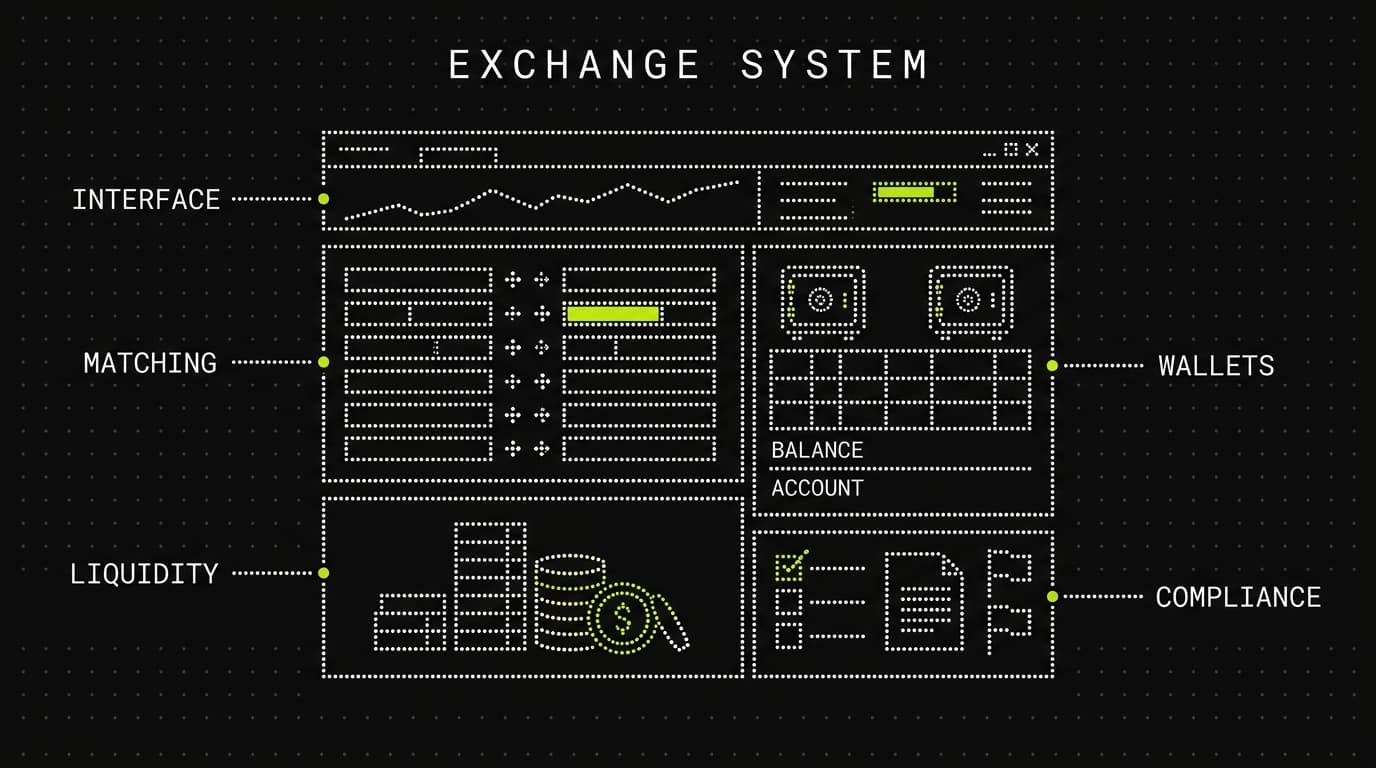 There are a few core questions that every exchange has to answer. How do you price trades? How do you execute them? Where do users' balances reside before and after a trade? What happens when a user makes a deposit late, attempts a withdrawal that fails, or hits a risk limit? The way in which these questions are answered can vary dramatically between a traditional central limit order book, an Automated Market Maker (AMM), and a hybrid architecture, but the number of possible "operating surfaces" is large.
Serious crypto exchange platform development usually includes:
There are some non-obvious interactions between these components. For example, changing withdrawal policy changes treasury design. Paying in a volatile asset changes maker behavior and user balances, and going onchain changes key management, settlement time, and incident response.
What the 2026 market will look like is a move towards onchain and hybrid exchange models as opposed to away from them. The Hyperliquid onchain orderbooks and perpetuals have become the new reference point for what a serious onchain trading experience looks like and what high volume traders want from an exchange, in terms of a trading experience. Meanwhile, the fintechs are launching their own, purpose built chains to better manage distribution, settlement and product. The launch of Robinhood Chain on 1 July 2026 is a clear signal in this regard.
This development will make the traditional exchange design choice of CEX vs DEX much less relevant, as exchanges will have the ability to leverage offchain matching for two party agreement and onchain settlement for the actual transaction, in addition to the ability to spin off their own app-specific blockchain or even merely route for custody across various liquidity sources, keeping some of the flows self-custodial. As a result, those that plan crypto exchange development in 2026 will really be deciding among three very different markets.
| Model | Best fit | Strengths | Tradeoffs |
|---|---|---|---|
| CEX | High throughput, fiat rails, controlled UX | Fast matching, simple recovery flows, easier internal risk netting | Custody burden, licensing exposure, concentrated security risk |
| DEX | Self-custody, transparent settlement, composability | Onchain auditability, permissionless access, contract-native integration | Gas and latency constraints, smart contract risk, fragmented liquidity |
| Hybrid | Performance plus onchain trust anchors | Flexible architecture, better transparency, easier cross-venue design | More moving parts, harder reconciliation, dual operational model |
For hybrid architectures (a fast matching layer coupled with onchain deposits, settlement, collateral, and proofs), there is value in keeping the matching engine fast and expressive, and then route through aggregated liquidity / cross chain architecture as appropriate. For such designs, the architecture of a Cross-Chain DEX Aggregator is relevant as the routing, settlement, and slippage management start to map very closely to an exchange architecture.
The matching engine is the heart of any CEX or hybrid trading venue. It validates orders, puts them in sequence, enforces price time priority, fills trades, emits trade events and balance updates for the ledger. The matching engine must be deterministic, handle concurrent orders, and recover from any failures. This can be achieved by using event sourcing, replayable logs, strict sequencing, and care to separate the matching logic from its downstream consumers.
Additionally, a production engine must have strict rules for order types and edge cases. Market, limit, stop, post-only, IOC, FOK, reduce-only orders as well as trigger-based liquidations and cancel-on-disconnect orders all create additional state complexity for the order lifecycle which is more than just place and fill: authentication, pre-trade risk checks, order placement in a queue, match events, calculation of fees, writing to a ledger, user notifications and reporting.
This is where doing it alone actually starts to get riskier than most teams anticipate. Matching mistakes don't typically fail loudly in staging, rather they show up as queue priority bugs, phantom fills, replay drift, imbalances that never resolve out during live bursts of activity. Then, after users and market makers have begun to interact with the new live system, fixing the issues that arise is very difficult because the new "engine" is now already the system of record.
Liquidity is a separate problem from software correctness. A clean order book with no durable depth is still a bad exchange. People often focus on the nominal volume of an exchange. But that's not really what matters for liquidity. What matters is the quality of the liquidity, i.e. the spread discipline, the quote persistence, the counterparty trust, the transparent settlement and last but not least the treasuries that market makers can work with.
A critical point of failure for many of the new venues to move beyond cold-start is providing sufficient cold-start liquidity.
To get market makers to list new pairs on new venues, they need:
In addition, market makers care deeply about whether the venue is settling in a stable unit of account (a stablecoin rather than a highly volatile asset). Thus, the design of stable settlement assets matters vastly more than say the branding or UI of an exchange's trading interface. And if one is still designing out stable assets, the Stablecoin Issuance piece is relevant to how one would architect an exchange.
Liquidity cannot be 'coded in' after the launch of an app. It is a combination of market structure, incentives of partners, treasury design and operational discipline along execution paths and maker/taker connectivity. A team that only builds apps to be launched later will usually find out the hard way what I mean by this. A recent case study of a DeFi protocol makes for interesting reading on how protocol mechanics interact with distribution strategy from launch day onwards.
For the core order book and liquidity stack, critical components are typically:
Custody design determines who can move assets and under what policy those moves are made. It also determines the blast radius when things go wrong. A CEX has the exchange hold deposits into user accounts (in the internal ledger), user balances within that account, and withdrawals out of the account. A DEX has users keep self-custody but the venue has smart contract custody risk for things like pools, vaults, collateral, and bridge contracts. A hybrid model tries to bring both worlds to bear.
The basic flow to put money into a wallet, send money out of a wallet, seems like a simple matter of creating a deposit address, detecting a transfer to that address, waiting for the transfer to confirm, then crediting the balances of the wallet with newly deposited funds, and then issuing a withdrawal from the wallet on request. But every step of that process has a lot of operational or security details that have to be handled. For example: chain indexing, reorgs, token-specific metadata, sweeps, gas management, labeled addresses, sanctions list checking, withdrawal queuing, and a host of other things to match on-chain activity to balances that the wallet is tracking internally.
A workable custody stack usually includes:
Custody is arguably the biggest attack vector in the wallet exchange. Wallets manage money movements for users, typically grant very high levels of access to individuals or teams, and are the most operationally sensitive part of an exchange. Therefore, it's commonly misunderstood the amount of design work that is required to ensure that proper role separation is in place for emergency freezes, that appropriate signer quorums are required for withdrawals, that withdrawals are batched appropriately to mitigate individual transaction impacts, and that proper playbooks are in place in the event of an incident. So, wallet architecture is rarely just an implementation detail, it is a product risk decision. This post about Crypto Wallet Development is likely to be of interest to those in the process of building out their custody model.
Exchanges get attacked at every layer. People probe public APIs for abuse, try to escalate privileges in admin consoles, test wallet flows for race conditions, and try to get trading logic to behave unpredictably in order to extract value. And then there is the DEX part where smart contracts introduce risks of misauthorized transactions, incorrect accounting, forced liquidation under unexpected circumstances, miscalculated prices, and failure to settle trades as agreed upon.
The highest-risk category for bugs within withdrawal exploits would be within the withdrawal queuing, address binding, and balance reserving stages of the transfer process. Admin key risk also poses a high amount of risk to an exchange, in that without proper controls in place, an operator can change fee structures, list or delist assets, modify signer parameters for the treasury, and change the destination for treasury transactions without ever requiring a public facing code exploit.
Attacks on matching and settlement deserve as much attention as others. If an attacker can front-run liquidation, abuse self-trading, spoof volume, or create a delay between when an event is executed and when it is finalized on the ledger, then they can destroy trust in the venue very quickly. For hybrid systems, the same set of problems then applies to the bridge assumptions, as well as to the offchain-to-onchain reconciliation.
The third area where DIY can go wrong fast is security for the exchange. That goes way beyond checking code for malicious intent. It encompasses designing your system to be hostile, segmented operations, a good key ceremony, proper transaction policy, reviewing of contracts, and adversarial testing of production paths. A good Blockchain Security Audit is a great place to start, but it must be performed in conjunction with an architectural review prior to the hardening of the key components.
Compliance is not something that gets checked off after launch. Compliance is an architecture constraint on the design of onboarding, custody, reporting, market access, and data storage and retention. For a U.S. user stored in a custodial account at a venue, the typical compliance requirement is that venue be registered as a money services (or money transmitter) business with FinCEN, and obtain any required state money transmitter licenses. There are also separate compliance issues related to the exchange of digital asset securities, such as separate exchange registration, exemption from typical exchange registration as a broker dealer, or even registration as a Regulation ATS entity.
The AML and KYC requirements form a significant part of the system design, encompassing customer identity workflows, sanctions screening, transaction monitoring and alerts for suspicious activity, case management for alerts and corresponding updates, and record retention for compliance with AML and KYC requirements, as well as banking and even regulator scrutiny. Geo-restrictions (as previously mentioned) are not just front-end banners and impact a number of different system components including IP blocks, device analysis, verification of customer residency, fiat rail integrations, token access policies, and corresponding support procedures for customers attempting to circumvent such restrictions.
The FATF travel rule is critical for VASPs that facilitate the transfer of virtual assets as it requires the collection and transmission of the originator and beneficiary information for covered transfers. This means that withdrawal and transfer flows must be able to detect whether the counterparty VASP is able to collect and transmit the required information, and facilitate the transfer with the appropriate messaging, with the correct policy applied for the relevant corridor, and with the ability to handle exceptions where the recipient VASP is unable to collect and transmit information to the same standard. A nice user interface does not solve any of these issues. Instead, message schemas, audit logs, and decision rules do.
This also changes the software boundary. A purely decentralized exchange with self-custody wallets has a very different exposure profile to a custodial exchange or hybrid exchange that intermediates transfers and reporting for customers. Often founders treat legal work and the software engineering to bring that to life as parallel tracks. However, in reality, the regulatory compliance model chosen will deeply affect the required changes to onboarding, the underlying ledger structure, wallet controls and the reporting for trades and wallets. That is why experienced delivery teams will have counsel, product and backend leads in the same room from the start.
Compliance-driven exchange systems typically include:
You can build a strong internal team to own product, marketing, user research, listing policy, core hiring, and the long-term operating model of the venue. If you already have leadership for backend, SRE, security, and compliance (with trading systems experience), keeping the exchange core in-house makes sense. Same applies if you are building the differentiated matching logic or a proprietary market-making stack that is at the heart of your competitive advantage.
Gaps generally appear where different disciplines meet. A smart contract that has to reflect the way a market really works. A wallet system that has to reconcile multiple chains with a business's internal ledgers. Admin tooling that requires strict privilege boundaries. Rules driven by compliance that dictate the way a business holds assets in custody and how users can interact with them via a database and APIs. These are areas where significant value can be delivered by an experienced partner without taking product away from the internal team.
If your venue includes onchain components, these references on Smart Contract Development Services and How to Hire Solidity Developers are a good starting point for designing your team. And if you are a product leader weighing execution quality, a live dApp case study gives you a feel for how design, engineering, and launch support work together when a project has to hold up under real user load.
Mapping architecture choices for crypto exchange development? DESH can provide a sober technical review before your assumptions solidify. Book a call with us.