A blockchain security audit reveals smart contract risks, scope, pricing, and deliverables to reduce exploits before mainnet launch.
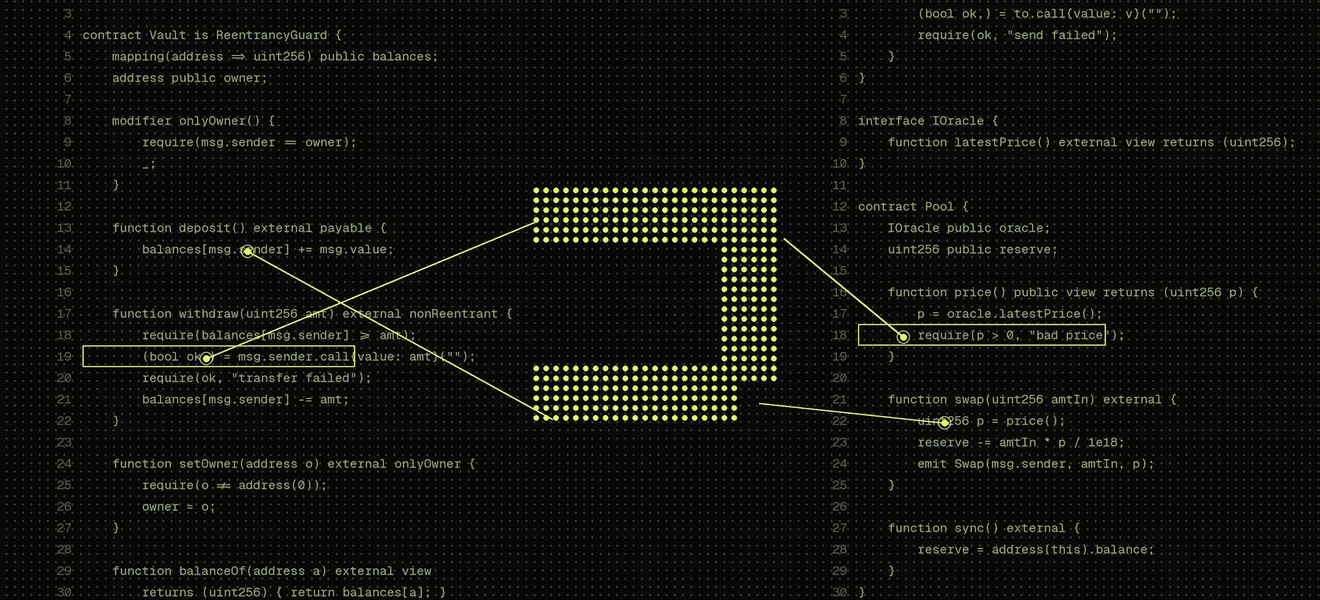
Most teams treat a blockchain security audit as the final gate before mainnet. It is not paperwork for the pitch deck. An auditor reads your code, questions the assumptions under it, and hunts for the ways it breaks, all at one frozen commit. When your contracts will custody assets, mint supply, move treasury funds, or hold protocol permissions, that review has to be precise.
For technical decision-makers, the questions are practical. What does a smart contract audit actually cover? Which risks matter most for this design? What does a strong deliverable look like? What is a fair budget and timeline for a Solidity audit before launch?
Across enough DeFi, NFT, gaming, and infrastructure codebases, one pattern repeats. Cost tracks protocol complexity and live risk, not raw lines of Solidity.
When someone is actively trying to break a protocol, the audit checks whether the contracts hold up. That covers a lot: control flow and privilege boundaries, external calls, accounting, upgrade paths, oracle assumptions, the business logic itself. On EVM projects people just call it a Solidity security audit. The Solidity code is what ships, so the Solidity code is what gets torn apart.
A good audit is not a guarantee that nothing ever goes wrong. It is a close review of one defined codebase, usually frozen to a commit hash, plus the assumptions baked into it. Change the code afterward and the review is worth less. It now describes an older version, not what you are shipping.
And not every crypto loss traces back to a contract bug. Phishing drains wallets. A leaked key ends a project. Operations break. A blockchain technology audit can stretch to infrastructure and process, but most engagements stay narrower unless you agree on that wider scope up front.
| Area | Usually checked in scope | Usually not covered unless explicitly scoped |
|---|---|---|
| Solidity contract code | Control flow, state changes, auth, arithmetic, exploitability | Future code changes after scope freeze |
| Privileged operations | Owner roles, admin paths, upgrade permissions, pause controls | Off-chain internal approval process |
| External integrations | Oracles, DEX pricing, token assumptions, callbacks | Reliability of third-party services over time |
| Business logic | Economic attack paths, liquidation logic, mint and burn rules | Full tokenomics viability beyond coded rules |
| Testing posture | Existing tests, missing edge cases, suggested invariants | Full QA ownership for the entire release |
| Operational security | Sometimes key architecture is reviewed at a high level | Phishing resistance, signer hygiene, device security, human error |
An audit tells you a lot. It does not run your deployment for you. You still handle signer controls and monitoring on your own. You still need a bug bounty, and someone still has to keep the code disciplined once it goes live.
Most serious findings are not rare. They come down to how state is ordered, who has access, how other contracts get integrated, or the protocol math. The names are familiar because the same issues keep coming back.
When you set the scope of a smart contract audit, these are the classes worth raising with the auditor directly:
Most of these rarely show up alone. A lending system might pair price manipulation with a rounding error on staking fees. Or read-only reentrancy sitting on top of a stale oracle. You catch these by hand. The bug is not in one function, it is in the way incentives and state shift across several contracts, and a scanner only checks a fixed list of patterns.
The SWC registry is fine for tagging findings by weakness class. The bugs that drain real money are different. They are protocol-specific logic flaws, not the textbook slips a scanner picks up. So a good auditor opens with the registry and then does the real work by hand.
A credible audit follows a repeatable process. If the provider cannot explain that process in concrete terms, the engagement is likely too shallow.
A clean workflow usually looks like this:
That first step carries more weight than teams expect. Start reviewing code while features are still moving and the report gets hard to trust. Tie the findings to one commit hash. Not a branch someone kept pushing to all week.
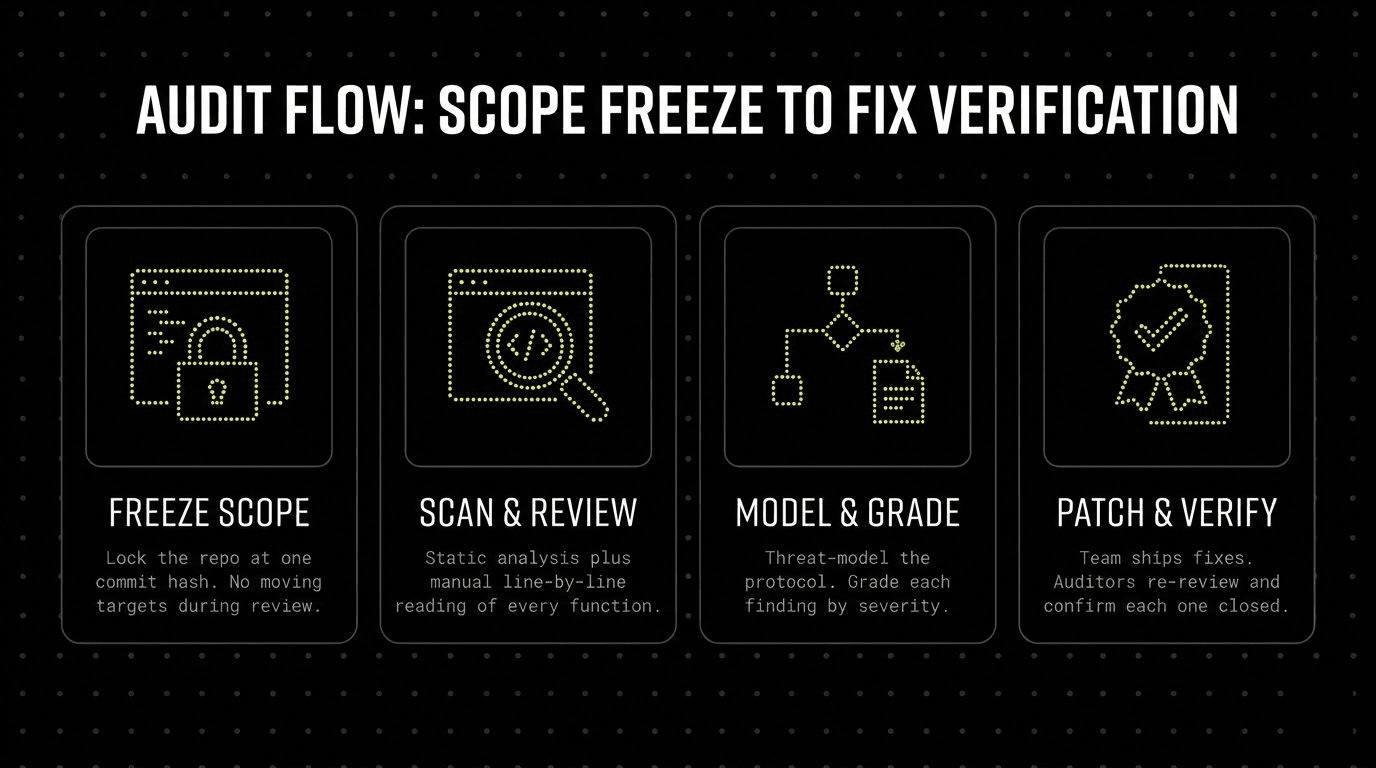
Threat modeling is where strong blockchain audit services pull ahead of scanner-only shops. A DEX, a prediction market, a vesting contract, an upgradeable token: each opens a different attack surface. The review has to fit the protocol, not just the language it is written in.
Good auditors lean on tools. They also do not mistake the tools for the audit.
On a Solidity audit, Slither is the usual first pass for static analysis. It is quick, and it flags the kind of thing you then go read by hand. Inheritance tangles. Shadowed variables. Unchecked calls. Events that should fire and do not. Mythril handles symbolic execution, which reaches paths that simple test cases never hit.
Then there is fuzzing. Echidna pulls its weight on invariant-based fuzzing. You hand it a property, total assets never drop outside an allowed withdrawal, and it goes looking for the input that breaks the rule. Foundry did something similar for invariant testing and fuzzing: it turned them into a normal part of writing code, not a step you bolt on later. Teams keep it on while they build, not just when the audit shows up.
But manual review is the core. It catches what the tools walk past. A bad assumption about liquidation ordering. Weak role architecture. A signature that replays because the domain design was off. An upgrade pattern that compiles fine and is a disaster in production.
A strong audit still uses the SWC registry to name and sort findings. Naming a bug and understanding it are two different things. Each finding gets mapped to how EVM security actually works today and to the threat model of the protocol in front of you.
A PDF stuffed with scanner screenshots does not count as a report.
A real report opens with the reviewed commit hash, the scope, and the methodology. Then it walks through each finding. Severity. The files and line numbers it touches. What the issue actually is, and what it lets an attacker do. A proof of concept or exploit path where one applies. The fix should be written down, not implied. Good documentation pulls all of this together: once the team ships fixes, the report needs a re-review pass that marks each finding resolved, partially resolved, acknowledged, or still open.
Who reads it shapes what counts. Picture a team a few weeks before an investor round or a token launch. To them a report they can actually read is worth nearly as much as what it found. Lead engineers want enough detail to patch without guessing. Founders want one thing answered: does this block launch. And the people outside the team want to know the report is honest work, not filler dressed up to look thorough.
Compare quotes by line count alone and the numbers stop making sense. Two codebases of similar size can demand wildly different review effort. A 1,200 line token and vesting package is simple. A 1,200 line lending engine with oracle dependencies, liquidation logic, proxy upgrades, and signature-based actions is a different animal, and it takes far longer to review.
As a rough guide, a small pre-launch review of simple EVM contracts runs one to two weeks. A mid-size DeFi or gaming protocol with upgradeability and external integrations runs two to four. Bigger systems run longer. Complex accounting stretches it. So does anything cross-chain, or a treasury holding real money. Budget moves the same direction. Some teams also stack reviews, a private audit first, then a contest or public program once the fixes land.
When you compare providers, a few questions are worth pressing on. Does the quote include fix review? Is test writing part of it? Are integrations in scope, or just the core contracts? Will they look at deployment and upgrade scripts, or only the source? The answers move the real cost of a release more than the headline number does.
Cheap quotes often hide narrow scope. Expensive ones are not automatically better. The best value tends to come from auditors who move fast because they build and review systems like yours all the time, not from firms that just pile on ceremony.
The fastest way to assess fit is to ask technical questions that force concrete answers. Ask how they scope by commit hash. Ask which tools they run, and what they do by hand after the tool output. Ask how they review upgradeability, price oracles, and signature flows. Ask to see a sample report with real proof-of-concept detail and fix verification notes.
You also want to know whether the provider can talk business logic, not just syntax-level bugs. If your protocol has staking emissions, round-based settlements, referral accounting, or privileged emergency controls, the auditor should be able to walk through the abuse cases without needing it all translated into generic scanner language.
A few signals separate serious partners from surface-level blockchain audit services:
And if you want a broader blockchain technology audit, ask what else the firm will look at. Deployment flow. Signer architecture. Admin controls. The off-chain services. Whether the thing is even ready to ship. Plenty of incidents happen around the code, not inside it.
Teams feel most confident when the auditor thinks like an engineer who has shipped, broken, patched, and re-reviewed real systems under deadline pressure.
If you are approaching mainnet, a token event, or a major upgrade, it helps to have engineers who build and break these systems regularly look at the contracts before users and capital do. That is the kind of focused audit work, remediation guidance, and fix re-review the DESH team handles. If it is useful, book a short call and walk us through your scope, we will tell you straight what the review should cover.