Learn what a token generation event is, how TGE launches work, and why supply, vesting, liquidity, and compliance shape token performance.

The token generation event, or TGE, of a crypto project is the time when the token of that project is generated onchain and launched according to the founders' launch plan. It is the moment when the full supply of the token is minted, when all distribution and vesting contracts are activated, and when the token enters its first real market activity. In this article we explain tge meaning, the mechanics of launch day, the supply and unlocks side of the token, and finally where and how crypto tokens are regulated.
If you are wondering what TGE stands for then the answer is quite simple: TGE stands for token generation event. By tge meaning we refer to the moment in time where tokens are technically created and then released according to a predetermined allocation. Allocation includes distributions to investors, to team members and their respective vesting schedules, community rewards, filling the treasury, staking emissions and more, as well as public claims and liquidity pools where users can claim their respective shares of tokens.
The term is common today because it is more precise and broader than other terms that are traditionally used to describe fundraising of earlier years. An ICO (coin offering) refers to the type of sale, whereas a TGE (token generation event) refers to the actual event in which the tokens of a project are launched live. Not all TGEs are public sales (ICO). In the meantime, projects can have private rounds of sales, launchpool campaigns, exchange listings etc. before the complete distribution of the tokens of a project takes place.
The language used in crypto also helps avoid treating every launch as if they are all structured the same legally and commercially. A token can be generated, distributed and used to fuel a network without an ICO style structure.
Several key events occur on the launch day of a token. First, either the token contract itself is deployed if not already live or the mint function of the existing contract is called to mint the planned supply. Additionally, other related contracts can be launched such as a vesting vault, claim contract, treasury control contract, staking contract and even a governance contract. After the launch of a token, its supply is then distributed to wallets or other contracts that represent the predefined allocation.
Initial distribution follows the tokenomics model:
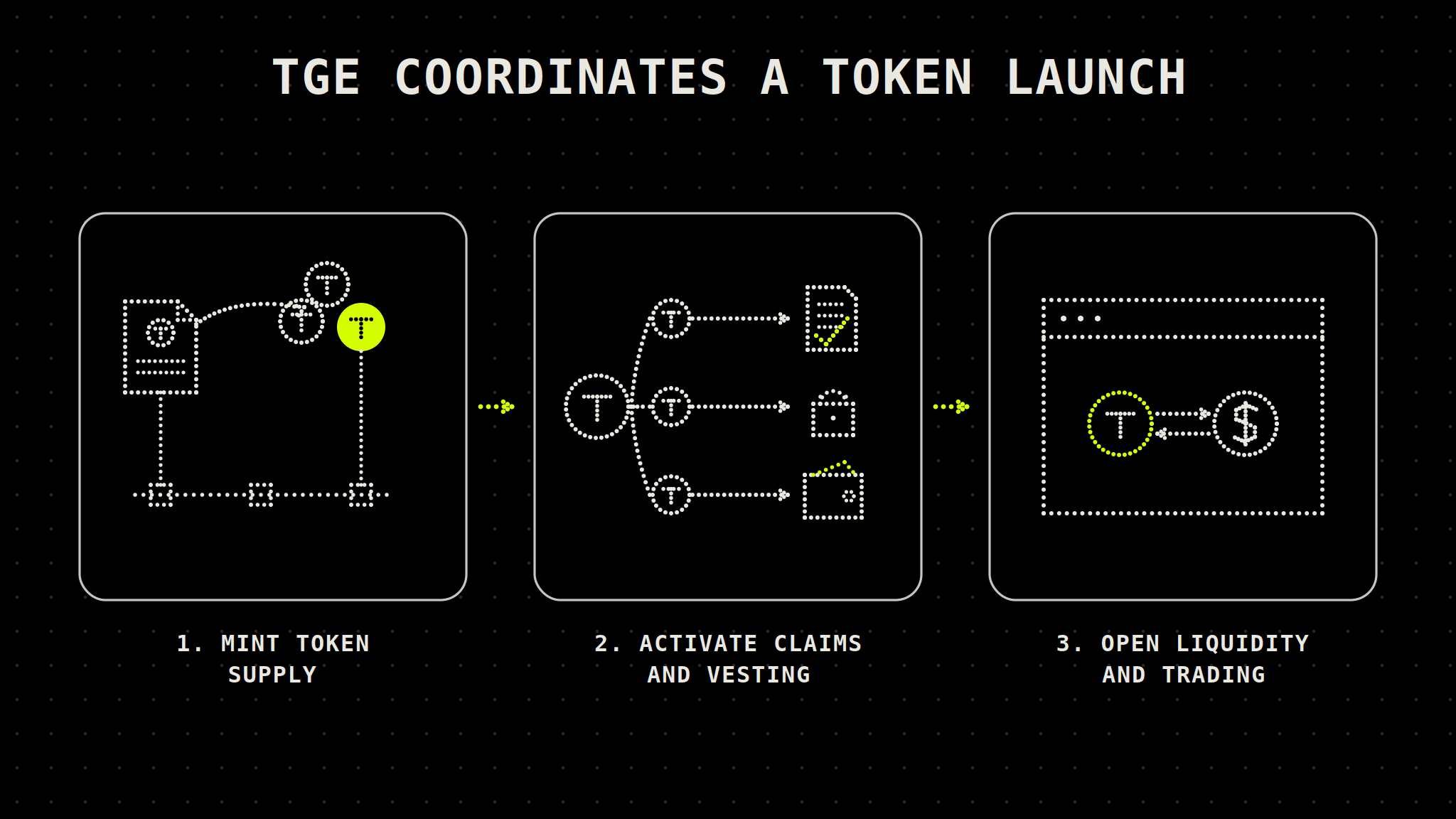 As you can see from the mint, vesting and claim contracts above, the live attack surface is exposed. A single bug could drain funds or even worse, break the launch. That's why audited, role restricted contracts and tested launch flows are critical to ensure the smart contract development and formal security audit work is up to par before TGE.
For the most part, liquidity is provisioned at the same time as the launch of trading. The inventory of a DEX pool with token and stablecoin pairs is initially seeded with some provisioned liquidity, or a market maker provisionally supports the listing on one or more venues. Once trading opens, price discovery begins and the resulting price is not a pure reflection of the project's quality. It is a mixture of the circulating supply, unlock expectations, the depth of liquidity, and early market behavior.
Many people confuse and mix up terms in relation to the token launch. TGE is referring to the event of creation and release of the said token. ICO, IDO and IEO on the other hand are referring to different formats of the token sale. Last but not least, an airdrop is a distribution method and can be used for rewarding users, bootstrapping attention for said token or even for decentralizing the ownership of it.
A project may choose to hold an IDO while the TGE has a separate date. In other cases, the project might choose to hold a TGE with no public sale at all. Lastly, airdrops may take place at TGE time, after TGE time or even in several waves after trading has opened.
| Term | What it means | Main purpose |
|---|---|---|
| TGE | Token goes live onchain and distribution begins | Creation and launch |
| ICO | Direct token sale by the project | Fundraising |
| IDO | Token sale through a decentralized platform | Fundraising and access |
| IEO | Token sale through a centralized exchange | Fundraising and distribution |
| Airdrop | Tokens distributed to users or wallets | User acquisition or rewards |
Distinctions such as these help founders launch in a more informed manner. They also enable founders to have more meaningful dialogue with counsel, exchanges, investors, and community members.
Circulating supply at launch and fully diluted valuation are the two most important numbers for a token launch. Circulating supply at launch is the supply that actually trades shortly after a Token Generation Event (TGE). Fully diluted valuation on the other hand assumes the entire supply of tokens has come into economic existence, even if not all have unlocked. A token with very low circulating supply but high FDV can look very good at launch but then hit a wall when unlocks begin.
Vesting is important too. Cliffs release all locked tokens at once after a set date, whereas linear vesting gradually releases all locked tokens over time. If the tokens of early investors, contributors or even of the funds of the ecosystem unlock too early, they create sell pressure before organic demand can take over. Hence launch charts usually react more to the vesting schedules than to news.
Creating vesting and emissions that last longer than the first unlock is very hard to do. It involves modeling out a number of variables such as supply, demand, reward rate and treasury requirements over time, rather than making best guess. Because of this it is common to bring in specialists to create the tokenomics design for you, as small mistakes in timing of allocation can have big market effects for months to come.
This segues into the liquidity topic as unlock pressure on thin order books only serves to exacerbate each other's negative impact. Most new tokens seed the DEX pools of various exchanges, launch on the occasion of a Liquidity Bootstrapping Pool event, or even coordinate market making for the initial trading phase. Without sufficient depth, even moderate selling can kickstart a sharp price decline in the short term and sustain it in the medium term due to continued selling pressure.
Liquidity provisioning and market making are operationally demanding. Several moving parts need to work together:
A launch with weak liquidity planning loses traction fast. Teams planning to create your own cryptocurrency often underestimate this part until the first hours of trading expose it.
Work on token launches has shown how these pieces interact in practice. The Ephemeral token launch and the Platnum pre-sale are useful examples of execution spanning token setup, distribution logic, and go live coordination without treating TGE as a single button press.
A TGE is a technical event, but it can trigger serious regulatory questions. In the United States, token classification often turns on the Howey test, which looks at whether purchasers are investing money in a common enterprise with an expectation of profits based on the efforts of others. That analysis can affect how a sale is structured, who can participate, what disclosures are needed, and whether certain jurisdictions must be excluded.
In the European Union, MiCA adds another layer with rules around token categories, disclosures, and service providers. Projects also need to think about KYC and AML expectations, sanctions screening, and restrictions for residents of specific countries. Even where a token is intended for utility, the surrounding facts still matter.
Getting token classification wrong is an existential risk. This is a specialist area that product teams rarely handle well alone, which is why legal review, operational compliance, and technical launch planning usually need to move together. Many teams pair counsel with experienced Web3 development services support so the product, contracts, and launch flow match the intended structure.
This is general information, not legal advice.
A token generation event brings smart contracts, tokenomics, liquidity, and compliance into one high stakes launch moment. Mistakes are expensive because they are public, onchain, and often hard to reverse once trading starts.
Teams that have shipped launches know that success is rarely about one decision. It comes from careful execution across contracts, allocations, claims, liquidity, and regulatory boundaries. DESH has worked on token launches and pre sales, including Ephemeral and Platnum, with that execution focused approach in mind.
If you are preparing a token launch and want a practical read on the moving parts, you can book a call to discuss your TGE plan, technical setup, and launch readiness.