You can create a cryptocurrency by building a new blockchain, forking one, or launching a token. Here is how each path works, step by step.

You can create a cryptocurrency in three ways: build a new blockchain, fork an existing blockchain, or launch a token on top of an existing chain. The right path depends on what you need the asset to do, how much control you want, and how much technical risk you are ready to carry.
This guide explains how to create your own cryptocurrency in practical terms, from choosing between a coin and a token to smart contracts, tokenomics, legal constraints, liquidity, and exchange listing. It is written for both beginners testing an idea and founders deciding whether to make their own crypto internally or work with an experienced team.
A lot of people searching for how to make your own cryptocurrency are really asking two different questions.
When people talk about blockchain, usually they are talking about a coin (or more accurately: a chain with a set of validators and rules for that chain, a consensus algorithm for that chain and a native asset for that chain). For example: Bitcoin is a coin. Ether is a coin. So if you build a chain and start your own network with your own set of validators, your own set of rules for that network, your own consensus, and your own native asset for that network then what you have built is a coin.
A token is something that lives on top of an existing blockchain. Thus ERC-20 tokens are issued on the Ethereum blockchain, SPL tokens on the Solana blockchain and BEP-20 tokens on the BNB Chain. Issuing a smart contract that details supply, transfers as well as the permissions for said transfers, is in effect issuing a token and not a new blockchain.
If your goals are utility within your app (governance, access control, loyalty etc), in game economies, or building out your own DeFi mechanics then building a token is the easiest way to achieve them.
Before code, name the job your asset must do.
Teams decide they want a token before they can explain why the product needs one. A token without a clear function is dead weight.
A strong use case tends to fall into one or more of these categories:
If you cannot summarize the key function of the asset in a sentence then stop here and go back to the product logic and then talk about deployment.
There are three real paths when people ask how to create your own crypto coin or token.
| Approach | What you build | Complexity | Best fit | Main risk |
|---|---|---|---|---|
| Token on existing chain | Smart contract on Ethereum, Solana, BNB Chain, or similar | Low to medium | Product launches, utility, governance, DeFi, gaming | Contract bugs, weak tokenomics, poor launch design |
| Fork existing blockchain | Modified version of an established chain | Medium to high | Teams needing custom chain behavior with existing architecture | Ongoing maintenance, validator setup, compatibility issues |
| New blockchain | Chain, node software, consensus, tooling, native coin | Very high | Protocols needing full control over execution and network rules | Security, infrastructure, adoption, operations |
Most founders asking how to make your own crypto should start by challenging whether they need a coin at all.
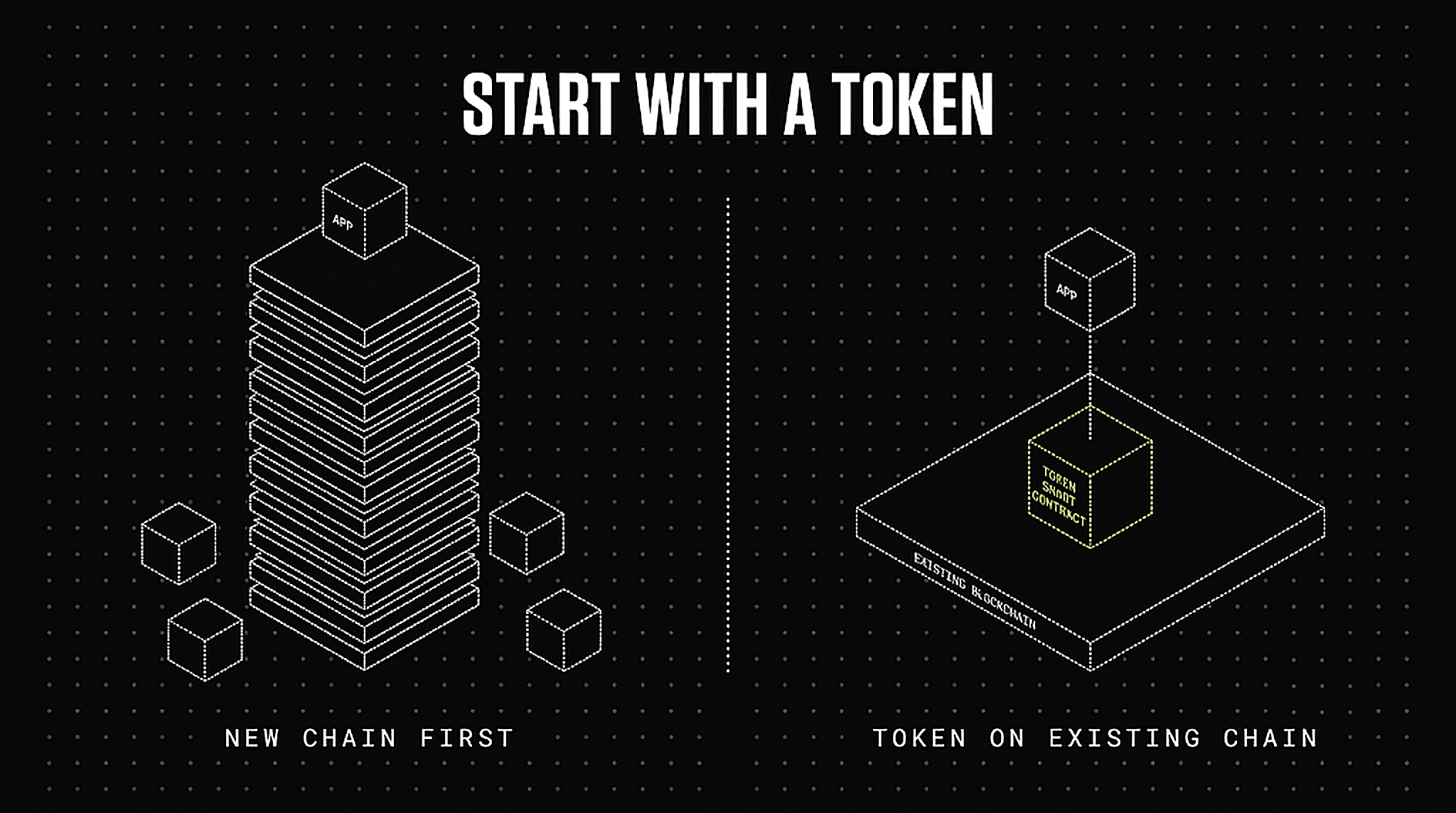 A token is often enough. You inherit battle-tested infrastructure, existing wallets, block explorers, and exchange support patterns. You can focus on product logic instead of maintaining a base layer network.
A fork makes sense when the chain itself is part of the product.
Once you know you are building a token, choose the chain and standard that match your product.
The reference for smart contract development on Ethereum is still Ethereum and the ERC-20 standard for tokens. It has mature tooling, very wide support in wallets, everyone in the industry is familiar with the typical patterns to audit for, and it is well documented at the official ERC-20 documentation. If you or your team writes in Solidity and wants to make use of most of the ecosystem already, ERC-20 is the obvious base to start with.
Solana uses the SPL token standard. For throughput and user experience for consumer apps, high-frequency transactions, and even game logic, Solana is very competitive. However, the development model around Solana tokens is very different than that of Ethereum tokens and so, for example, a team of developers used to building Ethereum based applications (e.g. contracts written in Solidity) would likely need to learn Rust in order to build applications on Solana.
BNB Chain / BEP-20 is popular for projects that want EVM compatibility but with less friction for existing users on the chain. Since it is EVM based, you can reuse existing Solidity contracts with minimal changes.
A simple way to frame the trade-offs:
If your product needs cross-chain reach, do not treat that as an afterthought. Bridging, wrapped assets, and chain-specific liquidity can create a much larger attack surface than the token contract itself.
When creating a cryptocurrency on an existing chain, the cryptocurrency becomes real at this point.
For EVM chains the standard stack consists of Solidity, OpenZeppelin contracts, Hardhat for local testing and deployment scripts and Remix for quick prototyping of contracts and their interaction. For simple ERC-20 contracts this stack can be set up in no time and expanded with functions such as mint, burn, pause, permit, role-based access, staking hooks, and transfer restrictions.
The useful beginner path looks like this:
This is also where many DIY launches lose money.
Most smart contract errors are irreversible. A simple typo with an access control modifier can enable anyone to mint. A reentrancy path or unchecked external calls can be directly exploited.
Security review is not a cosmetic extra. It is part of the build. For a more in-depth look at what auditors check, this guide on blockchain security audit is worth reading before mainnet deployment.
Tokenomics is where technical design meets market behavior.
When asking people how to make your own crypto, most people focus on how to deploy a contract to create a new token, and then are surprised when the token dies within 6 months as it received no sustained demand outside of the initial launch attention. There are many other details that need to be filled in, such as total supply, issuance rules, allocation, vesting, lockups, emissions, treasury use, utility loops, etc.
Core tokenomics decisions usually include:
This subject deserves more than a surface treatment. If you are shaping a real product, this article on Web3 tokenomics gives a better framework for supply, distribution, and incentive design.
You can create a cryptocurrency technically and still create major problems for the project legally.
First, there is the issue of classification risk. The way a token is set up, sold, marketed, and distributed can lead to the token being considered a security or other financial instrument by different regulators. That classification can even change from one jurisdiction to another.
Compliance for users and transactions. If you plan a fundraising, custody, fiat onramps for your platform, such as platform wallets for your users, gaming or rewards with economic value for users, then there is likely to be a requirement for the platform to undertake KYC and AML obligations for user sign up prior to launch. This will need to include appropriate terms and disclosures, sanctions screening, prohibitions on users from certain countries or regions, and a corresponding onboarding process for users.
A realistic compliance checklist should cover a few basics:
This is not legal advice. This is a warning about where beginners can go wrong. The risk is not only what your code does. You also need to worry about what your token promises, how it is being marketed, and who can access it.
Creating the token is only part of the job. A token with no liquidity, no market structure, and no post-launch operations plan is not really launched.
The key to a decent DEX experience is liquidity, to avoid huge slippage when you want to buy or sell. So, if you are starting on a DEX, you should be aware of the pool structure, the paired assets, the lock policies, the behavior of the market makers, the wallet concentration, and the anti-bot launch conditions.
Note that getting listed on an exchange is not a simple matter of filling in a form for many projects. An exchange will conduct a detailed review of a number of factors including the quality of the contract, the token distribution, real activity, the liquidity health, its compliance posture, and the project's operational readiness.
The work around launch usually includes:
The bigger issue with launch mistakes is that they are public and fast. So execution discipline is just as important as code quality.
The Ephemeral case study and the Platnum case study show how build and go-to-market work connect in live Web3 environments.
DIY is useful for learning, prototyping or internal testing of small concepts. You can create a cryptocurrency on a testnet, deploy a simple token, and learn a lot from it.
If your project will hold real value, onboard users, integrate with DeFi, or support a launch that carries reputational and legal weight, the risk profile changes fast. Smart contract security, tokenomics design, and legal structure are the three areas where mistakes become expensive and visible.
Many founders are at a crossroad between learning and shipping safely. Reviewing a serious Web3 development team can help clarify what parts to build in-house and what parts to hand over to specialists. A short call or Telegram chat is often enough to map the right build path.
Yes. You can create a new blockchain, fork an existing blockchain or even launch a new token on an existing blockchain. Most new projects start out with a token.
A coin has its own blockchain and native asset. A token is issued on top of an existing blockchain through a smart contract.
No, for simple no-code experiments maybe not. But for anything more serious, yes. For security, custom logic, or production deployment, you need to know how to code or have a team of developers.
Tokens can be legal, but this depends on several factors like the jurisdiction, the token design, the distribution model of the tokens and the compliance obligations of the tokens. Before launching a token it is wise to have a legal review.
A simple token can be launched quickly. However, a production ready launch takes time to test, audit, finalise tokenomics, check for compliance issues, setup liquidity and put in place the necessary operational processes.
Clear utility, sound tokenomics, secure code, healthy liquidity, credible distribution, disciplined execution after launch. Most failures are caused by bad design, not by the token standard being used.