What stablecoin regulation requires from issuers under the GENIUS Act: reserve controls, par redemption, reporting, and admin powers.

US stablecoin regulation now runs through the GENIUS Act. The statute is law, but several implementing rules are still unfinished, so issuers in 2026 are building against statutory baselines plus proposed rules on reserves, liquidity, custody, and risk management. That creates a specific engineering posture: systems have to satisfy what the law already fixes while leaving room for controls and reporting fields that final rules will sharpen. The focus here is what stablecoin regulation requires from contract design, reserve reporting, redemption operations, and compliance architecture, not a legal summary of the statute.
For a US payment stablecoin issuer, the GENIUS Act is the controlling federal law. In 2026, federal and state agencies developed proposed rules and guidance under the GENIUS Act with respect to such issues as reserves, liquidity, custody, and risk management; final rule making was not completed. In the interim, the terms of the GENIUS Act impose a number of duties that are already controlling.
The effective date provision is a tool every build team needs to know about to update their compliance calendar. The operative standards apply on the earlier of the statutory date set forth in the act and 120 days after the date on which final implementing rules are published. If the rules implementing a standard take a while to arrive, the statute will not wait indefinitely. If rules are published first, the 120 days become a calendar implementation requirement wallet infrastructure
When building a us stablecoin right now, operating under the statutory baselines means first writing the non negotiables as required by law and then isolating the rule sensitive sections of code that can then change without having to change the underlying asset.
The relevant regulator for a given project will depend on the issuer structure (e.g. bank affiliate vs non bank entity), the charter status of that entity, and the nature of the underlying token (e.g. whether it functions as a plain payment stablecoin). Each of the lanes outlined below will have different requirements for the systems in place and the evidence those systems can produce in order to satisfy the various stakeholders (regulators, attestors, and internal control owners).
| Regulator or regime | When it applies | What changes for architecture |
|---|---|---|
| OCC | National banks, federal branches, and certain federally supervised issuer structures | More direct scrutiny of operational risk, custody controls, incident handling, change management |
| Federal Reserve | State member banks, bank holding structures, payment system implications | Board level governance records, liquidity reporting, intercompany controls, reserve movement traceability |
| FDIC | State nonmember banks and insured depository contexts | Deposit treatment boundaries, custodial segregation evidence, resolution aware records |
| State supervisor | State qualified issuers under an approved state regime | State specific reporting schemas, money transmission overlays, localized examination workflows |
| SEC | When the token or surrounding program stops looking like a payment stablecoin | Disclosure, distribution, secondary market, and securities law controls enter the design surface |
SEC stablecoin regulation begins to apply when a stablecoin is no longer merely a payment instrument. For example, a stablecoin that generates return from reserve investment, lets holders share in profit, or is marketed for appreciation rather than redemption at par no longer functions as a simple payment instrument. In such cases the analysis shifts toward a securities product, and the architecture then has to include transfer restrictions, disclosure to investors, and distribution controls, not just the reserves, redemption, screening, and lawful order response that apply to a payment instrument.
The Permitted Issuer must hold the Qualifying Reserves, keep them separate from the other funds of the Permitted Issuer, and maintain complete and accurate records with respect to the ownership and location of each of the Reserve Assets. The result is a dual ledger that tracks the token liabilities issued by the Permitted Issuer and the Reserve Assets held by the Permitted Issuer, reconciled through immutable audit trails.
The issuer will need to redeem outstanding tokens at par in accordance with the required legislation and regulatory guidelines. This will involve intake, validation, queuing, treasury movements and related settlement controls. A redemption service will be provided as a separate function outside of the token contract, however this service will include atomic accounting to treasury, compliance and associated burn functionality.
It is typical for the monthly reserve reporting to require an attestation of the data. This typically includes cutoff of data, reconciliation status, exception handling, sign off and evidence to retain. This drives the reserve reporting to be in a reporting subsystem with locked accounting periods, source provenance and reproducible reserve computations in the form of snapshots.
A BSA, AML, and sanctions program needs to be applied across onboarding, the minting and redeeming of tokens, ongoing monitoring, case review and escalation. Therefore a policy engine that blocks high risk actions such as minting or redeeming would be suitable to implement such a program.
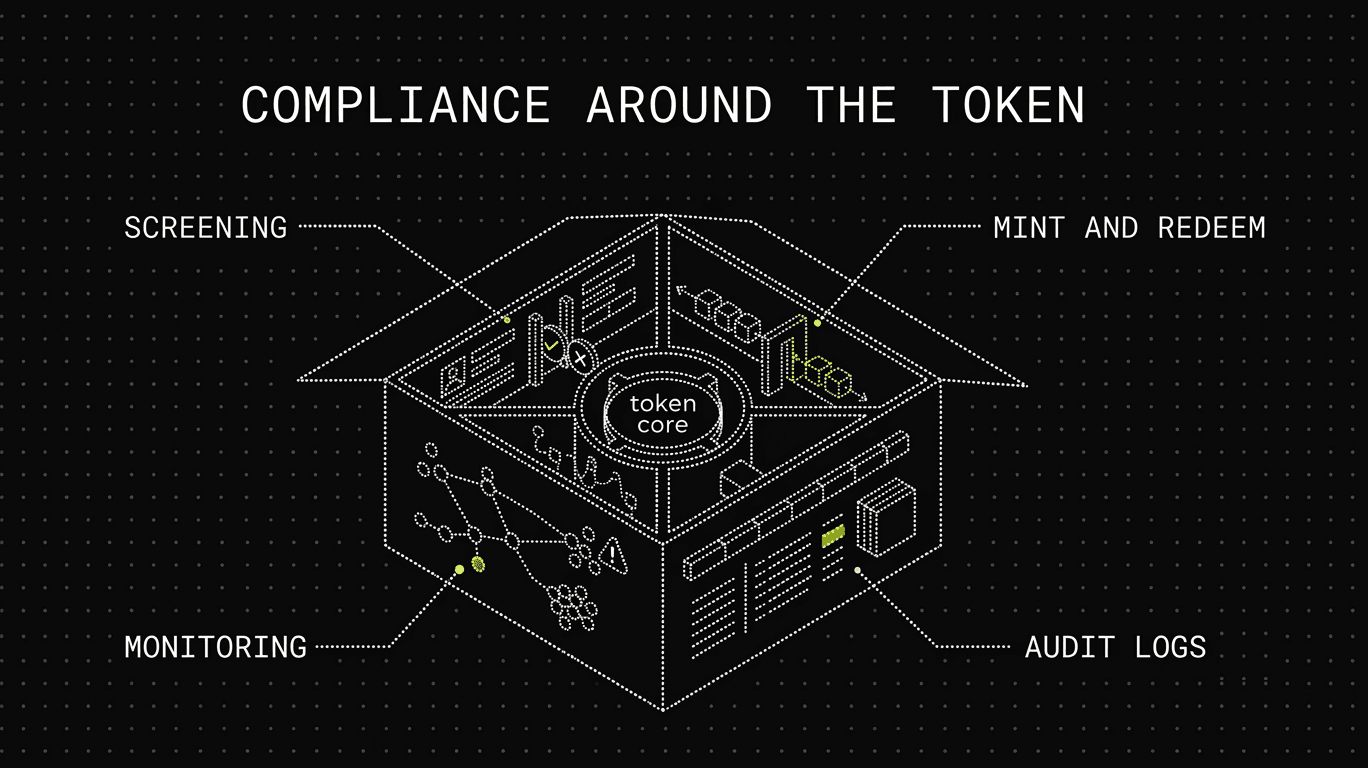
Finally, lawful orders such as account freezes, seizures of funds, as well as requests for disclosure of records also need to be supported. This is achieved through an admin control plane that grants tightly scoped contract powers, logs approvals and tracks legal order based workflows that are specific to a particular address and balance.
The statute doesn't care about proxy patterns or how many signer shards you hold. But it does force a number of design choices. A payment token that complies with the statute is not an ERC 20 with some branding on top and a mint key.
Lawful order compliance forces administrative capability into the token system. As a minimum the issuer needs to be able to freeze addresses, block transfers to or from listed accounts, and execute seizure on valid orders. If the token contract doesn't give the issuer the above capabilities then the issuer cannot meet a mandatory part of regulating stablecoins in practice.
Separation of roles is required for mint, blacklist, pause, upgrade and seizure. This means that each of these functions must be assigned to a separate set of signers, and that each function should emit separate events, have its own approval policy, and have its own emergency procedures. A single all-powerful admin key is a supervisory problem and a technical failure domain.
Minting should not be a "raw" operator function on a dashboard. The mint pipeline should require an attested funding event, sanctions and AML clearance, counterparty identity status, and balance sheet reconciliation prior to the contract receiving a mint command. The on chain transaction is the last step in the process, not the first.
In practice, many issuers only allow direct redemption for allowlisted counterparties, or have per address and per period limits. Retail wallets can be held by the user but then they only have the right to redemption under the issuer's policy and law, not to self-service burn on chain.
Redemption at par depends on off chain money movement, banking rails, and sanctions screening, so it cannot be enforced in the token contract. Settlement state can be guaranteed, meaning the amount redeemed is burned on chain only after the off chain process has reached the release point. The contract cannot pay out dollars from segregated reserves.
The pressure of the monthly report translates into a pressure to publish reserve evidence on chain, through oracles or as a signed statement anchored to a public ledger. That does not replace the formal legal reporting though.
Proof of reserves is a term with a very specific meaning, and showing all of the assets in a custodian's accounts does not prove total liabilities unless the liability side is complete and reconciled. A simple token supply number on one chain is not enough when there are wrapped versions of that token, or when balances are held in omnibus custody accounts, or when there are pending burns. What proves liabilities is a complete holder accounting, tied to a controlled liability record that includes treasury wallets, mint pending balances, and bridge lockboxes.
The payment stablecoin contract needs to be upgradeable. Over time, the controls, the reporting hooks, the legal requirements, and the interfaces to other dependencies all change. The issue is how much the administrator of an asset with compliance duties is constrained and reviewable by others, rather than whether or not the asset's contract is ever to be updated. An asset with such compliance duties should never be left sitting on some ad hoc proxy design that has not yet been battle tested for review by others.
The admin key path is part of the regulated perimeter. Regulators care to know who is in charge of the code, who can move admin rights, how emergency powers are deployed and what logging is kept after a change. HSM based signing, MPC approval flows, segregated signers by function and change windows with enforced timings all matter here, as does an external smart contract audit that covers both logic and upgrade paths.
Screening should occur before mint and before redeem, not after transfers have settled. A compliant stack therefore starts with identity and sanctions screening when a user sets up an account. Then a policy engine screens every mint or redeem request through a number of criteria, including the jurisdiction, risk score, source of funds status and whether the party is a blocked party. Once a request has been approved it is passed to the mint or burn service, which in turn talks to the treasury and the token admin module. That is where wallet infrastructure becomes more than custody UX, because address ownership, signing policy and payout routing are all enforcement points.
Transaction monitoring sits between issuance and case management. It monitors on chain transfers, cluster intelligence, counterparty exposure and bridge events, and sends alerts to investigator tooling where analysts add context or escalate cases. Travel rule handling runs in parallel for counterparties that trigger transmission obligations.
Suspicious activity reporting is typically handled as a pipeline rather than a memo to compliance. The process starts with the detection logic opening a case. The case system then collects wallet history and the relevant KYC data for the account. After compliance review of the disposition of the case, the reporting function will then generate the complete filing package for submission. Audit logging of all activity is also critical, with corresponding retention and export for audit examination.
The EU already forces an early branching in the design of tokens subject to MiCA stablecoin regulation. A token engineered as money (in the form of a so-called e-money token) automatically falls under the scope of the e-money token provisions, while a wider range of other tokens can also be categorized as asset-referenced tokens that are subject to a range of additional authorization requirements. Teams issuing stablecoins alongside tokenized real world assets need to keep those product perimeters clean, and eu stablecoin regulation applies even when the engineering stack is shared.
The UK is taking a somewhat different approach in establishing its stablecoin regime, using the financial markets authorities that already exist there rather than emulating the US model. In the UK, the relevant controls are applied at the points of issuance, custody, and participation by a stablecoin in a payment system. Singapore's MAS has established a framework that targets single currency stablecoins, requiring a reserve, defined redemption conditions, and adequate disclosure by issuers recognized under the framework.
For all three jurisdictions the problem is equivalent. For a single contract of one token issued in many jurisdictions the necessary jurisdictional controls have to be embedded into the mint and the redeem. The transfer layer is too late for this.
Treating compliance as a wrapper to be added after launch of a token-based system breaks the actual system boundaries already defined by the time the token goes live. It turns role definitions, event and data structures, wallet structures and reporting assumptions into brittle admin logic subject to massive rework and inevitable errors down the line.
Placing jurisdiction logic in the transfer hooks for non custodial wallets between their users greatly hampers composability and fails to grasp the control point for most legal duties, that of issue and redemption on the chain for the treasury's mints and burns.
Launching on a chain that has different finality assumptions than you have for redemption creates a problem of accounting drift. Once treasury starts treating mint or burn as final, and then settlement reverses, the issuer has created a liability mismatch and a big dispute problem.
When building a stablecoin, one should start with the issuer entity and its regulator: Is the stablecoin being issued by a bank affiliate or a federal non bank entity, or is it being qualified in a number of states? Who reviews and approves the program? That decision determines the reporting surface, the way the reserve is operated, and the approvals for control functions, and it should be made at the same table where the stablecoin issuance product model is decided.
As you build out your program, where are the reserves held? Who has control of the cash? Direct custody, tri party, omnibus to a service provider or spread across a number of approved financial institutions? A poor answer to this question can quickly unwind and expose a number of problems related to the reconciliation, attestation and lawful access to cash held in reserve to service redemption requests in stress.
Who is responsible for operating the redemption, and what are the cutoffs, screening gates and exception rules? If the operator of the redemption process is not designed into the program from the start, then par redemption becomes a promise with no reliable way of implementation.
Yes. The statute is law. The open issue is what remaining details are to be provided in final agency rules and when the various requirements in the new law become effective.
No, a bank charter is just one of several possible issuance structures permitted by the Act. The Act contemplates and permits qualified issuers to structure an issuance in various formats outside of a bank charter, subject to the federal or approved state framework for such issuer.
An immutable contract is difficult to reconcile with lawful order compliance, administrative remediation and future changes in the relevant rules. A compliant contract design should permit token transfer in normal circumstances while preserving tightly governed intervention and upgrade powers.
The Act requires monthly reserve reporting and related attestations, and the OCC has proposed rules detailing how those obligations apply to supervised issuers. In addition, supervisors might require more frequent internal reporting, event driven notices or support in supervisory examinations, which is not necessarily tied to the monthly publication cycle.
Stablecoin regulation is now a systems design input, not a launch day checklist item. What remains to be locked down in the last mile of rule making is detail. The architecture has already been shaped by the core reserve, redemption, reporting and controlled administration duties.