WA tokenization guide for builders covering architecture, ERC-3643 standards, compliance, custody, oracles, and secure launch planning.

RWA tokenization is the process of converting legal claims on off-chain assets into on-chain tokens, which are backed by enforceable ownership, verified data, and transfer controls. In practical terms, tokenization of Real World Assets links smart contracts, custody, KYC/AML, servicing, and reporting in order to allow them to flow through market infrastructure that is programmable.
For builders, RWA tokenization is more than just creating a token; it is about getting legal rights, identity, and state transitions to work in production.
Asset tokenization of real-world assets (RWAs) in practice maps an off-chain asset or claim into a token contract with rules for issuance, transfer, redemption, and state updates. The legal layer of such a setup maps the token holder to the rights as described in contracts, offering documents, custody agreements, or a Special Purpose Vehicle (SPV).
This is not simply a UI implementation. In practice, it is a full system comprising the token layer, the compliance layer, and the legal layer. Each component needs to agree on who can hold the token, what it actually represents, and what happens during the life of the token.
RWA meaning goes way beyond the initial tokenized real estate example. We see that builders generally work within four buckets of assets, all of which can be financial instruments in their own right. There are debt instruments, fund interests, claims on cash-flowing assets, and commodity-linked structures (treasury strategies, private credit, invoice financing, structured notes, carbon assets, etc., and many more – as long as rights and servicing are clearly defined).
Some assets are more suitable for tokenization than others. Standardized servicing, regular reporting, and secure custody are key characteristics of suitable assets. Contested title, uncertain valuation, and complex enforcement processes are key characteristics of unsuitable assets. The asset itself is only half the design problem: the quality of the legal wrapper and the quality of the data path are equally important.
Teams build Real World Assets (RWA) tokens because programmable contracts reduce operational drag and open up new distribution channels. Fractional ownership, controlled secondary sales, automated redemptions, and live cap tables are all easier to manage when the token is the system executing these rules rather than a simple representation of them.
A good build case usually has all of the following:
For most production stacks, there are four or so interdependent layers you are building out. So if you treat each of these as a separate project, you are creating failure points around the transition between legal state, custody state, and token state. What you really want is an integrated issuance system with explicit interfaces for each actor.
The token layer is responsible for the mint, burn, transfer, pause, recovery, and distribution hooks. For simple debt products, one token contract per issuance is sufficient. For multiple share classes, tranches, or series, partitioning or a multi-asset pattern (as provided by ERC-1155 or ERC-1400) is usually required.
The compliance layer determines who can hold and transfer the token. A serious system always separates identity attestations from token balances. Wallets and addresses change, but a user's legal identity does not.
What good are permissioned stacks built on top of ONCHAINID, IdentityRegistry, TrustedIssuerRegistry, and ModularCompliance for? Off-chain KYC/AML checks produce attestations. The on-chain registries store info on whether a wallet is linked to an identity that complies with a certain policy. The transfer functions on the blockchain then simply query the on-chain registries before changing the state in the blockchain for good.
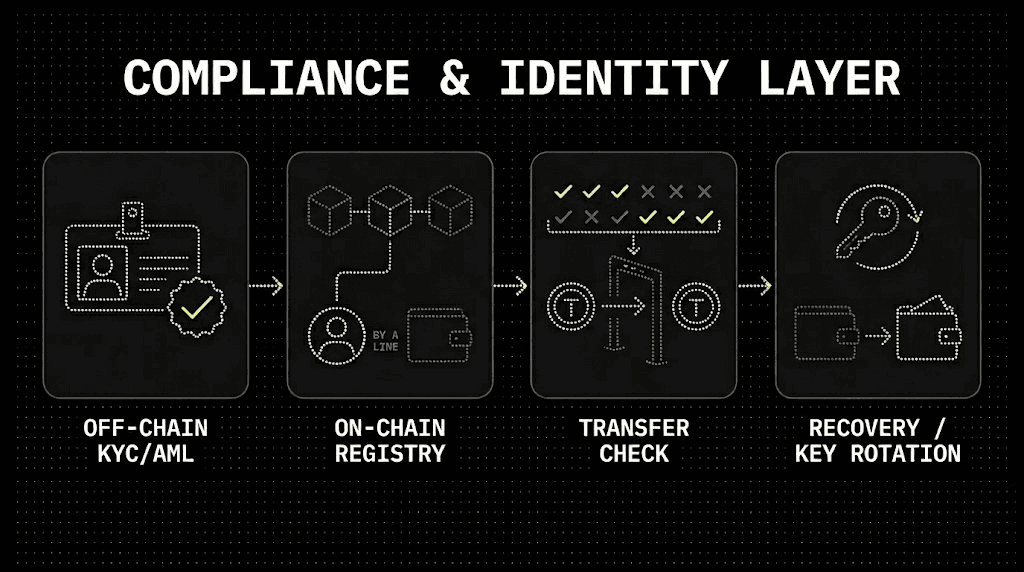 Recovery for the various "flows" is something that is typically overlooked. Institutions rotate keys, wallets get lost here and there, and a mature design handles wallet re-assignment without breaking the ownership records or creating a social-engineering attack vector.
The RWAs rely on a set of facts off the chain: NAV, coupon schedules, payment receipts, the collateral account balances, default events, and servicing reports. The oracle layer is more than just a price feed; it is the mechanism by which legally relevant and verified facts about the real-world state are moved into the on-chain contract environment in a verifiably timely and authorized fashion.
Starting from the event taxonomy of what changes balances and what changes reporting, through pause, redemption gates, and circuit breakers, of signed reports, of freshness windows, of quorum checks, and of replay protection. For a Proof of Reserve, it is enough to validate the cash backing, provided that one trusts the attestation source and the scope of the reserve is correctly defined.
This layer answers a very common question engineers would like to answer and actually end up putting off too long: What do you actually own when you own a token? In the vast majority of circumstances, the token holder is holding a claim on an SPV (which is typically a holding company or shell for a fund), or he is holding a fund unit (e.g., a limited partnership unit), or he is holding a beneficial interest governed by contracts. In most cases, the holder does not directly own the physical asset itself.
A cash and treasury strategy would typically utilize a regulated custodian and correspondingly regular account statements. A private credit strategy may require document storage (e.g. a ‘document vault’), tracking of liens and similar security interests, and reports from the servicer.
If this mapping is vague, the best smart contracts in the market will not fix it.
When we say token standards are not interchangeable, we mean that the standard determines the transfer logic, metadata, partitions and compliance extensibility of the token. Many teams start out with ERC-20 for the broad tooling support, but then realize that they need to issue identity-bound transfers, execute forced actions on the token, or even issue multiple classes of tokens.
| Standard | Best fit | Strength | Limitation |
|---|---|---|---|
| ERC-20 | Simple fungible claims | Wallet and DeFi support | No native permissioning |
| ERC-1155 | Many series or tranches | Efficient multi-asset issuance | Compliance logic is custom |
| ERC-1400 | Regulated securities with partitions | Rich lifecycle controls | Heavier integration surface |
| ERC-3643 | Permissioned RWAs | Built for identity and transfer restrictions | Requires registry architecture |
When looking for canonical references to interfaces and extension patterns, use the ERC-3643 standard (EIP-3643). Do not just read the spec text, also check the implementation maturity.
ERC-3643 is typically one of the first standards that teams look to implement when creating a permissioned RWA tokenization platform. Its T-REX architecture is designed to be practical and is composed of several core modules: ONCHAINID (identity), IdentityRegistry (wallet-to-identity on-chain resolver), TrustedIssuerRegistry (for trusted attestations), and ModularCompliance (programmable rule-based checks).
The architecture outlined earlier is well-suited to RWAs. The transfer validity of an investment is often dependent on characteristics of the investor, their location, their KYC/AML status, and whether they are currently under lockup. Rather than trying to bolt these features onto a generic token, ERC-3643 is designed to treat these characteristics as first-class features.
Paper based compliance in PDF format is not operational compliance. For RWAs, transfer validity depends on identity data, the rule modules and time-based conditions. This means the contract has to either enforce the rules of the policy engine directly or reject changes of state and wait for the policy engine that is authorized to make the change to confirm them.
The idea of releasing a raw wallet whitelist for production use is not good enough. A simple list of wallets does not equate to beneficial owners, to accounts held by institutions, to wallet key rotation, to issuers' attestations that are trusted by others. What is far better is an identity-linked permissioning system, where the wallet points to an identity record, and then the compliance modules check the identity against the currently in-force policy. Also, as the status of an investor changes, the attestation layer is updated, and future transfers fail accordingly, without rewriting historic balances. That's why ERC-3643 and T-REX are so relevant for the purpose of real world asset tokenization.
Most systems that implement transfer restrictions will find that their system becomes fragile. It is up to the contract and transfer rules to specify a deterministic order of checks, and a clean failure model. This means that when there are multiple rules that could block a transfer, the developer of the system must first decide which reason to surface first, and then how to present that reason through off-chain interfaces.
Common rules include:
Some teams add forced transfer, administrative freeze and court-order execution functionality. These need to be granted with narrow permissions, logged for auditing, and explicitly documented with written legal justification for when they can be executed. The code must not grant powers that are not granted by the legal documentation.
An oracle can update the blockchain about changes in reserve account balances of a backing account, but it cannot prove that holders of a given token have a claim on the funds in the corresponding reserve account, or that a given custodian will honor a redemption request. The last-mile problem includes all of the issues of document validity, control of a custodian, accuracy of servicing, bank disbursements, required signatures, and dispute resolution. Teams that solve only the oracle problem end up with a sophisticated dashboard sitting on top of broken legal engineering.
Proof of Reserve has value when there is stable reserves, frequent statements and a narrow attestation scope. Illiquid collateral, slow NAV assets and complex structures with layered liabilities do not lend themselves well to Proof of Reserve and rather are suited to a pattern of signed servicing data, scheduled reconciliations, stale-data cutoffs, etc. and more conservative pause logic around redemptions.
A Smart Contract for RWA investments includes the usual set of Solidity-based risks plus policy-related ones. As for bugs in transferring funds, a usual bug is already bad enough, however, if it violates rules on investment for a client or even enables an unauthorized redemption, then such a bug is much worse than the average case of losing money due to bugs in smart contracts. Therefore, it is necessary to adversarially test several aspects of such contracts, including access control, upgrade governance, storage layout, oracle integrity and admin roles. By separating the roles of the issuer, of the compliance department and of the oracle, and by enforcing least-privilege-based access rights, including appropriate logging and regular review meetings, one can significantly decrease the impact of the worst-case scenario.
In addition to testing all the unit paths, you should also test the invariants around transfer restrictions, fuzz identity, test replay protection for off-chain messages, and do a bunch of scenario tests for stale oracle data, wallet recovery, and all the ways that the redemption queue can get pressed. Before you launch, you really want to get a formal audit done and also do an operations review. We have a blockchain security audit breakdown that goes into scope, risk, and price for different audits.
Key areas to harden:
Building out a solid architecture for your asset starts with thinking through the entire lifecycle of the asset before you even start designing the interface for it. That means working through subscription, issuance, transfer, distribution, redemption, default, reporting and recovery before you even start picking out a contract or two to use in your architecture. It will help to reveal at what points in the on-chain workflow certain legal actions kick in and where there is still room for human intervention.
A typical delivery path looks like this:
The best RWA tokenization platforms are opinionated about such design choices and do not treat compliance, oracle design and custody as after-thought plugins.
Cost is not directly proportional to screen count. Rather, cost increases with legal complexity, identity complexity, integration surface and security requirements. A pilot with a fixed set of investors for a single asset class is fundamentally a light weight development project as opposed to a full RWA tokenization development project (as outlined above) which supports self-service onboarding of identity holding individuals / entities for a range of assets (issued in different asset classes) with support for secondary transfer of assets and sophisticated institutional level reporting.
Indicative planning ranges, assuming the legal structure is already defined:
| Scope | Typical timeline | Main cost drivers |
|---|---|---|
| Pilot issuance flow | 4 to 8 weeks | Token contract, basic registry, admin portal, custody and oracle stub |
| MVP platform | 8 to 14 weeks | Investor onboarding, compliance modules, reporting, payment rails |
| Production platform | 4 to 8 months | Audit cycles, multi-role admin, recovery flows, integrations, monitoring, legal iteration |
Rather than just comparing the functionality of different vendors, asking hard questions of them about how they handle failures, map legal states, treat oracle authorities and manage upgrades is far more important. A good RWA tokenization vendor should be able to explain these things concretely.
I would describe RWA as a way to issue on-chain tokens that represent claims on real-world assets or cash flows. RWA is an acronym for “Real-World Assets” locked on blockchain to be used in financial services on blockchain.
A legal wrapper, be it an SPV / special purpose vehicle or a fund, holds or controls the underlying asset. The Smart contracts then issue assets in the form of tokens which are tied to this wrapper. For the tokens, in addition to normal KYC/AML and custody records, also the feeds from the oracle and the events from the servicer are taken into account to manage who can hold which balances and how these can change over time.
Development costs will vary greatly depending on the asset classes, integrations and level of compliance that are required. A very narrow pilot can be set up and completed within weeks. A production-grade development of RWA tokenization with audits, identity registries, custody integrations and multi-role admin logic will take months to complete and cost a lot of money.
ERC-3643 is a token standard for permissioned assets. Such tokens are typically managed by using T-REX architecture, which combines ONCHAINID, IdentityRegistry, TrustedIssuerRegistry and ModularCompliance. All these components together enforce identity-aware transfer restrictions for any tokenized, regulated financial instrument.
We can help with the design, the smart contract build out, the integration and the go live plan for an RWA product. We can also review our RWA tokenization development service to scope out the legal-to technical model prior to implementation. See also our guide to DeFAI and AI agents in DeFi for adjacent automation patterns.