DeFAI explained: what AI agents in DeFi are, how they work, real use cases, and how to build one — for Web3 founders and engineers.

Run DeFi by hand, and you realize quickly that you are repeatedly making the same decisions over and over again. You are constantly comparing rates on different exchanges and rebalancing your collateral positions. You are monitoring your bridges and revising your exposure in your treasury based on market fluctuations. And just before the window to sign a transaction to actually put that into action closes, you hit the button.
DeFAI lives at this point of friction between what is programmable finance and a system of agents that read from on-chain state, make a determination regarding a goal of that system, and then take action within very strictly defined policy boundaries. As an engineering team, the real change here isn't that AI is talking to a wallet. The real change is that the AI agents in DeFi function as operational software. That they have bounded authority. That you can track certain metrics about them. And that you have a list of failure modes for them.
The real work here is system design. What does the agent see? What can the agent touch? And how does the agent recover from a market failure, an RPC failure, or a model failure?
We've been building DeFAI: agentic AI for DeFi workflows. A DeFAI system is composed of strategy logic wired to data, model-driven decisions within given policy bounds, and transaction execution through a controlled execution path.
 DeFi is already largely machine-readable and very composable, so it is one of the natural areas for us to apply AI. In DeFi, contracts already expose a lot of state, price feeds are updated very frequently, mempools are just pending transaction streams, and indexers have recently enabled cost-effective analytics on top of the chain. The controls on these systems have to be real for the AI to work faster and more consistently than a human.
From a chain perspective, there is no new category created by AI DeFi but rather a new architecture: a model or policy engine processing on-chain as well as off-chain data, with the aim of reaching a goal by acting on a set of on-chain primitives.
Decentralized AI agents are characterized by the decoupling of reasoning, data access, and execution authority. Any of these can be distributed across different services, such as indexers and contract-based services, a multisig, or even protocol-controlled components, as opposed to a "black box" bot running on a central server.
In crypto, an AI agent is typically a software program designed to perform a set of predefined actions to reach a pre-specified objective. That could be, for example, generating the maximum return in stablecoins while keeping the drawdown to only 5%. The same program might automatically manage a treasury by adhering to set policy allocations across different assets, or perform a swap (say, exchanging BTC for ETH) while keeping expected slippage as low as possible and routing it through the various available chains.
A crypto agent is more than a program that fires off alerts to a human trader, and less than a fully autonomous trading program handed unrestricted keys. Such a program has a bounded scope or functional focus, defined permissions, deterministic fallbacks for when the primary path to a goal fails, and a log of every decision it makes.
In practice, many of these agents are built on top of other systems, and the "AI" is just one layer. The AI can classify potential opportunities, summarize large amounts of information into a concise report, rank different options by potential return, and generate intents or trades that the program then decides whether to take based on a set of hard rules and simulations.
DeFi is highly automatable. It has a public state, programmatic actions, and highly repetitive strategies that can be executed by an agent. Human intervention is often not required, and indeed can be a bottleneck.
DeFi is a unique space in which DeFi agents can thrive for a few key structural reasons. First, DeFi markets are always open and therefore present opportunities around the clock. Secondly, the window in which to capitalize on an opportunity is short and can pass in the space of minutes. The rules of a protocol can be deterministic and therefore easily enforceable by a program. Finally, in DeFi, the execution of an action can be abstracted behind a contract or relayer, or even use account abstraction. Therefore, while a human treasury lead may, for example, review treasury exposures twice a day, a corresponding AI agent can monitor the same exposures on a per-block basis (or on a basis of its own, determined by the agent's cost constraints).
In short:
As AI agents in DeFi emerge to tackle various challenges, the most effective first use cases will involve operational roles, rather than speculative trading strategies. These roles can efficiently reduce response time, increase discipline, and remain confined to a narrow scope of operation.
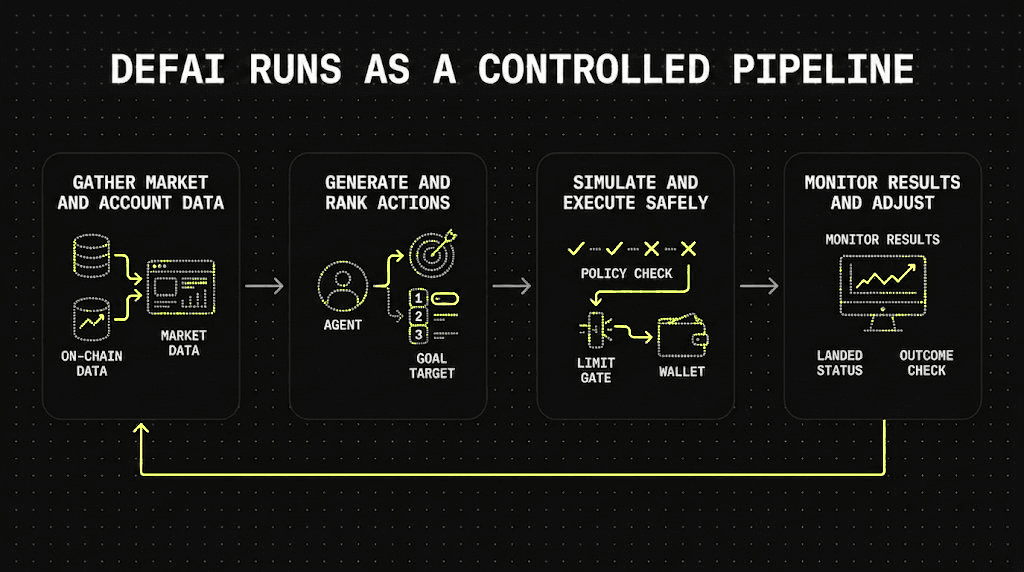
DeFAI agents are typically run as a pipeline through several layers of data, reasoning, and execution, and are therefore not suited to be monolithic models. They begin with some data: on-chain data retrieved from RPC nodes or indexers, off-chain market data, protocol metadata, governance data, etc., plus the internal account positions of a user. Raw feeds are normalized into features, such as the utilization of funds, the funding spread, the health of borrowing, the depth of pools, the deviations of the oracle, the latency of the bridge, gas estimates, and many more account-specific risk measures.
On top of the data layer, in the reasoning layer, the LLM interprets the objectives (formulated in natural language) on a feed-by-feed basis, sums up changes to the situation in a way that is meaningful for a human in the loop, or ranks different strategies generated by a search process. Most DeFAI systems are, however, mostly symbolic/statistical, and the LLM is used for explanation and to enable an operator to interact with the system in a structured way. Hence, there is a big difference between a model that proposes actions and a model that directly controls execution.
The on-chain execution layer encodes proposed actions as transactions, simulates their effects, checks policy rules, routes the transactions through wallets that are granted permission to spend from certain accounts, and handles cases where transactions fail (retry, nonce management, gas policy, etc.). Account abstraction can greatly help in this regard, as it allows for granular permissioning of accounts, such as by function, by token, by volume, by time, etc.
Finally, there is the monitoring and feedback layer. For every action that the agent performs, it should produce a trace of what it saw, the possible actions that it considered, the reasons why it chose a particular action, the actions that it performed as a result, whether the actions actually landed as transactions on the blockchain, and so on. The agent's traces can then be used in a variety of ways: to evaluate the performance of the agent in a variety of scenarios, to fine-tune its prompts and policies, and so on. Without this monitoring and feedback layer, the worst-case scenario for using AI in finance is untestable automation.
Most useful DeFAI systems are narrow. They do one job well, under clear rules, and generate measurable outputs. That is a better path than building a general-purpose operator from day one.
A practical way to think about use cases is by mandate, data horizon, and execution frequency.
| Use case | Primary inputs | Typical action | Main risk |
|---|---|---|---|
| Yield optimization | APY, utilization, incentives, exit liquidity | Reallocate idle assets | Hidden smart contract risk |
| Cross-chain arbitrage | DEX prices, bridge latency, gas, MEV exposure | Buy on one venue, sell on another | Execution failure across legs |
| Treasury management | Balance sheet targets, runway, exposure caps | Rebalance and hedge | Policy drift or overtrading |
| Security monitoring | Wallet activity, contract events, anomaly scores | Pause, alert, revoke, escalate | False positives |
| Intent-based trading | User objective, route options, slippage, fees | Construct and submit best route | Poor intent interpretation |
Yield optimization is the clearest entry point. The agent watches lending markets, vaults, and incentive programs, then shifts capital when the expected net return beats a threshold after gas and liquidity costs. Cross-chain arbitrage is more demanding because state changes during execution, bridges add latency, and each leg has its own settlement risk.
Treasury management is where an AI-CFO pattern becomes useful. A treasury agent can maintain allocation bands, roll idle assets into short-duration strategies, manage stablecoin diversification, and flag governance or counterparty events that justify de-risking. Security monitoring is another strong fit. Agents can score unusual wallet behavior, contract upgrade patterns, or governance proposals, then trigger predefined responses.
Intent-based trading is the part that many teams mean when they say “AI DeFi.” A user gives a goal, not a route: “move 500k USDC into a low-risk yield strategy and keep 20% instantly liquid.” The system translates that into route selection, simulation, and policy-checked execution. That is useful, but only when the intent parser is paired with hard constraints.
The strongest DeFAI systems are not built by starting with a model. They are built by starting with a narrow financial task and then deciding where model-based reasoning adds value over rules, optimization, or search. If your current question is how to build your own AI agent, the shortest path is to pick one workflow with clear metrics and bounded permissions.
Start by defining a single job, a success metric, and a hard loss boundary. “Improve yield” is too broad. “Move idle stablecoins between three approved protocols when net expected APY improves by at least 80 bps, and liquidity remains above X” is usable. The same applies if you are making an AI agent for treasury or execution.
A good first spec usually includes:
Then decide how much autonomy the system gets. Many teams begin with an approve-then-execute mode where the agent proposes transactions and a human signer reviews them. Once decision quality is proven, execution can become semi-automatic for low-risk actions and remain gated for large moves or new venues.
The stack should map cleanly to the job. Do not add an LLM because the category name says AI. In many cases, retrieval, scoring models, deterministic simulations, and rules are enough. Use an LLM where language or abstraction is genuinely needed: interpreting human intents, summarizing governance changes, generating strategy candidates from structured state, or explaining why the agent acted.
A practical stack for DeFi agents usually looks like this:
The data layer is where many early systems fail. Inconsistent indexing, stale prices, and missing protocol adapters create bad decisions before any model gets involved. Treat your adapters as production infrastructure. Version them. Test them against protocol upgrades. Cache carefully, but not so aggressively that you trade on dead state. When debugging a suspect transaction or verifying contract state, a block explorer like Etherscan is the fastest ground truth.
On the reasoning side, separate proposal generation from action approval. A model may suggest a rebalance, but a policy engine should verify exposure, expected slippage, liquidity, and contract allowlists before any transaction is signed. This separation makes audits easier and keeps failure domains smaller.
For execution, account abstraction is attractive because it supports granular permissions and programmable validation. A session key limited to approved functions and token amounts is safer than a hot wallet with broad authority. If you need cross-chain behavior, avoid assuming atomicity that does not exist. Model each chain and bridge as its own risk domain.
The fastest way to damage a product is to let an agent reach the mainnet without hard controls. A DeFAI agent should be treated like automated trading or treasury software, not like a chat feature.
Before production, put these constraints in place:
Add kill switches and rate limits as well. A good system can be paused at the strategy, protocol, wallet, or chain level. It should also have a shadow mode that runs live decisions without submitting transactions, so you can compare predicted outcomes against real market behavior.
If someone asks, “how do you build an AI agent” for finance that is worth deploying, the honest answer is that architecture matters more than prompts. The model can help with abstraction and decision support. The production edge comes from clean data, strict execution controls, and an evaluation loop that catches drift early.
If the mandate is narrow and the internal team already has strong backend, smart contract, and data engineering capability, building in-house is reasonable. You keep full control over policy logic, wallet architecture, and deployment practices. That is often the right choice for core treasury or protocol-native agents.
Partnering can make sense when time matters and the build spans several specialties at once: Solidity or Rust, indexers, infra, agent evaluation, UX for operator oversight, and launch support. Production DeFAI rarely fails because the strategy idea was weak. It usually fails at integration boundaries. Teams fluent in both chain-specific engineering and agent systems reduce that risk, especially when the first release needs to move from prototype to guarded mainnet quickly.
What is DeFAI? DeFAI is the use of autonomous or semi-autonomous AI systems to monitor, reason about, and execute actions in DeFi. The useful version is narrow, policy-bound, and measurable.
Is DeFAI safe? It can be, if authority is constrained. Safety comes from scoped wallets, simulations, protocol allowlists, slippage limits, MEV-aware execution, observability, and human escalation paths. Unbounded agents with broad keys are not acceptable.
How do you build a DeFAI agent? Start with one task, one KPI, and one loss boundary. Build the data layer first, then the policy engine, then the execution layer, and only then decide where model-based reasoning helps. If you are asking how do you build an AI agent or how to build your own AI agent for crypto, think in terms of bounded automation, not general intelligence.