Cross-chain DEX aggregator development: architecture, routing, bridges, security, and real cost drivers. A practical Web3 engineering guide.

There are a thousand venues where liquidity sits, not speaking to one another (various pools, cross-chain bridges, token standards that don't line up across chains, etc.). You can search for the best price to swap one token for another on Ethereum, the cheapest possible path via BNB Chain, and then have the final token sent to TON or to the Arbitrum chain.
Of course, this can all be done, but only if one programs a decent algorithm that correctly computes the optimal route for the customer, correctly calculates the total fees for him or her, and presents it to the customer for signing before he or she initiates the process.
This is what is called cross-chain DEX aggregator development, and if you are a founder or a product owner considering launching a cross-chain DeFi product then this is what you need to learn about the shapes of the things that can be built, and what are the crucial technical decisions along the way that one cannot get wrong while writing a specification for a future development or while hiring people to develop a product.
If you search what dex is, the short dex definition is simple: a DEX is a decentralized exchange where users trade from their wallets against onchain liquidity, not an internal custodial order book. A cross-chain DEX aggregator sits one level above that. It does not own the liquidity. It queries many venues, works out which routes between them can actually execute, then coordinates the source swap, the bridge step, and the destination swap. It is sometimes called a cross-chain defi aggregator.
A single DEX would see only the pools of that DEX on one network, whereas a cross-chain DEX needs to reason about the reserves of the pool, the capacity of the bridge, the latency of the messages, the gas at the destination, and the token mappings. So it can't just glance at current prices and grab the lowest one. It has to simulate what you actually net out, after fees, slippage, route splitting, and the chance that assets settle out of sync.
These three products solve different problems for their users, so the architecture differs depending on where settlement happens, making the role of a liquidity aggregator crucial in connecting disparate liquidity sources.
| Product | Custody model | Liquidity source | Best use case |
|---|---|---|---|
| Single-chain DEX | Non-custodial | Pools on one network | Fast swaps when users stay on one chain |
| Cross-chain aggregator | Non-custodial or partially delegated by route design | Multiple DEXs, bridges, RFQ venues | Cross-chain swaps with route optimization |
| CEX | Custodial | Internal order books and market makers | High-frequency trading, fiat ramps, deep books |
A decentralized exchange runs on the chain itself. So, an approval, a swap, a bridge message, each one clears through the user's wallet and the target network, where anyone can see it. A CEX tucks all of that away behind its own internal ledger entries. Easier to use, yeah, but now you've handed someone else your custody, and you're sitting around waiting on deposits and withdrawals.
DEX aggregators? Those are for the people who want to keep custody and still get the genuinely best route they can execute across venues. Not just whatever number one half-empty pool decides to show them.
Routers do not "find the best price" for you. They set up a graph where each edge represents a possible swap or bridge action, and then each candidate path is scored in terms of expected output, gas cost, slippage, and route reliability.
For EVM chains, the engine typically retrieves pool state from RPC calls, indexers, and venue quoters, and then performs pathfinding offchain, since doing full multi-chain search onchain is too expensive and too slow.
For constant product pools, price impact can be estimated from reserve changes, while for concentrated liquidity pools, the router often uses protocol-specific quoter contracts, since crossing ticks changes the execution curve for such venues. When a product supports split routing, the engine may split the order and send 60% through one pool and 40% through another, because a pool that looked deep at first starts to lose efficiency after crossing a few ticks.
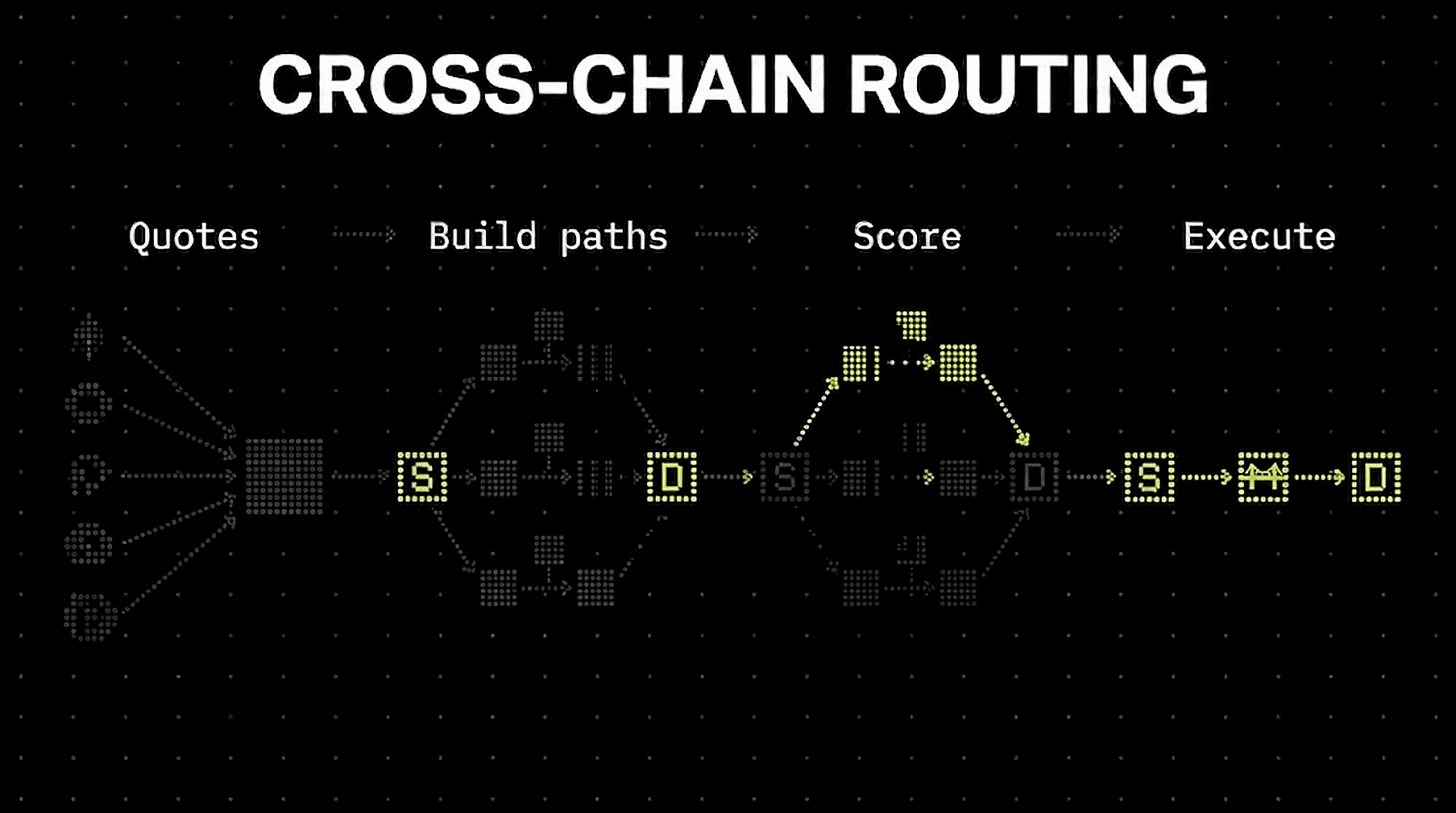
A serious liquidity aggregator would also look at the failure probability for each possible path to your end goal. So if a bridge looks cheap at first glance (say it only charges 0.01% to cross) but has poor relayer support (only 2 active relayers, with low success rates for forwarding swaps), then it should be rated lower than another route that is, say, 20% more expensive in total fees but completes successfully 99% of the time instead of 50%.
The penalties for stale quotes, low bridge inventory, or unstable RPCs on certain chains are usually set by the engine's team and depend on many factors, including how the aggregator is meant to be used and how liquidity is expected to behave in different situations. When choosing which blockchains to support in your aggregator, use real depth from actual venues and real DeFi liquidity data, not the overhyped marketing claims of the chains themselves.
For cross chain swaps, you need to transfer value or state between the chains. There are several methods: canonical bridges, burn and mint, lock and mint wrapped assets, and liquidity networks of relayers, where the relayer first pays out on the target chain and rebalances later.
Native asset transfer over a bridge usually issues the canonical representation of that asset on the target chain. But there are also wrapped token designs used for cross-chain value transfer. In those, the swap on the target chain also depends on the redemption of the wrapped asset and the liquidity behind it. This leads to a number of latency components: (1) confirmations on the source chain, (2) the relayer observing the outgoing transaction and creating its proof, (3) inclusion in a block on the target chain, and (4) finality on the target chain, which some bridges require before they release funds.
The worst type of bug is the partial success bug. The source chain swap completes. The bridge accepts the relay message. But the destination swap fails. Often, because the token mapping has been paused, the relayer has exhausted its daily quota, or the user runs out of gas for the final transaction on the target chain. So a recovery path for these failures needs to be built into your product before launch.
When cross chaining, instead of displaying a single figure to the user, it helps to display what happens on each leg. The confirmation screen for a cross chain swap should show the source rate, the protocol fee, the bridge fee or the destination network fee, and the minimum amount the user will receive. If the quote was generated by an RFQ maker, the screen should also show the RFQ quote expiry and a way for the user to refresh it.
Exact-output transactions are difficult to implement cross-chain, because settlement in most blockchain scenarios is essentially asynchronous. This is why teams commonly implement exact-input first and present a "You will receive" amount of the destination token as an estimate, with a slippage range that protects a minimum the user actually receives. If the destination token is too illiquid, the route engine can widen slippage for that route or block it altogether, rather than returning a quote that only works in a lab.
The best dex aggregator is not the one with the longest chain list. Instead, it’s the one that can route, explain and fail safely, without locking the user into an unknown state. To build a production-grade crypto aggregator you need a transaction state machine, chain-aware token metadata and consistent error reporting across all wallets and chains.
There are a couple of real-world implementation details to note here. First, you will actually need to map the state names to real events in your backend. “Pending” in and of itself is not a state name. So something like this: “Source tx submitted”, “Source tx confirmed”, “Bridge tx observed”, “Destination tx executing”, “Destination tx confirmed”, “Recovery required”. If you don’t do this, support volume will instantly go through the roof as users have no idea where their funds are.
When building a good dex aggregator, most of your work will revolve around deciding where to put certain pieces of logic. Typically, the route search will be offchain for performance and flexibility, but settlement guarantees and the permission boundaries for users should stay onchain, in order to keep the system upgradable without introducing a single point of failure in the form of a server you have to trust.
For contracts, the default is Solidity for EVM routing, allowances, fee collection, and adapter execution. When supporting non-EVM networks, the contracts or programs on that chain may be written in Rust or another native stack. Many teams use Permit2 or typed signatures to cut down on repeat approvals, but as always, the contract has to strictly whitelist the adapters it allows to call it, and implement reentrancy protection where needed.
The backend is where the route engine lives. Most developers use Node.js as it is a well-established platform, and there is mature support for the protocol SDKs and wallet tooling. The core store of data for the application is PostgreSQL. It stores the market data quotes, transaction history, information for all the tokens, and the analytics data for all the computed routes. In addition to the core store, Redis is used for short-lived caching, nonce locking, and hot pool state. The application also requires indexers or event consumers, as relying solely on wallet callbacks for tracking of settlement events is not sufficient.
The frontend will be built with React and Next.js and a wallet library like Wagmi to connect to EVM chains. The UI handles a fair amount of logic, like switching between chains, requesting allowance for tokens, displaying errors that occur during the simulation, and polling the status of transactions.
For sanity checking against sharp price movements, Chainlink or Pyth can be used; they are not a replacement for the execution quotes that are pulled from the trading venues themselves.
The RPC layer requires dedicated endpoints for each chain, which are then backed by fallback providers. If the dedicated RPC endpoint for a chain starts to degrade, it quickly turns a valid route into a bad user experience until the fallbacks start to return data.
Decentralized exchange development should start from the route scope, not from design files. The exchange developer first defines the scope of possible routes, e.g., which chains, which bridges, which DEXs are supported, whether route splitting is supported in the first release, or only single paths are executed. This scope decision affects the architecture of the contract, the complexity of the backend, the scope of the audit, and the burden on support.
Test more than happy-path swaps. Test chain reorgs, stale quotes, rejected signatures, duplicate callbacks, and late bridge messages. If the route engine retries a destination call after a timeout, then idempotency matters - test marking one swap twice and reading an already settled state as failed.
Cross-chain systems have the attack surface of routers, adapters, 3rd party bridges, and operational controls. Therefore, audits are non-negotiable. A good audit scope would cover contract invariants, upgrade permissions, signer roles, replay protection, adapter isolation, and fee accounting. If you are planning a product for cross-chain use, make sure to get a blockchain security audit done against a clear checklist before you go to mainnet.
A lot of the losses are not simple bugs. They are caused by a series of assumptions made about the integrations. Your contract might be safe while the bridge adapter is accepting unexpected tokens, the route engine is trusting stale destination quotes, or the recovery flow is leaking funds while it’s trying to recover from an error in the flow of transactions through your contract.
A mature design fails closed (i.e., in a defined/controllable fashion). If the destination swap cannot be executed, then the funds should be sent to a recoverable intermediate (e.g. a stablecoin) or a claim path opened up. “We will handle it manually” is not a security model.
The cost is more related to the route complexity rather than the number of screens. The same UI can sit on top of a simple single-path engine or a multi-bridge routing system, and the price difference between these two options is large. Rather than specifying a figure that will go out of date quickly, it is more helpful to explain the variables that determine the budget.
The main cost drivers:
We focus on supporting the chains with executable liquidity and a real user base. A destination chain with thin liquidity pools and poor bridge coverage to that chain quickly leads to product cost outpacing user value. To get a realistic budget number, we suggest first defining the route scope and then pricing that scope. We’re happy to go through that scope with you on a short call and then give you a very realistic estimate for an MVP, for getting audit ready, and for launch.
The DeFi platform Feyorra has a bridge to cross-chain the FEY token on Ethereum, BNB Chain, and TON. The build of this bridge required chain-specific network adapters and routing. In order to keep the product logic identical across the chains, the adapter layer for the different chains was a crucial aspect. This layer keeps the quoting, validation, and status reporting identical for the user, while the execution and the token movement are different for each chain.
The user-facing product showed the user the data that matters to them before the transaction is confirmed, i.e., Rate, Platform fee, Destination network fee, Total fee, and the “You will receive” amount. It also correctly handled all the failure cases that users encountered in production, such as network mismatch, no gas, transaction rejected, and other technical failures. It achieved 99.8% uptime across 3 integrated networks, a good benchmark for cross-chain transaction routing with reliable error handling designed up front.
Typically, yes, and this will depend on the specific bridge and the execution logic behind the product. If the user signs off on the swaps from their wallet and onchain settlement occurs, then it’s non-custodial at the wallet level. However, there’s typically going to be some amount of trust placed in the bridge relayer, the RFQ makers, and the various upgradeable adapters. It’s best to detail these trust assumptions.
The hardest reverts aren’t normal reverts; they are partial-success states. Thus, the source swap could succeed, the bridge message accepted, but the destination leg fails for any number of reasons — paused token mapping, relayers out of inventory, user ran out of gas on destination chain, etc. A product that does not design for recovery for all partial success cases will lock user funds indefinitely in an unknown state. The real hard work of route design and failure handling happens far below the UI.
Begin with the chains where your users hold assets, and there is real liquidity on the destination. Supporting Ethereum plus one or two low-fee chains is far easier than supporting six thinly traded chains with poor token mapping and fragile bridge paths between them.
Yes, if you design your adapter layer correctly then it shouldn’t be a problem to keep the routing logic abstracted from the specific calls that you make to each bridge, to normalize the status events that your bridges raise and to store the metadata for the routes so that you can compare and contrast the performance of the different bridges without having to re-implement your entire backend for each of them.
DESH can review your proposed route, required chains, and error handling before you start writing code for your cross-chain product. We can discuss our Web3 development services and a practical build roadmap for your MVP, audit, and launch on a call.