Learn how to build a prediction market with the right architecture, oracles, trading model, resolution flow, security, and compliance.

In building a prediction market in 2026, one of the biggest design challenges is creating a system where creating an event contract, issuing outcome shares, trading those shares, resolving the outcomes of said shares and settling the resulting payouts all occur in a very unambiguous fashion. A prediction market is more than a pretty UI asking a single question. It is a financial protocol. Users buy and sell claims on various outcomes, the market price for each outcome's shares reflects an implied probability of said outcome occurring. When the relevant contracts are resolved via some defined process, the resulting true outcome is then paid out to the holders of the corresponding shares against their locked collateral.
The usual mistake is building a prediction market from the wrong end. Teams first design the order flow, the wallet for the UX, or a mechanism to get in demand from the community. Then they try to slap on a resolution model on top of that. In serious prediction market development, the hard parts are architecture, oracle design, dispute handling, settlement correctness, and compliance boundaries.
A prediction market is essentially a market for event contracts. A market begins with a question, some possible outcomes for that question, a close time for the market, a way to determine the true state of the event (the resolution source), and a rule for paying out to the holders of the outcome shares for that event (the payout rule for that market). Users of a prediction market purchase shares in the various possible outcomes of a question. Each of these shares will pay out a certain amount of a user's collateral if the corresponding outcome for the market's question is true for the event that the market is about to resolve. In a binary market (i.e. a market with two outcomes), a YES share will pay out 1 unit of collateral when the event in question is true, and a NO share will pay out 1 unit of collateral when the event in question is false. As in any other market, the prices of the various shares of an event will change as users of the system express their beliefs about the outcome of the event, and as new information relevant to the market is announced to the traders in the market.
Prediction markets made the transition from being a crypto niche to serious event contract infrastructure on Polymarket and Kalshi in 2025 and 2026. This also became clear to founders and CTOs: only when market question, trading mechanism and resolution pipeline are locked together as a closed system, the product becomes credible. Polymarket demonstrated how crypto native markets can scale on shared liquidity via a clear oracle path. Kalshi demonstrated that regulated event contracts can also be operated in the US within a defined framework.
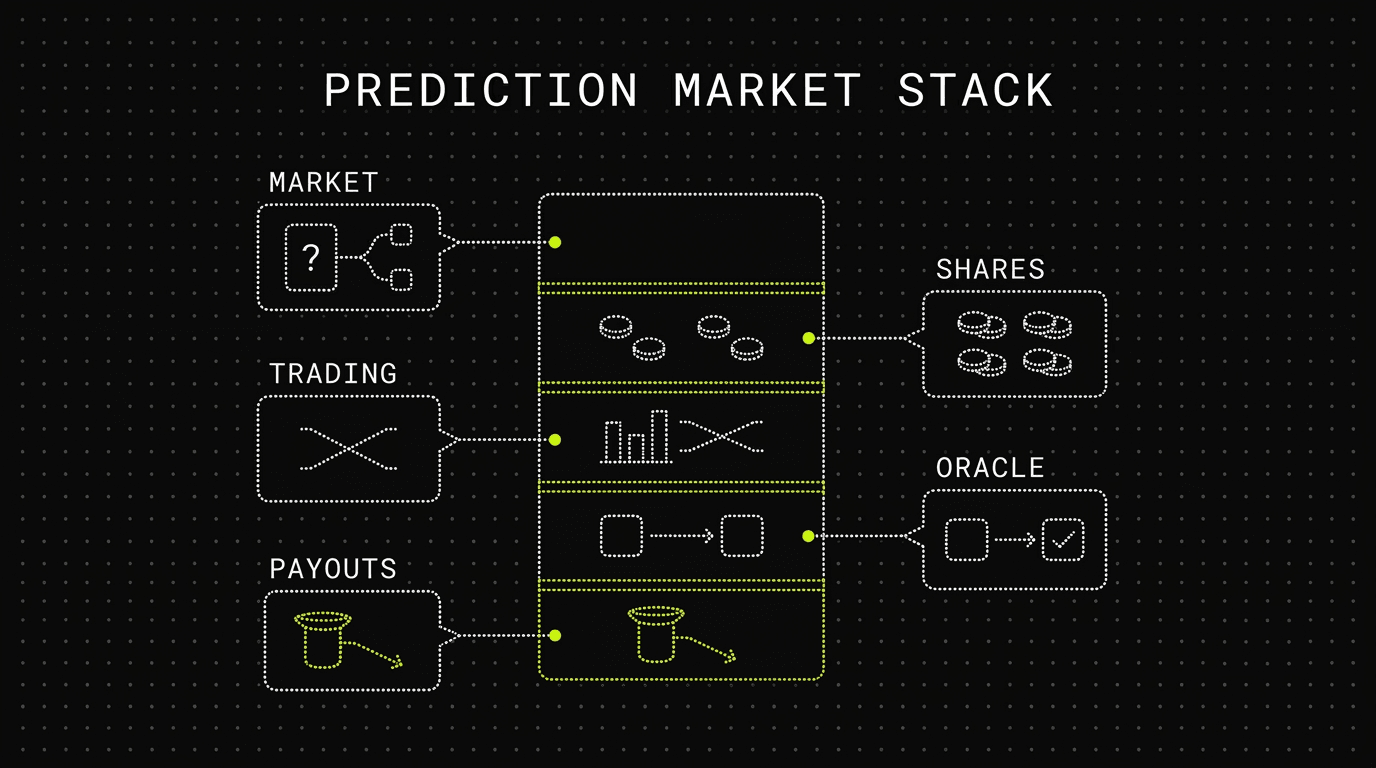
At the protocol layer, prediction market platform development usually breaks down into a few modules: market definition, position tokenization, collateral custody, trading, resolution, and settlement. These can be split across many different contracts or wrapped in an application layer on top, but the individual responsibilities remain the same.
For onchain outcome shares, the common foundation is the Conditional Tokens Framework, usually implemented with the ERC-1155 standard. This is the same broad design family that Polymarket uses. The reason it persists is straightforward. Conditional tokens let you split collateral into outcome positions, combine positions, and redeem winning claims after resolution without inventing a custom token model for each market.
A minimal production architecture usually includes the following components:
Within the new event contract created by the market factory, the metadata is immutable or allows a very limited scope of mutability as determined by policy. The condition registry ties the market to the question ID and the outcome space for that question. The collateral vault accepts approved collateral (in this example USDC or other assets) and mints the relevant positions for the different outcomes. The settlement contract then unlocks redemptions for the winning outcome on resolution.
The data layer is easy to underestimate. Just because you have a correct protocol does not mean the data will index quickly enough to serve real time queries for open interest, implied odds, depth, user positions, past trades, and other relevant data points as well as resolution status. CLOBs require offchain matching with onchain settlement guarantees. And for any AMM, one must index and do analytics on the market's pricing as well as the slippage that users will get and the state of the liquidity providers.
 In-house development quickly becomes harder from here. Writing the outcome token contracts should be within the capabilities of a solid Solidity or Rust developer. However, building out the entire system such that the factories, the collateral logic, the indexing, the front end state and the settlement all work in unison under load is a completely different class of engineering problem.
Next is how users trade, and for most teams this is a choice between a central limit order book (CLOB) and an automated market maker (AMM), typically a variant of LMSR.
A CLOB is superior for traders who want to have control over their own bids and asks. It is best suited for deep markets, for faster price discovery for professional traders and for traders who already think in terms of an order book, like they do for event contracts on Kalshi. The tradeoff is that a CLOB requires active makers. Without them, the market appears empty.
First, continuous quotes from an AMM are far better than waiting for another trader to come and cross trade against you. Secondly, LMSR is a common choice as it bounds loss and also smoothly maps through all possible outcomes. Launching a market maker based exchange is far easier with an AMM than an order book, but easier does not equal solved. Thin liquidity leads to very unstable pricing, very wide effective spreads and serious traders hate it as it gives them little confidence in the market.
| Dimension | CLOB | AMM, often LMSR |
|---|---|---|
| Price formation | Trader bids and asks | Inventory based curve |
| Early liquidity | Weak without makers | Available from day one if funded |
| Professional trader fit | Strong | Mixed |
| Slippage profile | Depends on depth | Depends on curve and inventory |
| Operational complexity | Matching, cancellations, maker strategy | Curve design, LP economics, inventory risk |
| Best use case | Active markets with durable flow | Launching new markets with lower initial activity |
But to execute on a vision for decentralized markets, you need to switch gears from designing a protocol to market design, i.e. designing a system to bring in cold start liquidity. Cold start liquidity is NOT a problem that can be fixed by patches after the market has launched. It is a completely separate problem and even discipline. A market can open up with poor depth, resulting in poor execution for its users, noisy price signals and even if the protocol is fixed in the end, it is likely to fail to get enough adoption if it launches with thin liquidity. Teams that have built out full exchange infrastructure (e.g. building out a Cross-Chain DEX Aggregator and borrowing from other such systems) treat the liquidity problem as its own product surface, as opposed to something that is implemented via a set of smart contracts on top of an existing exchange.
Durable liquidity at scale requires a combination of mechanism design, incentives, and market making. This can manifest as LP rewards, maker rebates, curated markets to participate in, inventory management, and token logic that does not muddle the probability signal. Incentive design is a key component of a well-engineered protocol, and a solid Web3 Tokenomics model is a core component of a successful product launch even if the product itself is not a speculative token play.
Resolution is when a prediction market actually happens. Until then, every share of every prediction market is just a conditional claim, a position that can be unwound until the event actually occurs. At that point, a trusted path from reality to money on the blockchain is required.
The cleanest way to think about this is to distinguish between the market question and the resolution rules. Before trading opens, a good market spec should define all of the following:
This is exactly why Polymarket’s approach is useful to study. Its documentation makes clear that every market carries predefined resolution rules, a resolution source, an end date, and edge case handling. For resolution, Polymarket uses the UMA optimistic oracle. In an optimistic flow, someone proposes the winning outcome and posts a bond. That proposal enters a challenge period. If nobody disputes it, the market resolves. If it is disputed, the process escalates to a stronger arbitration layer. Polymarket documents a 2 hour challenge period and escalation to UMA’s DVM after repeated dispute.
The optimistic model is attractive because you only pay for heavier dispute infrastructure in the rare cases where a market cannot resolve cleanly on its own. Even so, this is the hardest correctness and trust problem in the entire stack. A prediction market can tolerate a clunky UI or mediocre analytics for a while, but it cannot tolerate a dubious oracle path resolving trades, because once traders lose faith in the oracle path, liquidity vanishes almost instantly.
But that's on top of another layer that serious teams are now designing into their systems, as the functions of trading, monitoring, and ops are increasingly supported by AI: a DeFAI-style workflow for market surveillance, source validation, anomaly detection, and dispute triaging. It's a secondary mechanism to augment the primary oracle and dispute-resolution system, but it provides another layer of visibility into unusual proposals, as well as into mismatches between proposed sources and their actual behavior.
Even when building alone, things can go quietly wrong in a technical sense. Your contract compiles, oracle adapter returns data, dispute path is triggered as expected, and tests pass. However the real failure modes all have to do with wordings, source substitutions, stale feeds, bad incentives on the challenge side, and poor edge case policy. Debugging such a pipeline end-to-end for issues related to how the final payout is computed is entirely different from debugging a single contract.
Prediction markets have a wide attack surface because they mix trading infrastructure with oracle dependent settlement. The protocol is exposed before resolution, at resolution, and after resolution when claims are redeemed.
There are a few failure zones that are well known, but very hard to close completely:
In addition to the typical DeFi threats there are also market specific threats that seem unrelated at first glance. An attacker might create fuzzy questions, abuse front end metadata mismatches or manipulate thin liquidity close to expiration to manipulate the implied probability story. When offchain matching is added to the market, also the sequencing, replay and settlement reconciliation threats come into play.
So security work here isn't just a contract audit with some invariant testing for collateral conservation along the way. You need forked environment testing for the key resolution events in the protocol, role minimization, circuit breakers, and a very careful audit of the oracle adapter, among other things. So a good Blockchain Security Audit is not optional when the core promise of the protocol is that the correct outcome will pay the correct people.
DIY security is very high risk in this category because the bugs that are actually problematic tend to be cross module in nature. Thus even if you have implemented a function correctly (say to settle a trade) it can still go wrong when combined with a disputed oracle state or bad ERC-1155 position. This is why mature teams treat security as a property of the system as a whole as opposed to something that can be solved as a feature before deployment.
Compliance is not a footnote in the legal text when developing a prediction market platform. It is a hard constraint on the architecture of your system. Therefore the set of possible market types, the jurisdiction logic, the onboarding process, data retention and admin interface all have to be determined based on compliance.
In the US, the CFTC is the relevant authority for event contracts. Kalshi is the main reference point here, as they already operate regulated event contracts on their platform. Launching a generic onchain market and hoping that being in a different geography, using different wording, or having a different token on the blockchain will somehow solve problems for the CFTC is not realistic.
A prediction market and an illegal sportsbook are not just two different names for the same thing. They can differ in the type of events being held, the form of the contracts being issued, the country or set of countries in which the platform is being operated, the set of users that are able to access the markets, and the relevant regulators that the platform would have to deal with in order to remain compliant with law. Thus, the founders of a new platform are forced to decide relatively early on whether they are building a regulated event contract exchange, or a restricted protocol for the rest of the world (excluding the US), or even just a platform that is offering a very limited set of markets, restricted to certain categories, and to which certain groups of users are not granted access. And this decision determines the rest of the system design.
Geo restrictions typically need to be enforced as part of the app and potentially even by your service provider. KYC requirements vary depending on jurisdiction, market structure and whether your platform is custodial, regulated or not and if you are working through intermediaries. If your architecture currently assumes users can sign up anonymously from all over the globe and later down the line you realize that it's very important for significant parts of your users to sign up with their real identities, that's a really difficult rewrite.
Another area where experienced operators add value is by selecting which compliance options to implement in smart contracts and how to set up market creation policy, treasury flows, reporting, moderation and support tooling. Here, the technical team require clear legal input but need sufficient product/protocol experience to translate this into working system functionality.
A strong internal team can own a lot of a build. Depending on the size and depth of your internal team (protocol engineers, backend developers, product leadership, legal direction), market taxonomy, front end experience, analytics, and parts of data pipeline are things that can be reasonable in house scopes. Typically, teams with an exchange, DeFi, or order routing background can adapt pretty well to the trading side of things.
The de risking of delivery happens at the boundary zones: conditional token architecture, oracle integration, resolution design, security review, and tying together the protocol logic with the trading UX and growth mechanics. The more that these areas are not just handed off to be checked off but are jointly designed and tuned with the outside help to meet the real market requirements for defensible settlement and durable liquidity the better. A demo is not a market.
However, the more experienced your team is the fewer architectural mistakes you can actually do before launching. That means a lot for contract modularity, for the definition of the privileged roles, for market templates, for the design of the indexer, for the liquidity strategy and for the important handover between dispute logic and payout logic. When choosing partners you should check for the depth of their Smart Contract Development Services, even if the partner claims to understand event markets on the surface.
Looking at adjacent dApps that have to deal with real time state, oracle updates, and fairness in some form is also super valuable. It's really good to have a dApp case study to compare to your own needs for prediction market resolution, concurrency, and trust assumptions.
If you are planning to develop a prediction market and would like a technical review of architecture, oracle design and resolution etc. please book a call with DESH.