x402 protocol enables AI agents to pay for APIs via HTTP 402 using USDC, unlocking account-free, per-request web payments.

The x402 protocol is an open, HTTP-native payment standard for digital resources. Built on the HTTP 402 status code, it was created by Coinbase and is governed by the x402 Foundation. With x402, software can pay for APIs automatically with stablecoins such as USDC. It allows for AI agents to pay for APIs without the need for accounts, subscriptions or API keys.
The x402 protocol enables the long-forgotten HTTP status code 402 Payment Required to become a functional payment channel on the web. Unlike many payment solutions that add a completely separate payment flow on top of the rest of the HTTP interactions, x402 payment is integrated into the request and response interactions on the web. A client requests a protected resource, a server responds with a payment offer, the client completes the payment, and the server returns the protected resource to the client.
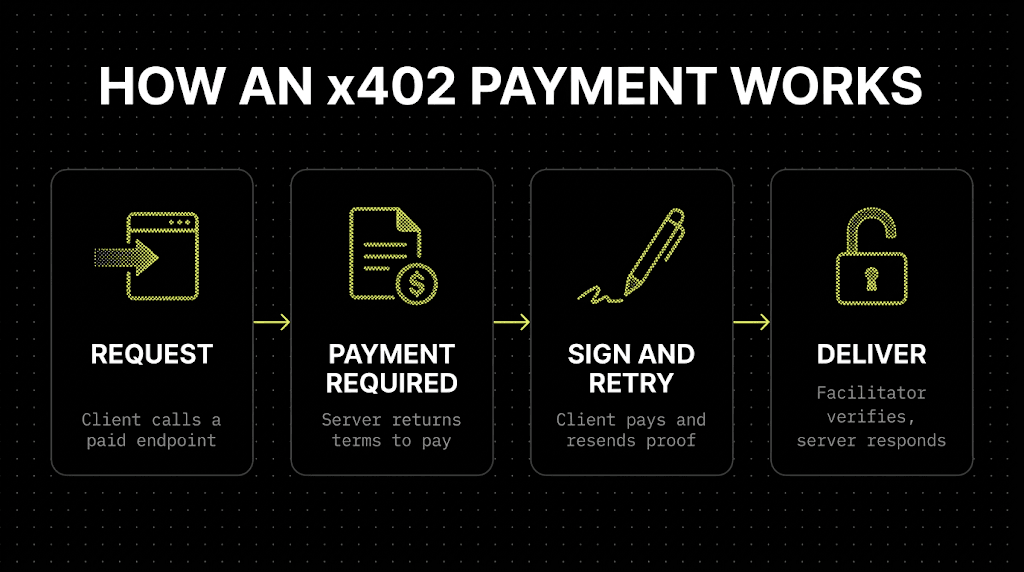 Settlement is typically done using stablecoins such as USDC, which for both buyer and seller creates a programmable, internet-native unit of value. No need for a parallel billing channel.
x402 is also open, started by Coinbase but is designed to be used by anyone, including API vendors, without locking them into any specific Coinbase product. Governance of x402 is held by the x402 Foundation. This standard is of particular interest to those building autonomous software, machine commerce, or DeFAI systems more generally where models, wallets, and data services all interact through APIs and thus need to transact directly with one another.
The traditional approach to billing APIs assumes a "human customer" at the center of the process. Someone signs up for an account, enters their payment details, chooses a plan, is issued an API key, and is prompted to approve each renewal of service. That works for SaaS procurement, but completely breaks down for autonomous software.
An AI agent does not want a monthly plan when it needs one request, and it cannot handle account recovery or card declines on its own. It needs to call a paid API, authorize a small payment, and continue its task. For a payments agent acting in real time, standard billing was built for teams and subscriptions, not for machine to machine payments.
In production, the failure points are consistent:
At protocol level, x402 is simple to explain, hard to get right. It consists of three actors. One is the client (app, bot or AI agent). The second one is the resource server for the paid endpoint which the client wants to access. The third one is the facilitator who checks payment proofs for validity and bridges the HTTP flow with the onchain settlement. You can find the official x402 specification of the x402 standard here.
A typical x402 payment protocol flow looks like this:
Payment and authorization happen synchronously over HTTP while funds settle onchain, so x402 feels immediate to the client even though the guarantee is provided by the underlying crypto rails.
For technical teams, the design choices here really matter: How long is a quote good for? Can a payment proof be used for a whole batch of calls, or just one? These trade-offs affect fraud resistance, throughput, and developer experience.
x402 is "chain aware" rather than "chain exclusive". Current implementations center around Base, Ethereum, Polygon, Arbitrum and Solana. The most practical settlement currency is likely to be USDC due to broad support and familiarity with the infrastructure providers.
The facilitator model enables the protocol to be used without each API provider building a payment processor. The facilitator verifies the payload, checks the policy and facilitates the transition from the HTTP intent to the settlement (hosted or self-hosted).
| Ecosystem choice | What it changes |
|---|---|
| Base or other EVM chains | Wallet tooling, signature formats, settlement assumptions |
| Solana support | Different account model and operational tooling |
| USDC as default asset | Predictable pricing and lower volatility risk |
| Hosted facilitator | Faster launch, less control over policies and metadata paths |
| Self-hosted facilitator | More control, more infrastructure ownership |
It feels like we hit a point where DIY build outs stops being just "middleware" integration and actual decisions get made around how something is hosted (e.g. hosted x402 facilitator vs self-hosted). And even then, there are trade-offs made around observability and privacy, as well as how much of the payment logic lives within your own DIY stack. When you add multi-chain settlement, wallet funding, and gas sponsorship for autonomous agents to that, suddenly the question shifts from how to wire up a spec to actually running a reliable payments system.
For API providers, x402 is more than a payment protocol, it is a new API monetization strategy. Providers can now charge per request at the protocol edge in stablecoins and no longer need the old stack of user accounts, card vaulting, subscription management and invoice tracking.
To monetize API access, teams can turn a model endpoint, a data feed, or a premium analytics route into a paid API with direct pay per call economics. In this way, teams can test various API monetization models without having to design around different pricing plans first.
A practical x402 API monetization strategy tends to differ from conventional SaaS billing:
The business logic does not go away, but x402 moves the payment primitive closer to the request, which fits autonomous consumers far better.
For most teams, integrating x402 into their existing application stacks happens through middleware and SDKs, rather than re-implementing the protocol from scratch. Typically, you start by adding a payment check into the backend of an existing web service (an Express, Next.js, Python, or Go service), mark the relevant routes as paid, and have the server respond with an HTTP 402 status code along with the payment terms in a machine-readable format. On the client side, the wallet signs the generated payment payload and resubmits the request to complete the payment.
While completing the first demo was relatively easy as developers can easily protect a route, fund a wallet with USDC and see a paid call complete within minutes, this success hides the true complexity of agentic payment systems: the client now controls money.
When the client is an autonomous agent, control of the signing key of the agent wallet becomes the core design problem. What is to prevent the agent from emptying its balance by issuing bad prompts, by using adversarial tools, or by constructing recursive loops? Designing a self-built agent wallet that signs real value transfers is not a detail of minor importance. It is a high-risk security boundary.
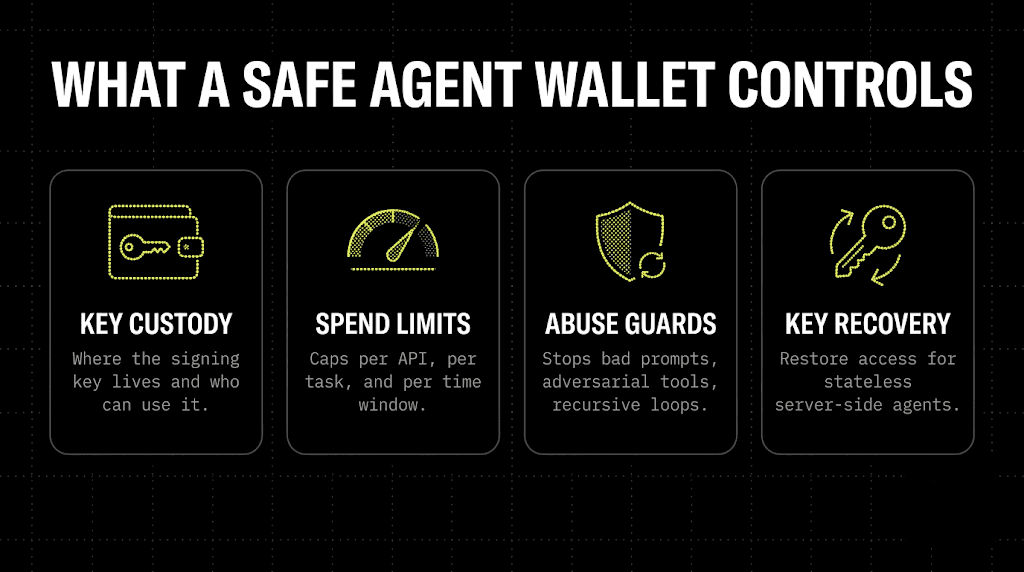 Treating x402 seriously means integrating it with a wallet architecture, a policy engine and transaction simulation. Mature crypto wallet development is highly relevant here because in x402 the wallet is both identity and payment mechanism. If key storage, signing permissions, and delegated access are weak, the protocol can be correct and the system can still be unsafe. The real target is not to support x402, but to support x402 in a controlled money-moving runtime.
The main x402 security risks are not theoretical and they are the reason most DIY builds fail. The Coinbase x402 documentation is a great starting point for production hardening but wiring up to the docs is not enough.
Further, public research into payment channels has also highlighted the issue of metadata exposure. Specifically, payment payloads contain resource descriptions, URLs, and reason strings that are processed by the facilitator’s infrastructure before the payment is finally settled. For sensitive workloads, therefore, privacy review needs to be an integral part of the protocol design rather than an afterthought that can be cleaned up afterwards.
The gap between a demo and a production system shows up in a few areas:
This is the third honest breakpoint for DIY work. First it is easy to test the x402 payments function. Then it becomes very hard to test that the payments function stays correct in face of concurrency, retries, partial failures, duplicate messages, and evil automation. That's where engineering discipline matters far more than protocol novelty.
x402 payment process is greatly simplified, but compliance does not disappear. Payments with stablecoins can trigger the same KYC/AML checks, same exposure to sanctions, same consumer protection requirements and geographic restrictions as before. That "no account required" is very attractive to developers does not mean that in the end the same questions will not be asked: who is paying, who is behind the wallet, who is granting access.
The hardest problem is accountability. When an autonomous agent makes a payment which later gets disputed in a business workflow, who made the payment? End user, software operator, wallet custodian or the platform that exposes the paid tool to the user? There is no clear mapping for this in legal terms. It becomes even harder when the access model is account-free but the compliance model needs to be able to identify the responsible party.
The fourth place complexity really hits home is when teams can correctly implement x402 at the protocol level but still have open questions around who needs to be screened, what records need to be stored, and how an agent's permissions translate to a legal entity's authority to act. These questions are above the code but will shape out the architecture from the very beginning.
x402 matters more than allowing a single API to charge per call because it provides the web with a native payment response that can be acted upon by software. This is a significant change for agentic payments, moving from having an AI agent act as a passive user of prepaid tools to the agent being an economic actor that can compute value, authorize spending and continue to carry out a task without human intervention.
That foundation for AI payments and machine to machine commerce is concrete: a research agent can buy enriched data. A trading agent can pay for low-latency market access. A game economy service can pay another service for fraud scoring or identity checks. In each case, payment happens as part of the task itself.
x402 is not going to be the only protocol attempting to solve these problems. There will be others that focus on account abstraction, delegated authorization, escrow and offchain credit for example. But x402 payments will occupy a very powerful lane of functionality: stablecoin-settled, HTTP-native, per-request access for autonomous software.
As a product that x402 could fit within, the upside is a direct path to paid APIs, autonomous settlement and a cleaner interface between software demand and software supply.
The friction really starts at the borders of three areas: custody, security controls, and compliance. Getting those right early is a big part of how an experienced engineering team removes delivery risk. You can read our Web3 case studies if that is of interest, and Book a Call if you would like to discuss your specific use case and the implementation depth required.
x402 is an open payment standard built on HTTP 402 Payment Required. It lets apps and AI agents pay for APIs and other digital resources within a normal HTTP request, typically with USDC, without accounts or API keys.
The server returns HTTP 402 with payment terms to the client, the client signs the payment payload and retries with proof, the facilitator verifies it, and the server returns the paid content or API result.
When people talk about the x402 ecosystem they are generally referring to a set of blockchain systems including Base, Ethereum, Polygon, Arbitrum, and Solana. The extent to which you can do something will depend upon the particular facilitator, wallet and set of stablecoin rails that you choose to support in your implementation.
To monetize an API with x402, a provider marks paid endpoints, returns an HTTP 402 with machine readable terms and then grants access to them after valid payment proof has been submitted. This allows for pay per call API monetization, real-time settlement and much simpler access control than account-based billing.
API keys are used to identify and authorize a caller within an account system. x402 ties access to a payment event. Therefore, the caller can pay for a request using a wallet instead of long-lived credentials. This is particularly suited for autonomous software and AI agent payments.