Smart contract development services cover architecture, testing, audit prep, and deployment. Here is what to expect and how to vet a Solidity or Rust team.

Smart contract development services should include contract architecture, implementation, testing, audit preparation, deployment and post-launch support. The most important criteria when selecting a service provider are coverage of relevant ecosystems like Solidity and Rust, a transparent security process and a proven track record of delivering production contracts on the relevant networks for your product.
Finding a serious smart contract development service is not easy, they are not just Solidity or Rust coders. They need a solid specification to start with. Many founders require the developer to create a protocol design and integration plan prior to the contract being written. Then there is the testing, the infrastructure to run the contract on, and the support after it has been deployed until it goes live. And this applies to almost all smart contract developments, whether it's an ERC-20 token, ERC-721 collectible, staking system, full DeFi protocol, game economy or onchain workflow.
Typical scope includes:
Beyond the contracts themselves, teams want ABI documentation, backend integration, front-end wallet flows, admin tooling, analytics hooks, indexer support, and more.
Even for simple token launches, contracts are not siloed projects. They are part of a larger product. Claim mechanics, vesting, the signer workflow, all of it has to be built into the wider blockchain development work around the contract. That is why a smart contract development company is often hired for the full build. The app layer and the launch matter as much as the contracts.
Pick the ecosystem early, it shapes everything after. A provider may look strong as a Solidity development company but be weak outside the EVM. That becomes a problem if your roadmap includes Solana, Near, or CosmWasm based chains in Cosmos. A team that has shipped on both stacks can point you to the right environment for your product, instead of steering you toward whatever they happen to staff for.
If you are building on Ethereum or an EVM chain like Polygon, Arbitrum or Base, Solidity is still the obvious pick. Most token, DeFi, NFT, and governance work runs on it. The standards are settled, and the tooling is mature. And there are more auditors working in Solidity than in any other part of Web3. The Ethereum developer docs are a solid place to start, and most EVM chains document things in a similar way.
Rust based smart contract development is different. On Solana, Rust gives access to high-performance programs and an account model built for parallel execution. On Near and Cosmos via CosmWasm, Rust offers strong type safety and strong control over state and serialization. The trade-off is a steeper learning curve, fewer auditors relative to EVM, and a smaller hiring market. Solana’s official documentation is a useful starting point, though production delivery still depends heavily on team experience.
Here is the practical comparison that most founders care about:
| Factor | Solidity | Rust |
|---|---|---|
| Main ecosystems | Ethereum, Polygon, Arbitrum, Base, BNB Chain, Optimism | Solana, Near, Cosmos via CosmWasm |
| Learning curve | Lower for EVM-focused teams | Higher, stricter language and chain-specific models |
| Audit and security tooling | Very mature, strong static analysis and auditor coverage | Improving fast, but fewer auditors and less standardization |
| Developer tooling | Hardhat, Foundry, ethers.js, OpenZeppelin | Anchor for Solana, CosmWasm tooling, Near SDKs |
| Hiring and talent pool | Larger global pool, easier to hire Solidity developers | Smaller pool, harder to hire experienced Rust smart contract engineers |
| Ecosystem maturity | Highest for DeFi, tokens, DAOs, NFT standards | Strong for performance-focused systems, but varies by chain |
Solidity and Solana teams are not interchangeable, and that gap shows up right here. For an EVM-first product, you want someone who lives in Solidity day to day. Proxy contracts, ERC-20 and ERC-721 variants, the audit findings that keep coming back on the EVM, that should be second nature to them, not something they look up. Solana is its own world. The dev needs hands-on Anchor experience and has to think in the account model from the start. PDAs (program derived addresses) get designed carefully. CPI (cross-program invocation) has to be handled with caution. And the tests have to go deep enough to catch a broken instruction before it ships.
Having a provider that supports both stacks is highly useful for those still undecided or already planning the expansion to other ecosystems. This applies especially to web3 smart contract development services for exchanges, wallets, DeFi, gaming and infrastructure products.
The most reliable projects follow a defined delivery process. Call it risk control, not red tape.
In practice, a solid process runs like this:
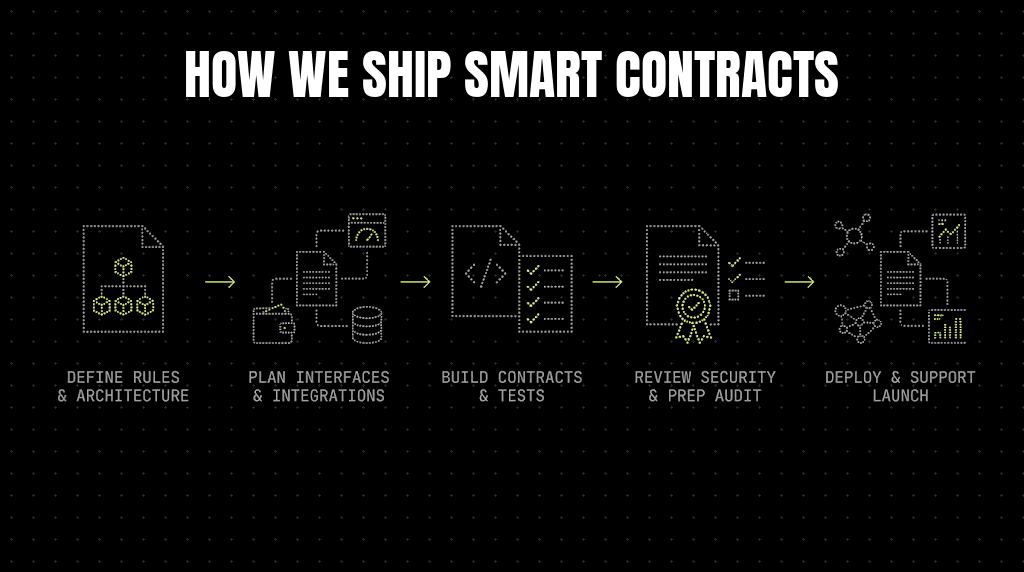 Good smart contract development services follow this kind of process end to end. Hiring one developer and hiring an agency are different decisions. A single developer can write solid contract code. An agency also owns the test strategy, the deployments, the audit coordination, and keeps integrations from breaking when the protocol changes partway through.
Security in smart contracts is not a single event, but rather a way of working from the very first architecture sketches to the post-launch operational phase. This is especially true for DeFi smart contract development services. Here, a single tiny mistake in the logic could cause problems with accounting, permissions, liquidation or even the token flows, and is hard to reverse.
Evidence of audit readiness is one of the strongest signals of quality. A team that is audit-ready can explain your invariants, trust boundaries, emergency controls, and upgrade logic, as well as how each test suite checks a specific part of your contract's behavior. This is not the same as treating your auditor as your first real reviewer.
In practice, the useful security indicators come down to these:
If your shortlist can't talk you through audit preparation, test strategy and post-deployment controls, they are not ready yet. The way a team describes its own process tells you most of what you need to know, and that shows up well before launch.
When you compare smart contract development services, the choice is in part technical and in part how you expect them to deliver on their promises. A nice sales page does not automatically qualify someone to work with you. You want to make sure the team can work in your technology stack, communicate risk properly and execute on a specification to mainnet without constant intervention.
Chain and product is a good place to start. A company that predominantly does ERC-20 token deployments, for example, is likely to be a poor fit for a lending protocol, game economy or even a Solana program with custom account architecture. A solid smart contract development company is likely to have relevant examples of work by product type and chain, even if some of the details are private.
Signals worth paying attention to include:
The real choice is between a specialist freelancer, staff augmentation, and an agency. A single expert works fine when your architecture and security review are already set. A small cross-functional team is the safer call when contract work is tied to a launch date and sits next to app development and an audit. We break this trade-off down fully in our web3 development services guide.
If you are comparing different providers for a project and would like a technical second opinion on scope, architecture or even on the given ecosystem, it's best to book a call or continue the discussion on Telegram before you start building. A short review of the contract, test cases and the audit process should give you a good indication if the given provider fits your needs or not.
The provider should take full responsibility for the entire journey from architecture and contract specification through testing, audit preparation, release, and ongoing support. If the provider just writes the contracts and drops them in your lap for you to implement, then the majority of the risk of successful delivery will have shifted to you.
Choose based on product fit, network strategy and team constraints. For Ethereum, Polygon, Arbitrum and Base, Solidity is usually the practical choice, since the standards, tooling and audit market are more mature there. Rust is the better fit for Solana, Near and CosmWasm based projects in Cosmos, when you actually need those ecosystems or their execution models.
A team of experienced Solidity developers is used to working within EVM patterns, tools and standards. A Solana smart contract development company, by contrast, would typically be fluent in Rust, Anchor, account validation, PDAs, instruction design and Solana-specific testing. The teams share experience across blockchains, but the engineering model is very different from Solidity development.
If you have the core product management, architecture, security review and deployment processes already in place within your organization, then direct hiring would likely be the preferred route for building out your team. A team that can handle the entire contract delivery life cycle from spec to launch is usually better brought in through an agency. The question isn't who can write code, it's who owns the risk from spec to launch.
Yes. On top of traditional finance logic, DeFi logic adds a layer of complexity with respect to accounting, oracle assumptions, liquidation paths, etc. Additionally, the various incentives that are in place also increase the complexity of the system and add even more edge cases that can have disastrous consequences. Therefore, the requirements for an architecture review, for the depth of tests that need to be conducted, and for an audit, are increased.
In addition to the general information about their experiences, ask them to describe specific networks they have deployed on, the specific standards they have implemented, their test harness or test process, their process for handling contract upgrades, how they prepare for audit, and how they hand off the work of deploying new services to other teams. A strong candidate can describe these things in significant detail and describe actual experiences, rather than just listing out a set of bullet points of features they claim to have implemented.
Sometimes, but not always. Often it is wallet integration, admin tools, indexers, event listeners, and even whole backend services. So it's worth figuring out early whether you are including them in scope, as they can heavily influence the design of the contract interface and events, and you should design those to be used throughout the whole product, not just the chain layer.