A crypto launchpad runs a project’s first token sale through smart contracts. Here is the architecture, allocation and vesting logic, and security a build needs.

A crypto launchpad is a product and contract stack that runs a project’s first token sale, enforces allocation and vesting rules, and moves buyers from deposit to claim before the token reaches open trading. If you are deciding whether to build one, the hard part is not the sale page. It is the contract architecture, the compliance gates, and the launch mechanics, all of which have to hold under adversarial conditions.
A launchpad hosts the initial token sale for a new project, covering investor onboarding, eligibility checks, deposits, allocation, vesting, and the handoff into a token generation event and listing. What it does not do is run the token’s market after that, and that boundary defines where the engineering work ends.
Fundraising labels depend on the venue. An ICO is a direct sale run by the project. An IEO is hosted by a centralized exchange. An IDO is tied to a decentralized launch into a liquidity pool, facilitated by an AMM. An ido launchpad sits one layer before the pool goes live, controlling access and sale terms. Many ido launchpads also manage staking-based access, allowlists, KYC and distribution schedules.
A full exchange runs markets and trading risk continuously. A launchpad runs the first sale, moves funds and tokens into their post sale state, then hands off. Teams evaluating Web3 fundraising options should keep this scope in mind to avoid building an exchange by accident.
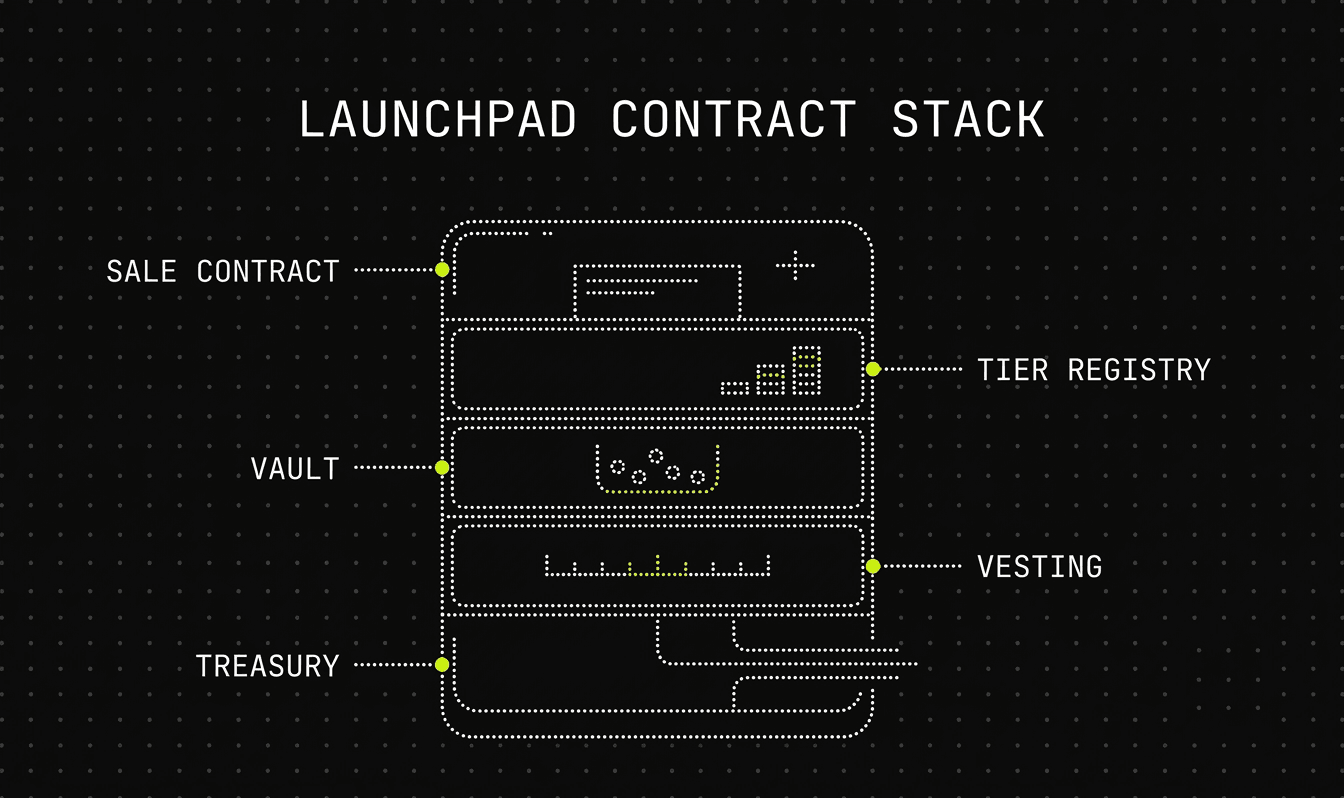
A small set of contracts, all with different trust assumptions, sits at the core of every crypto launchpad: the sale contract, the token vault / distributor, the vesting contract, the staking / tier registry, and the treasury logic. Each contract has a different set of privileges and therefore a different way to fail.
For most ido launchpad development, it is better to keep these components separate rather than bundling them into one smart contract. This limits the impact of bugs, makes audits easier, and lets you update single parts without affecting the rest. A tier engine reads staking snapshots. A sale smart contract reads a Merkle root for the whitelisting. A vesting contract is often deployed per sale, or reused with different schedules.
This interaction pattern should be deterministic. Admin configures sale parameters, users prove eligibility, deposits are accepted for a fixed window, then the sale closes, proceeds move to the treasury, and purchased tokens go into a claimable or vesting state. Soft cap failure paths must be explicit and refundable. Every transition needs explicit invariants, and no step should rely on an admin manually moving state between contracts during a live sale.
Serious teams treat launchpads as smart contract development, not a frontend problem.
| Module | Core responsibility | Common design mistake |
|---|---|---|
| Sale contract | Accept deposits, enforce caps, finalize or refund | Mixing access control, pricing, and fund movement in one path |
| Tier registry | Read staking or snapshot state for eligibility | Using mutable balances without a snapshot boundary |
| Vault or distributor | Hold token inventory and release to buyers | Funding the wrong token amount or wrong token address |
| Vesting contract | Time-based unlocks and claims | Off-by-one periods, early unlock paths, broken claim math |
| Treasury logic | Route raised assets and platform fees | Granting withdrawal rights too broadly |
Allocation design determines who gets into the round and how much they can buy. A tiered model grants guaranteed access and larger allocations to users who stake the platform’s own token. **** A lottery model admits more users than there is inventory for, then selects buyers at random. A hybrid model combines the two: guaranteed minimums up top, lottery access for the rest. Overflow models let everyone commit, then scale accepted buyers down pro rata if the round is oversubscribed.
What looks simple in product copy turns into a precision problem in contract logic: caps, rounding, wallet limits, oversubscription, and decimals between the asset paid in and the token sold. Until the contract determines the exact token allocation, settlement math must preserve refunds and purchased amounts exactly.
Where teams get this wrong is usually not the UI, it is the edge cases in allocation state:
This is not cosmetic. Unfair distribution damages trust exactly when users are locking capital into a new token.
Launchpads rarely release the entire purchased amount at sale close. Instead they use a vesting schedule: a TGE unlock, then a cliff, then a linear or stepped release. Linear is smooth and easy to track. Stepped is easier to operate because claims come in discrete tranches. The choice depends on market structure, the project’s treasury model, and how fast it expects usable circulating supply.
A claim contract has to answer four questions the same way every time. How much did the buyer purchase? How much unlocks at TGE, and what stays locked? How much has already been claimed? Get any of these wrong and the claim math drifts. If the project plans to create its own cryptocurrency, vesting belongs in supply planning, not bolted on after the sale mechanics are coded.
Bugs here are particularly bad because distribution moves tokens from platform-controlled accounts to holders’ wallets:
On public chains such errors are permanent, and changing a published schedule after users have bought into it creates governance, trust and security issues.
For most launchpads, wallet connect plus a buy button doesn’t cover it. You need whitelisting, jurisdiction filters, KYC/AML hooks, and explicit permissions for who can configure, pause, finalize, refund or withdraw. Much of this lives off-chain, but eligibility still has to be represented on-chain, typically via Merkle proofs, signed permits from a backend verifier, or a registry contract.
Access control is where your product assumptions collide with your legal assumptions. DIY teams tend to underestimate two things. First, frontend geofencing is not enforcement: if a restricted wallet can call the sale contract directly, there is no gate. **** Second, admin roles are rarely one-dimensional. The address allowed to pause the sale should not be the one allowed to drain treasury or change the Merkle root after registration closes. A weak role model creates legal exposure if restricted users get in, and security exposure if privileged actions are too broad.
A mature design includes: role-based permissions, immutable sale terms where possible, pause scopes that are narrow, and logs for every sensitive state change.
After the sale ends, the launchpad’s work switches from allocation to market readiness. For an IDO on an AMM-based launchpad, this means seeding the pool with the token and quote asset, setting the initial ratio, and locking LP tokens or sending them to a timelock. The launchpad takes the token to listing. It is not where the token trades after that.
Liquidity is where a correctly executed launch can go wrong. A thin pool makes price discovery volatile, and early volume can take the price far from the implied sale valuation. If the initial ratio contradicts the sale terms, the market notices immediately. If LP is not clearly locked, the market reads that as rug risk even when the sale was legitimate. Poorly seeded liquidity turns a correct launch into a credibility failure within minutes.
Sale contracts are typically deployed in hostile environments. The contract manages assets over time, and admin power is granted at some point. That creates reentrancy risk around deposits, refund paths and claims, plus ordering risk on scarce allocation, where one buyer can buy ahead of others.
The less obvious risks deserve more attention. If you price with an oracle or a TWAP, understand the manipulation windows before mainnet. If allocation depends on a last-minute whitelist or snapshot, transaction ordering can produce unfair outcomes even when the arithmetic is correct. **** Upgradeable contracts add proxy administration, initializer safety, and storage layout to the threat model.
Before deployment, teams should expect targeted review on a few non-negotiables:
A launchpad’s code should go through a full blockchain security audit before mainnet. The attack surface is financial and procedural, and a public launch on a hard timeline leaves no room for silent arithmetic bugs.
White label crypto launchpads work when the sale format is standard, the chain is supported, and compliance requirements are light. They get a team to market quickly with proven flows for registration, deposits, allocation and claims. The tradeoff is rigidity. As soon as you need non-standard tier math, unusual vesting schedules, chain-specific integrations, or a custom admin and compliance model, the abstraction starts to fight the product.
Custom build makes sense when sale logic is part of the platform’s moat: overflow models with project-specific rules, a staking system already live, sales on non-EVM chains, deep KYC integration, or treasury paths needing stricter controls than a template provides. Here you are not looking for a launchpad development company to assemble a UI, but for a team that can design contract boundaries, audits, and launch operations coherently.
At DESH we treat launchpads as a product system, scoping sale flow, smart contract development services, admin tools, QA and launch preparation as one piece of work, as we did for Ephemeral and Platnum. The launchpad should fit the project’s timeline, not sit beside it as a microsite. If you need a Web3 development partner to scope a launchpad build, book a call and review the architecture before committing to a direction.