What separates elite smart contract development companies from average ones, how to vet them before signing, and which engagement terms protect you.

The vast majority of on-chain failures are not failures of concept. Rather, most on-chain failures are caused by code that was rushed, not fully reviewed, or handed off to an inexperienced team without proper knowledge of the protocol in question. Mistakes made in selecting the wrong smart contract development companies to build with at the onset of a project can compound to create months of additional work for subsequent teams, delayed security audits, and repeated deployments of suboptimal contract configurations that bleed launch window.
The following sections discuss the critical differentiators between solid blockchain development shops and mediocre generalists, present a framework for evaluating shortlisted smart contract development companies, and outline key terms and conditions with which your client should be familiar in order to negotiate a healthy engagement. This content is designed to be concrete, fully-auditable, and not wildly subjective, so that it can be equally applicable to assessing the qualifications of a bland but capable company with a dull website and generic pitch deck, as to highly-regarded but thinly-staffed boutique firms.
Selecting the wrong vendor to deliver a part of a system not only delays the delivery of the whole system but also creates new types of risk that will continue to create problems after the system has been deployed.
The rework required by a failed mainnet release typically adds months to the overall delivery date of a project and multiplies the engineering hours required to fix what could have been corrected at the architecture stage. Contracts are immutable once deployed, so a flaw that would take an afternoon to resolve in a design document becomes a migration, a redeployment and a liquidity move after launch.
Most classes of blockchain security risk originate in architecture and implementation decisions, not in the review that follows them. An audit surfaces what is already there. It does not redesign an access control model, restructure an upgrade path or replace an oracle dependency, which is why the choice of development team constrains how much an audit can realistically fix.
The DeFi hacks that affected various protocols in 2025 even triggered inquiries from regulatory bodies. The hacks also caused a great loss of confidence on the part of institutions. Teams that cannot show a documented independent security review before deployment also face harder conversations with launchpads, exchanges and institutional counterparties, which increasingly treat that review as a precondition rather than a formality. The scope of such a review is covered in this breakdown of blockchain security audit scope and risks.
How scope actually works for a typical founder-led engagement.
The final deliverables for fully complete smart contract code will include the contract architecture, the Solidity code itself, full unit and fuzz test suites, integrated deployment scripts with automated build and test pipelines for continuous integration, and a comprehensive upgrade strategy.
Note also that development and auditing are very different disciplines. A team auditing its own code is a structural conflict of interest, which is why production code should be reviewed by an independent party before it reaches mainnet, as detailed in these smart contract security practices.
Many firms deliver dApp frontend work alongside contract development, and that should be treated as a separate scope with its own quality metrics. Frontend delivery speed says nothing about contract engineering depth, and the two are usually staffed by different people. The evaluation criteria for that side of the work are covered in the dApp development companies guide.
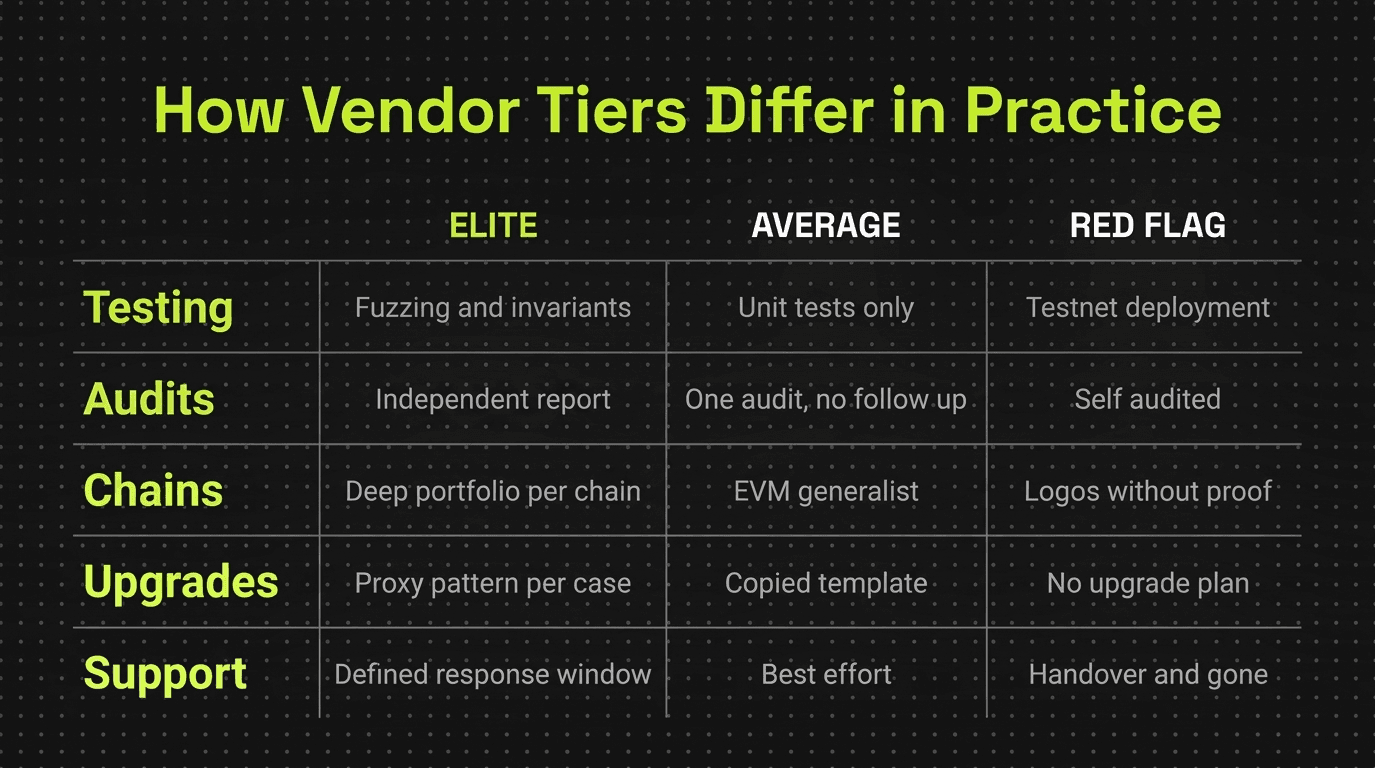
Five indicators separate teams that ship production grade contracts from teams whose code becomes someone else's remediation project. Each of them is verifiable before a contract is signed, which is the point: none of this requires taking a vendor at their word. Patterns of failure in deployed code are covered in this breakdown of how on-chain attacks execute.
Even experts in Solidity for the EVM cannot immediately start programming on Solana (Rust/Anchor) or Aptos/Sui (Move) or StarkNet (Cairo). Look for experience with specific portfolios for specific chains, not just a pretty logo on a wall.
Beyond basic line coverage (95%+), then, elite Solidity development shops are also able to go to town with smart contract fuzz testing (Foundry/Echidna), invariant test suites, and even formal verification.
They have a strong track record of getting named, on-chain protocols to high TVL, and can back up "DeFi experience" claims with proof of actual, audited, working deployments.
The proxy upgrade patterns of UUPS, Transparent or Diamond (EIP-2535) also need to be aware of. An in-depth analysis of the most common critical vulnerability of misimplemented upgradeability is available in this guide to proxy patterns, storage layout and migration risks.
Although rarely discussed in pre-contract conversations, bug bounty coordination, emergency pause functionality, and hotfix response times are all terms you should push for prior to engaging the smart contract development firm for production work.
Audit smart contract developers before sign. This audit should include a review of code, references and technical discussion with developer.
A GitHub repo audit of a smart contract developer's coding practices reveals their engineering culture within minutes of reviewing the repository. Are there a sufficient number of commits to review? Is the ratio of tests to code adequate? Are there CI/CD configuration files and even NatSpec documentation files?
Turning to references for blockchain vendors, we can ask very specific questions. Did they identify any architectural issues prior to us finding them? How would they deal with a post-audit bug? Perfunctory words of praise don't tell us much. The way they respond to real incidents is everything.
Evaluating a smart contract firm can be as simple as a scoping call where you can ask questions such as: how would they implement a TWAP oracle that is not vulnerable to flash loan attacks? Request the past deployment addresses and verify their past activity, TVL history on sites like Etherscan or Solscan, as well as how to trigger emergency functions on a deployed contract.
These vendor red flags can be structural as well as situational. It is possible to identify delivery failures prior to signing the contract that no audit can reverse.
The red flag is not that a vendor offers security work. It is a vendor presenting its own internal review as a substitute for external verification. Ask directly which independent firm will review the code, when that review is scheduled, and whether the report will be published. A vendor that treats independent review as optional, or leaves it out of the delivery plan entirely, is the one to walk away from.
Testnet deployment is not the same as running a battery of unit tests (using Hardhat or Foundry), integration tests, and fuzz campaigns. If a potential smart contract vendor doesn't have a formal test suite for their code in production, then they are not working at a production-grade level, and you will have serious problems when you deploy smart contracts on the blockchain for development.
Finally, the IP ownership of smart contracts must be transferred to the client in the smart contract itself. The source code, the deployment keys and all documentation must be transferred to the client on final payment. Vague clauses or vendor default clauses are a major legal liability and should not be down played as minor issues.
These profiles are merely examples for you to use for your own evaluation of potential developers, rather than a ranked list.
OpenZeppelin smart contract audit reviews form the basis of many production protocols today, whilst much of the ConsenSys development work has been on the protocol layer of the Ethereum infrastructure. These companies are generally best suited for well-funded protocols with long procurement cycles.
The mid-market DeFi development firms, where DESH Group operates, typically will engage a client faster and have senior engineers actually working on the project throughout the development phase rather than purely on architecture. Typically Series A-stage Web3 protocols are on the EVM chains (Ethereum, Polygon, BNB).
Developing a smart contract on Solana, written in native Rust or with Anchor, is typically far better served by a smart contract development shop fluent in Solana smart contracts rather than hiring a generalist EVM-centric shop.
The structure of a good blockchain development contract can prevent all sorts of disputes.
A reasonable structure keeps the upfront portion to roughly 20 to 30 percent, with the remainder tied to gated events defined in the contract terms. That places delivery risk on the vendor, where it belongs, without starving the engagement of working capital.
Incorporate the review gates for your milestone payments into the contract: have each release require the signature of your technical advisor or of a third-party reviewer that you have nominated.
Only after you have established trust with your vendor for fixed scope work, retainers are suitable for ongoing maintenance and for incident response. SOW smart contract terms should specify languages, target chain IDs, the audit firm that is to review the agreement and any other terms and conditions. Furthermore, the agreement should specify how handover will occur.
No instinct for choosing the right engineering partner. Instead use a repeatable process for selection.
Start by scoring candidates on five weighted criteria: chain and language fit at 25 percent, security track record at 25 percent, test coverage standards at 20 percent, scope transparency at 15 percent, and post-deployment support at 15 percent. Note that for high-value protocols, you may want to reverse weight these dimensions to put more emphasis on security.
Simply ask the potential engineering partner for a time they pushed back on a client's architecture decision and why they were correct. If they have stories for this type of question then you can feel comfortable they are true engineering partners. If not, then they are order-takers and you should look elsewhere for a smart contract partner.
Prioritize a paid discovery sprint as a short project before deciding to go with a developer to assess their communication, the accuracy of their estimates and other factors. This step should also be used by founders evaluating a frontend scope simultaneously to prevent costly scope conflicts at the project's kickoff. Teams benchmarking vendors against the criteria above can also review how DESH Group approaches smart contract development and structures delivery around independent audit gates.
Several verifiable differentiators separate elite and average smart contract development companies: independent audit history, competency with proxy patterns, capability with formal verification tools, and more importantly a list of mainnet deployments in relevant chains. Companies that cannot provide a set of independent audit reports, descriptions of past work with real clients, or an outline of how they handle upgrades to past work are companies that introduce significant delivery risk. The engagement structure and terms of work with proposed development companies matters as much or more than the actual company and its personnel. In order to protect oneself from such delivery risk, founders and CTOs should engage with proposed development companies in a series of incremental milestones with corresponding releases from escrow, with clear and definable audit gates for verification. Founders ready to move forward with a shortlisted vendor should request an independent audit report and relevant portfolio samples to then be benchmarked against the criteria outlined above.
What should founders look for when vetting blockchain development firms in 2026?
First, verify the developer's on-chain portfolio, for example an Etherscan profile. Next, ask for third-party audit reports from well-known firms in the space such as Trail of Bits, OpenZeppelin or Certik. It is also crucial to verify that named engineers have a public GitHub history and to ask for references from past clients who have projects in production, not testnet. It is also very important to verify engagement transparency, meaning whether the firm provides a detailed scoping document and milestone-based payment. Finally, beware of firms that cannot explain their testing in detail and also beware of firms that bundle auditing with development in-house.
Is a separate audit necessary if the development firm offers auditing?
Yes, independent audits are strongly recommended even if the development team offers an internal review. The conflict of interest inherent to a team auditing their own code means that they are likely to miss critical errors that they introduced to the code. Leading independent reviewers include Trail of Bits, OpenZeppelin, and Certik. Most institutional investors and launchpads require at least one external audit prior to a launch.
Why do protocols fail even with experienced developers?
The most common errors in smart contracts include inadequate threat modeling prior to starting development, lack of sufficient testing against real-world economic attacks such as those involving flash loans or the manipulation of oracles, and failure to take into account risks related to protocol composability when using third-party DeFi services and building on top of them. Many errors are caused by rushed development timelines and corresponding audit windows that are not long enough. Many errors also are caused by poor governance design that is not identified prior to deployment and subsequently causes catastrophic exploits in what would otherwise be secure smart contracts.
How long does a smart contract development engagement usually take?
Scope drives the range. A single token contract with standard mechanics is a matter of weeks including tests. A lending or perpetuals protocol with custom economic logic runs several months before an audit window, and the audit itself adds time that should be scheduled at kickoff rather than discovered at the end. The most common cause of overrun is not engineering speed but scope that was never written down precisely enough to estimate.