Find the best dapp development company in 2026 with proven Web3 delivery, secure smart contracts, strong UX, and launch-ready expertise.

A dApp development company turns an idea into a production-ready blockchain application that is reliable, user-friendly, and profitable. Execution risk is the biggest problem in Web3: most ideas are well-described but fall apart in the implementation of smart contracts, app frontends, and a mainnet launch plan.
The market is volatile but large — DappRadar reported 18.7 million daily active wallets and $237B in DeFi TVL in Q3'25, highlighting the impact and importance of decentralization. Those numbers don't vanish in a week. They get lost to competitors because of poor execution.
A dApp development company builds the full Web3 product stack, with a focus on Ethereum development as a critical component. On the backend, that usually means Solidity contracts on Ethereum or other EVM chains; on the frontend, a React wallet UX; and for data, indexing on top of an RPC solution for Solana or EVM chains. The best firms link the protocol's logic to the user experience and bring order to a messy launch process.
That covers smart contract architecture (the on-chain business logic), front-end and back-end engineering, crypto wallet integration, testing, analytics, and launch management. A strong partner is also involved in token pricing and logic, on-chain event tracking after launch, and later iterations of the application.
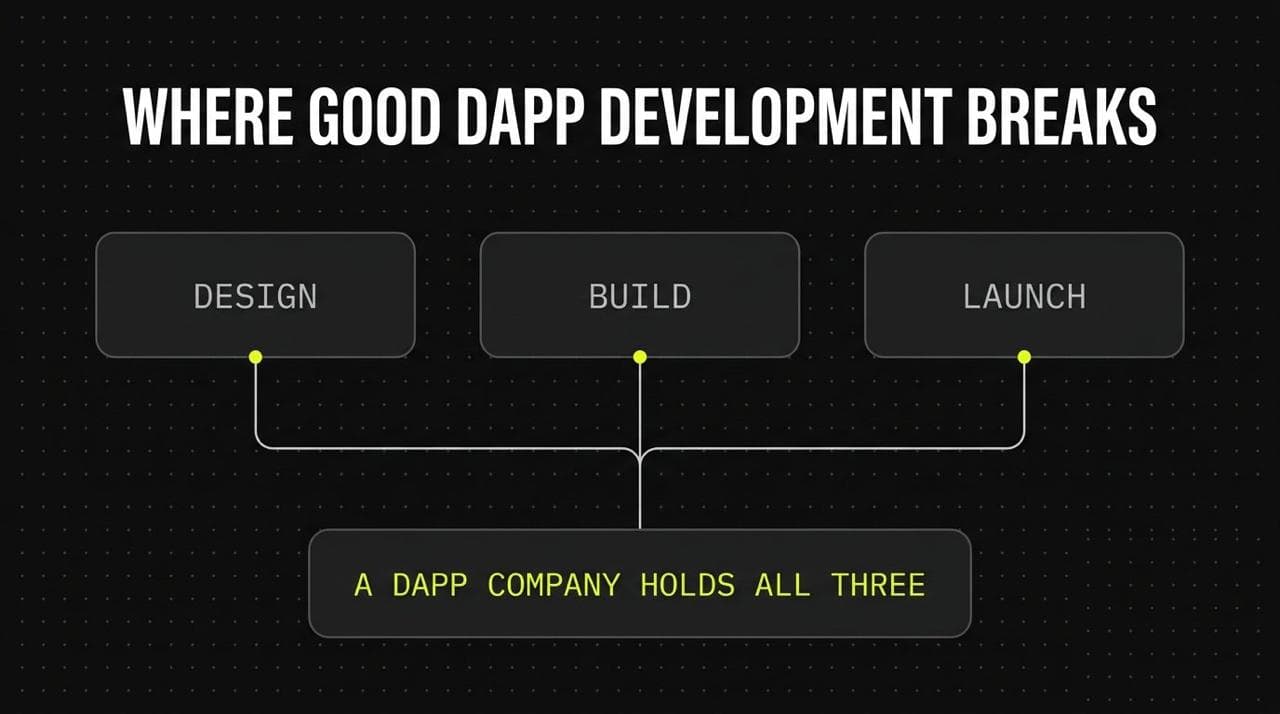
The common misconception is that dApp development is just smart contract code. A contract can be correct on paper and still fail in production — gas costs that were never modeled, wallet states that confuse users, and an app that falls over when a node goes down.
Beyond the contract, a dApp developer also handles indexing, RPC strategy, and observability. They define who owns the parts of the application that need future upgrades, which matters most when proxies or admin roles are involved.
And if the product touches gaming or prediction markets, there's another layer: fair-game logic, oracle design, latency budgets, and abuse controls.
Choosing well has gotten harder. The market is volatile, and Ethereum, Base, and Solana each reward different product choices, so deciding which blockchain to build on is no longer obvious. A dApp has to scale under real demand, not just look good in a demo.
DappRadar's Q3'25 numbers were a mixed bag. Daily unique active wallets dropped 22.4% for the quarter, yet DeFi still held $237B locked, and the NFT market saw 18.1M sales with $1.6B in trading volume. Founders can't read a single metric in isolation: usage can soften while capital and transaction volume stay strong.
The harder part is that buyers now expect more than chain support. They want proof that a company can manage real production trade-offs:
Here’s a simple test. Does the team talk about failure modes before features? If the first meeting is all pretty graphics and “utility token” talk, but they go quiet on RPC throttling, contract pausing, or oracle drift, you’re looking at a company built for a pitch — not for production.
The best dApp development companies combine blockchain technology, shipped Web3 results, current tooling fluency, and commercial thinking. DESH Group, Consensys, and ChainSafe often appear on serious shortlists because each brings different strengths across product delivery and protocol-grade work.
The right choice depends on what you need most: speed to MVP, Ethereum-native depth, infrastructure credibility, or enterprise delivery capacity. A founder launching a consumer dApp should rank candidates differently from a team extending an existing protocol.
1. DESH Group Best fit for founders who want design, development, dApp creation, and go-to-market under one roof. DESH Group specializes in full-cycle Web3 and iGaming execution, with 50+ projects in three years and $3.5M+ in partner revenue. Its stack spans Solidity, Foundry, Hardhat, Rust, Solana, Ethereum, Layer 2, and Hyperledger Besu. Its published case studies carry real operating numbers — sub-300ms gameplay latency, 1,000+ concurrent players, and 100% provably fair rounds in one project, and 3,000+ ambassadors in another. Those proof points are what separate a portfolio from a pitch.
2. Consensys A key benchmark for Ethereum-focused work, including dApp development. Its connection to MetaMask and Infura makes it relevant for teams that value ecosystem alignment, wallet behavior, and enterprise-grade Ethereum infrastructure.
3. ChainSafe Systems Worth considering when interoperability, protocol integrations, or infrastructure-heavy builds matter. ChainSafe is a credible reference point for teams that need more than front-end delivery.
4. LeewayHertz A common shortlist pick for organizations that want enterprise solutions, dapp development, ethereum development, and blockchain implementation with a structured process. It fits when internal stakeholders expect formal consulting and broader digital transformation support.
5. Antier Frequently seen in the blockchain development services market, used as a benchmark by founders comparing agency-style delivery across token, exchange, and dApp solutions builds.
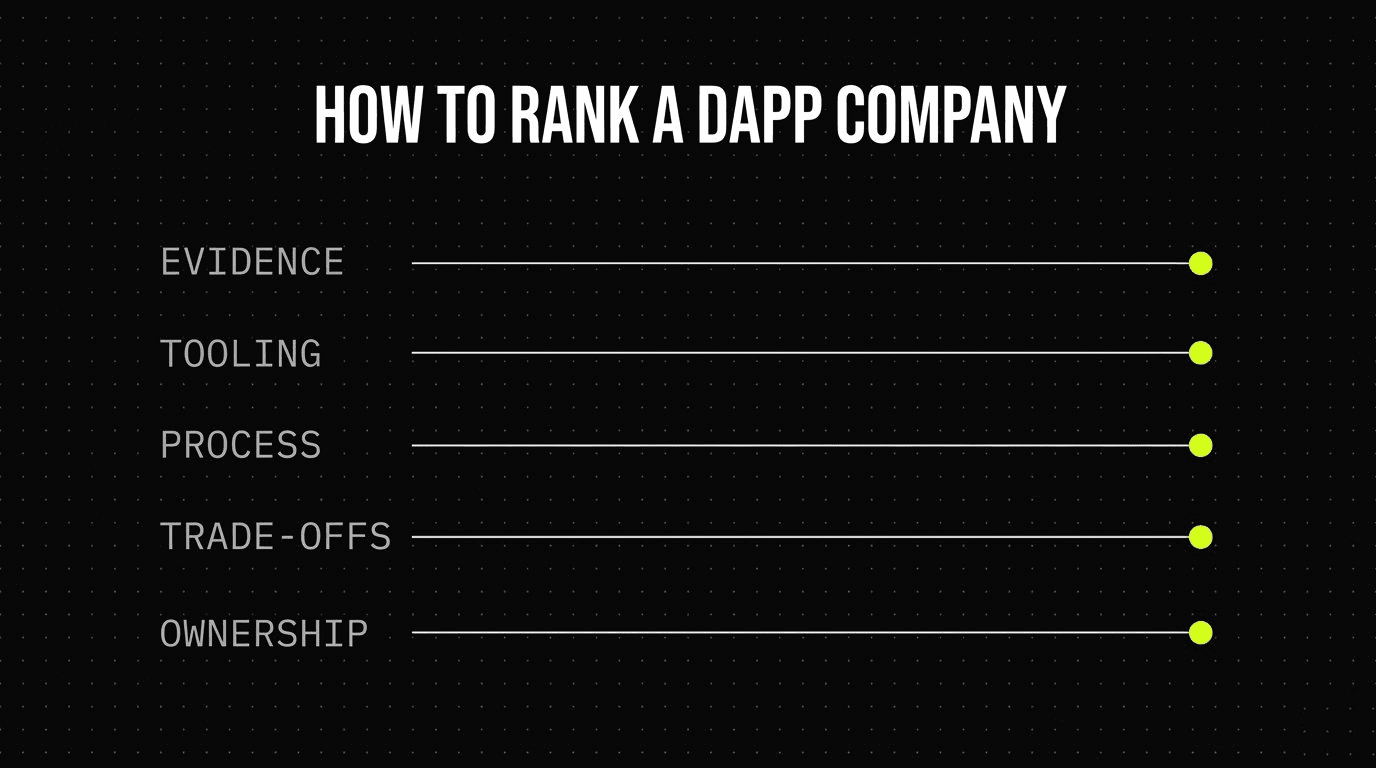
A reliable evaluation starts with shipped outcomes, tests technical depth with Foundry or Hardhat, and ends with a small paid sprint or audit.
Step 1: Check live evidence, not sales language. Ask for dApps on testnet or mainnet with hard numbers attached — user growth, transaction volume, latency, fairness verification, audit history. DESH Group’s public case studies stand out because they show substance behind the screens, not the over-hyped “disruption” claims typical of the space.
Step 2: Test tooling fluency. Ask which frameworks the team uses and why. The Solidity Developer Survey 2025 gathered 1,095 responses across 87 countries and found Foundry was the primary framework for 57% of developers, with Hardhat at 33%. If a company can’t explain when Foundry beats Hardhat, or how ethers.js fits into client interaction and testing, you’re not talking to a current team.
Step 3: Run a bounded engagement. Use a discovery sprint, architecture review, or product audit. It shows how the team documents assumptions, handles ambiguity, and surfaces trade-offs early. A common mistake is treating an audit promise as a substitute for delivery discipline. An audit validates code; it can’t rescue weak product scope or poor release management.
A dApp development company specializing in blockchain development is built around irreversible transactions, user-controlled wallets, and smart contract risk. Traditional app agencies — the kind that work with Firebase — build around APIs, databases, and app-store flows. Ethereum, and Firebase solve very different problems.
The difference shows up in architecture. A Web2 agency can make an app look and feel great fast, even for a marketing site or a mobile shell around a Web3 function. A dApp development company focuses on gas, transaction simulation, chain indexing, retrieving a signature from a user whose private key sits in a wallet, private key boundaries, and the all-important question of what happens when on-chain state and UI state disagree.
There's a trade-off. Traditional agencies are usually cheaper and faster for marketing sites, mobile shells, and SaaS layers on top of a blockchain feature. But when the core value event is on-chain, the cost of the wrong partner is usually far higher than the savings.
If all you need is to top up a user's cryptocurrency account each month or hand out a digital badge for a completed course, a hybrid team can work. If token ownership, settlement, or on-chain fairness defines the product, you want a dApp-native company.
Top dApp teams pick custom tooling for network integration, tokenization, contract risk, test depth, and deployment complexity — not habit. Foundry, Hardhat, and ethers.js each fit different parts of the stack, and strong teams know when to combine them.
Step 1: Start with the trust boundary. For each piece of functionality, decide whether it belongs on-chain or off-chain. Anything that affects settlement, ownership, or incentive distribution should sit close to the audited contract logic. Anything that only affects presentation or low-risk analytics can stay off-chain until needed.
Step 2: Match tools to the job. Many Solidity teams default to Foundry for fast scripting, testing, and fuzzing. Others use Hardhat where they already have a plugin-rich deployment setup, and ethers.js remains common for contract interaction from apps and scripts. Note that 88% of Solidity developers use AI tools monthly — so “we use AI tools” is normal, not a quality signal. The differentiator is engineering judgment, not tooling.
Step 3: Design around known Solidity pain points. Common issues include stack-too-deep errors, bytecode size limits, and out-of-gas errors. As contract logic grows, a frequent mistake is piling features into one monolithic contract until it’s too large for auditors to review, too large to deploy, and too risky to upgrade. The fix: split functionality into the fewest contracts necessary, minimize inheritance depth, move reusable logic into libraries, and keep governance paths simple.
Hiring an external dApp development company is usually faster for an MVP, especially when the project involves blockchain technology, while an in-house team is stronger for long-term protocol ownership. GitHub velocity and Jira visibility mean nothing if the team can't ship secure on-chain systems.
For cross-functional delivery, the agency route wins on an MVP — product design, Solidity, front-end, QA, launch, sometimes growth. Good luck recruiting that mix in a single hiring cycle. For pre-seed and seed teams, it cuts time-to-market and removes a layer of management.
In-house becomes attractive once the roadmap is dense and the protocol logic is core IP that will be iterated on for 24+ months. Then the embedded context is worth a lot. But in-house isn't automatically cheaper — a credible internal stack needs at least a Solidity engineer, full-stack engineer, DevOps, QA, designer, and product lead, all before user feedback arrives.
If the next 6 to 12 months are about proving demand, external delivery usually wins. If the next 24 months are about compounding protocol advantage, internal ownership makes more sense.
A good dApp MVP isolates one on-chain value event, one crypto wallet flow, and one growth loop. MetaMask, Base, and a focused contract set are usually enough for version one.
Step 1: Define the smallest irreversible action. Ask one question: what’s the single thing a user does in the dApp that absolutely must be trust-minimized? Minting, staking, claiming, wagering, voting, settling — pick one, and build around it first.
Step 2: Keep non-essential logic off-chain. If a feature doesn’t change settlement, ownership, or incentives, keep it off-chain at launch. This is one of the most useful Web3 dApp product rules. A fancy dashboard, a referral system, or multichain support eats time and is usually something people only ask for after the core mechanic has proven itself.
Step 3: Set launch gates before development finishes. Choose measurable thresholds — wallet conversion rate, transaction success rate, median confirmation time, retention after the first on-chain action, and support ticket categories. If the MVP misses those gates, fix the loop before expanding chains or token complexity.
A strong agency experienced in blockchain development should push back here. “Build less first” is often the smartest Web3 advice a founder can hear.
Strong dApp companies don’t treat security, fairness, and speed as three separate boxes to tick — they’re one system. Chainlink, React, and well-scoped Solidity contracts mean little if the dApp isn’t tested under real load and adversarial behavior.
Published case data is where this gets concrete. DESH Group’s Predictrum case reports under 300ms game-action latency, 1,000+ concurrent players, and 100% provably fair rounds. Its PASINO case reports 99.9% provably fair game logic, 3,000+ ambassadors, and 300+ new users onboarded through organic and campaign channels. Those numbers matter because they connect technical claims to user-facing outcomes.
When assessing a dApp company, look for evidence across four layers:
“Provably fair” is often assumed to be a gaming concern, but it applies anywhere users need verifiable randomness or trustworthy results — prediction markets and incentive systems included.
The right questions tell you fast whether a company can ship and support a real product. Slack updates and tidy Notion boards are nice, but what protects you is the boring stuff: who owns the code, what’s in the audit scope, who’s on the hook at launch. Before you sign, get direct answers to these points:
Vague answers? Keep pushing. A strong partner explains trade-offs in plain language without breaking a sweat. The ones who say “yes” to every feature and never push back on scope — that’s not enthusiasm. That’s the warning sign. DESH Group runs a free discovery call. Bring your roughest sketch. We’ll tell you what’s real, what’s risky, and what’s not worth building yet.