How DeFi lending works: pooled liquidity, utilization-based interest rate models, health factor and liquidations, and isolated market design.

DeFi lending platforms enable users to lend out assets that they hold in their digital wallets to protocols that operate on-chain marketplaces and earn interest at algorithmically set interest rates. This rapidly growing space has already seen massive volumes flow through it, with pooled lending protocols processing hundreds of billions in cumulative loan volume.
However, the mechanics behind DeFi lending are far from simple. Interest rate models, health factor calculations, liquidation incentive structures, and market isolation decisions all interact and have major implications for the solvency and capital efficiency of a protocol. Designing all of this correctly is what separates resilient protocols from fragile ones.
DeFi lending protocols allow users to lend and borrow assets on blockchain-based protocols with the possibility of variable interest rates set by smart contracts. Assets are typically over-collateralized to ensure the safety of all parties involved in the lending and are subject to liquidation should the borrower default on his or her loan obligations.
Aave and Compound operate by aggregating all depositor capital in smart contract pools, rather than matching individual lenders with individual borrowers. Borrowers then borrow from these pools, with interest accruing on a per-block basis and updating in real-time. The interest is then paid by the borrower, in a manner similar to traditional finance, but on a per-block basis as opposed to on a per-month basis, for example.
The amount of collateral required to take out a loan on a DeFi lending platform exceeds the amount borrowed to account for the fact that the platform has no way to look up a borrower's credit history or force them to pay back a loan through legal recourse. This is known as structural overcollateralization and allows borrowers to verify for themselves the collateral requirements before entering into a loan agreement without requiring identification.
A protocol makes the interest spread between borrowing and supply rates, and this interest flows to the depositors in the form of a rebasing token balance or a rising exchange rate against their originally supplied assets. This is detailed in the Aave protocol documentation and Compound documentation, where interest indices for supported asset markets are also described.
Interest rate models on chain for borrowing determine interest rates based on algorithms, as there are no order books or counterparty negotiations, and the decisions on the models can have large impacts on capital efficiency and on the stability of a protocol.
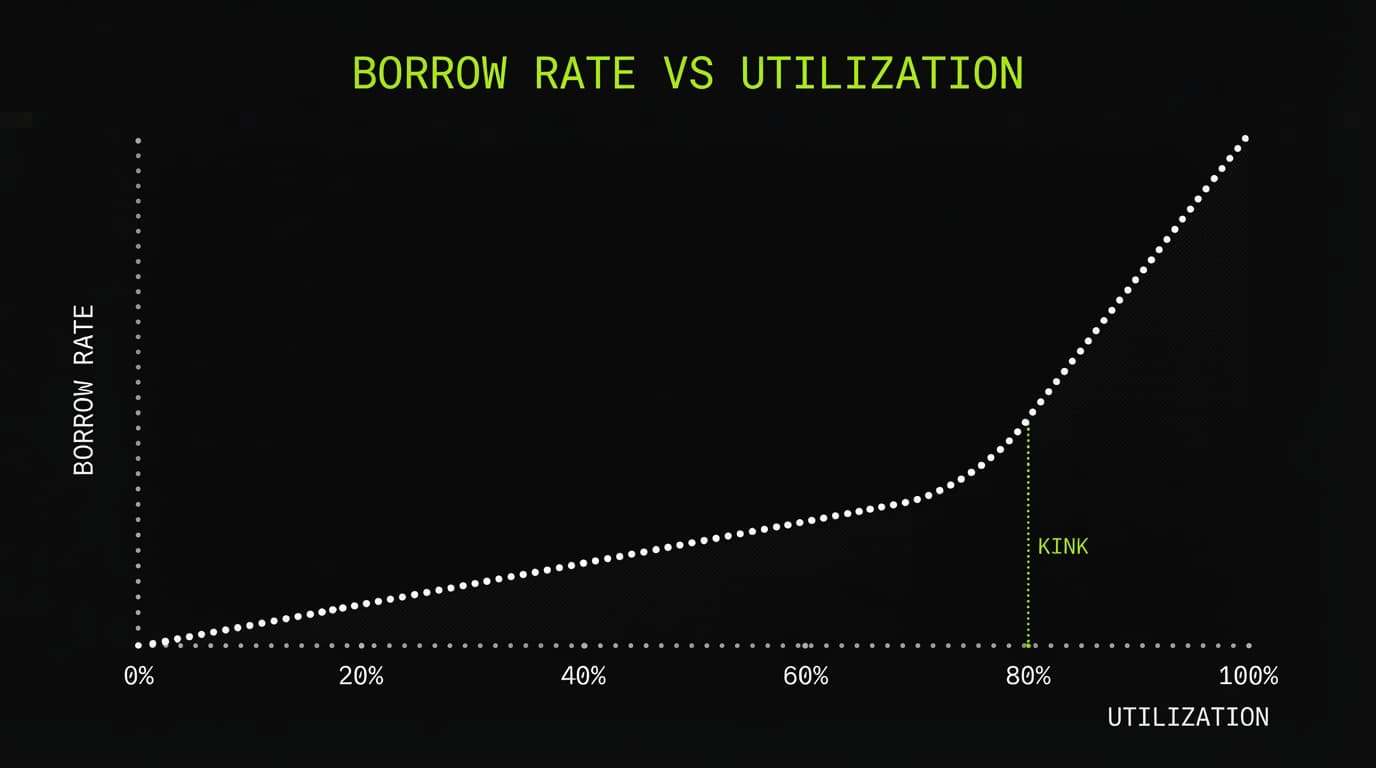
The kinked, or jump-rate, interest rate model is by far the most utilized model in current production protocols. A linear interest rate is applied up to a target utilization level, typically around 80%, at which point the rate "kinks" or "jumps" to a much higher level in order to discourage over-lending and subsequent pool exhaustion. Compound documents its model in the cToken interest rate implementation, and Aave documents its model in its interest rate strategy contracts.
The utilization rate is calculated as the total amount of borrows over the total amount of supplied liquidity. As the utilization rate approaches 100%, the interest rate jumps sharply to very high levels in order to strongly incentivise depositors to keep their funds in the pool. This single variable is used in all downstream calculations within a DeFi lending protocol and thus needs to be up-to-date and accurate in real time.
Votes by the governance DAOs for changes to the slope or kink of the interest rate for small changes can have drastic effects on capital efficiency and liquidity, and should thus be treated with similar respect to other events affecting the stability of a protocol. See Morpho's documentation on market parameters for a tightly scoped governance example.
Liquidation is the enforcement layer for on-chain credit markets. Its mechanics, incentives, and architecture decision all affect the risk profile of a protocol.
When a borrower's health factor goes below 1.0, their position can get liquidated. There are several bots monitoring on-chain data for such events 24/7 and immediately call liquidation functions when the case occurs. A liquidator then repays part of the outstanding debt and purchases the collateral at a discount, with the size set per asset in the protocol configuration, as detailed in the Aave documentation.
The bonus creates a conflict for liquidators to try to front-run other liquidators. This MEV hunting is then open to bots that try to capture the maximum bonus by engaging in gas auctions, which can in turn create further congestion on the network.
The lending markets of isolated assets, such as those developed by Morpho, are designed to be separate from other lending markets on the protocol. This ensures that any bad debt incurred in one market will not drain other markets and cause further loss. It is this class of failures that was seen in the oracle manipulation of cross-collateralized markets, covered in more detail in the smart contract exploits breakdown. Supply caps for individual markets also enable maximum loss to be bounded and allow for auditability of risk parameters per market.
Creating a lending protocol requires making a series of critical design choices across three highly interrelated facets: real-time interest rate functions that correctly price in the current level of utilization, liquidation mechanisms to maintain solvency in times of high volatility, and a marketplace architecture (pooled or isolated). A number of existing lending protocols, such as Aave (pooled) and Morpho (isolated markets), expose these design trade-offs and consequently embed the attendant risks within the architecture of the protocol. On the supply side, depositor positions increasingly follow the ERC-4626 vault standard. To build out a design for a new lending protocol, founders should stress test utilization curves and corresponding liquidation parameters against historic volatility for applicable asset pairs, and bring in experienced lending protocol developers as early as possible to uncover the protocol's various edge cases before they can cause harm on mainnet.
Smart contracts enable fully on-chain lending and borrowing via DeFi lending protocols. These contracts require borrowers to post collateral for a loan, typically exceeding the amount to be borrowed, and can automatically implement the terms and conditions of the agreement, including interest rate settlements as well as repayment terms. All steps and decisions are executed automatically without any human interaction.
Liquidation of a borrower in DeFi systems typically happens when the value of the borrower's collateral falls below a threshold set by the protocol (the liquidation ratio). In such a scenario, the position is liquidated by third party liquidators who, for their trouble, repay part of the debt and receive collateral at a discount, which they can sell at market. This serves as a safeguard for lenders to avoid being stuck with bad debt.
Isolated lending markets confine each collateral and loan pairing to its own market with its own risk parameters. If the value of one asset drops sharply, this only affects one market and not the entire platform. The possibility to list riskier assets or even newly created ones, on DeFi platforms is thus not posing a threat to all liquidity providers in one go.