In Q3 2025, crypto and blockchain startups still raised about $4.6B across 414 venture deals, which is the baseline for Web3 projects funding right now.
Galaxy also highlights how concentrated that quarter was: 7 deals accounted for ~50% of all capital deployed.


That silence after you send the deck is easy to call bad timing. It rarely is. More often, a few small misses stack up until the raise starts feeling heavier than the product work itself.
First comes the timing illusion. That same quarter, later-stage captured 56% of all capital in crypto and blockchain VC. In founder language, “later-stage” just means fewer unknowns. Investors can point to something real, and they don’t have to guess as much.
That doesn’t mean early-stage is dead. It means early-stage has to look calmer and more proven than founders expect, even when the product is still moving fast.
Then there’s information asymmetry, and it’s sneakier than people think. Founders talk product because that’s what they’ve been living in for months. VCs listen for what reduces risk and uncertainty, because that’s what the job turns into when the market gets selective.
This is where “how to raise capital crypto” turns into a translation problem. The same project can sound like a breakthrough or a guess, depending on whether the story answers the investor’s hidden questions without making them ask twice. In practice, that’s how to attract investment for web3 projects : reduce the questions they didn’t want to ask.
The third friction is credibility, and it shows up before anyone touches a spreadsheet. Credibility is the invisible API between your story and their decision: it decides whether a stranger leans in or moves on.
In Web3, token mechanics live inside that credibility layer too. Tokenomics doesn’t need to be a full lecture at this stage, but it’s part of what makes a project feel legible, especially when investors have seen enough messy allocations to flinch on instinct.
Put this together and the pattern is easier to see. Projects don’t get stuck only because they’re early. They get stuck because the room can’t place them quickly, and it can’t verify the team without doing extra work. That’s the fundraising landscape for Web3 projects right now.
That’s why the next part matters: a data room request usually comes after someone has a reason to take you seriously, and in crypto that reason often starts with an introduction that carries a name they already trust.
That “extra work” from the last section has a name. It’s the VC network – the set of people investors already trust enough to route new deals through.
A good way to see how real this is comes from a 2025 venture pipeline dataset analyzed in a University of Chicago / BFI working paper. Among scored deals – pitches that made it past quick skimming and into internal discussion – 44% came through co-investors, versus 25% inbound and 30% outbound.
The gap widens when you look at what actually converts. Deals sourced via co-investors were scored at 13.5%, versus 5.3% for inbound and 2.7% for outbound.

In simple terms, a co-investor intro doesn’t buy you a yes. It buys you seriousness. The pitch gets handled like a real opportunity, with a clear next step attached.
That’s what “warm intros beat everything” looks like once you put numbers on the pipeline.
Warm intros work because they compress uncertainty. A trusted person is doing a small part of the diligence upfront, even if they never say it out loud.
A short anonymized example shows how this plays out in practice. A Web3 team spent weeks on cold outreach with little movement – a few replies, lots of “send more info”, and almost no follow-up that forced a decision.
After two warm intros, the tone of the first calls changed. One came through a founder in the same ecosystem, the other through a co-investor. Suddenly the questions were specific: how the token structure avoids misaligned early supply, what the first distribution looks like, and which usage metrics would make the next round feel obvious.
No part of the product changed in that window. The routing did.
This is also why a fundraising checklist only gets you so far. It can help tighten the deck or sharpen the narrative. It can’t create the moment where someone trusted vouches for you just enough to unlock real attention.
Once that door opens, the conversation shifts. The question shifts from who knows you to whether you’re actually ready to raise. And that’s where timing gets practical – it behaves like a sequence problem you can actually plan around, which is the part most founders miss when they talk about strategies for Web3 to fundraise.
After the first warm calls land, a weird thing happens: the calendar becomes the easy villain. It starts to feel like you’re early or late, or you simply picked a bad week to ask for attention.
Most of the time, it’s none of that. What’s actually breaking is the order of operations, and the room can feel it before you do.
It usually starts with proof. The pitch is built on promise, but the signals aren’t there yet. So every meeting turns into “come back when…”, and the follow-up quietly dies.
Then the structure gets stress-tested. If token and equity conversations are still half-finished, investors can’t model outcomes without guessing. And guesses are where deals go to sleep.
Once those two gaps stack up, even friendly calls get cautious. People start protecting their time, because they can’t tell what they’re underwriting yet.
After that, the narrative meets daylight. If the go-to-market story only works inside the team’s head, the first serious questions will sound like someone trying to find what breaks.
Access is the last trap. Without ecosystem validation and credible warm paths, even a solid project gets treated like it’s expensive to evaluate. There’s nothing around it that reduces the risk of wasting time.
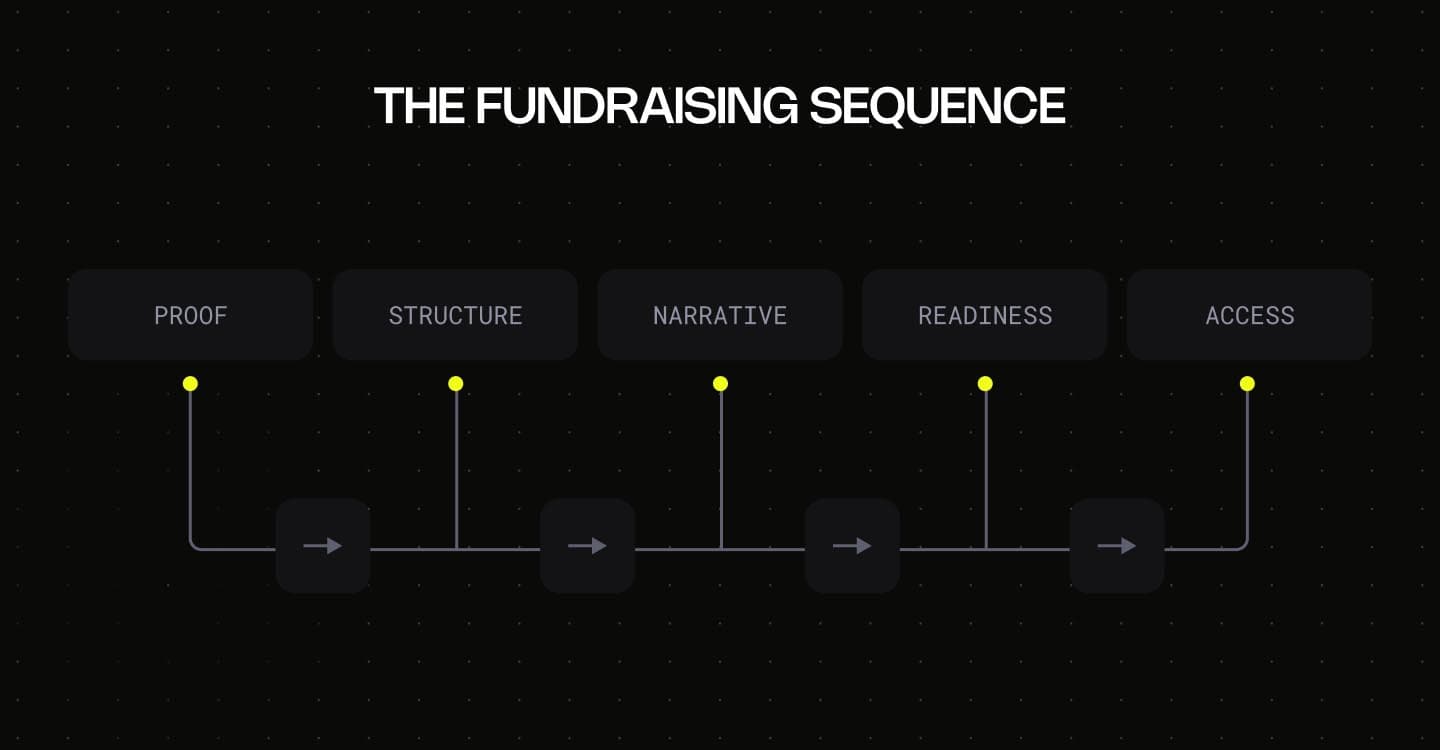
The right moment looks calmer on the surface, even when the team is moving fast. There’s at least one traction signal that fits the product, like recurring users for a wallet flow or steady volume that doesn’t disappear the moment incentives taper.
The team is also legible in a way investors can repeat to each other. It’s clear who’s shipping, and it’s clear who can get the product in front of users without hand-waving.
The narrative has been tested where it matters, in front of builders, users, or partners who aren’t paid to be polite. That public pressure makes the story tighter, and it makes follow-up questions feel fair instead of personal.
Add a couple of warm routes into the funds you actually want, and the fundraising timeline becomes less mysterious. You’re not relying on luck to get seen, and you’re not burning your best intros before the project is structurally ready; that’s what decides how Web3 startups can raise funds in practice.
In a venture funding bear market, the stage mix mentioned earlier points in the same direction: this cycle prefers fewer unknowns. The teams that do raise early end up proof-heavy by necessity, and that discipline tends to carry forward. It also matches the trends in web3 funding founders keep running into.
The next step is simple to describe and harder to do alone: find where the sequence is broken, fix it before the best intros are spent, and only then step back into the room.
That’s where the right kind of partner starts changing outcomes.
Once you stop blaming the week you picked, what’s left is pretty unglamorous. Deals stall because they land in the wrong rooms, because the project isn’t yet diligence-ready in the places VCs poke first, or because the first ten minutes start from skepticism.
And when those three stack up, founders do the natural thing: they push harder. More outreach, more calls, more versions of the deck. That’s also how you end up spending your best intros on meetings that were never set up to convert.
This is the point where a partner only helps if they can protect the sequence, not just widen the top of the funnel. It’s the kind of help people look for from web3-focused firms to raise funds.
The first job is cutting dead rooms. DESH works through direct relationships across 300+ active VCs to route you into funds that can actually evaluate your category, so “send the deck” turns into a real next step instead of polite drift.
After the intro, the fit still has to be obvious for that specific fund. So the narrative gets tightened around what they’ll stress-test anyway, not what sounds best on a generic deck.
Then comes readiness. DESH starts with a fundraising audit before pushing a team deeper into meetings. It’s designed to surface the usual breakpoints early: cap table and token allocation logic that collapses under second-order questions, supply pressure that makes upside harder to underwrite, traction that only exists inside incentives, and a “why now” that doesn’t hold up once it’s challenged.
From there it becomes a short plan you can actually execute. If a team is at 60% today, the goal is to get to 90% in 60 days with clear milestones, so the next conversations happen when the structure can carry weight.
The credibility piece is quieter, but it changes the tone fast. In this market, intros are reputation signals, and a DESH co-sign shifts the starting assumptions, especially when it’s paired with due diligence support that helps you answer hard questions cleanly without rewriting the story mid-thread.
This approach has been repeated across 20+ Web3 investments and 30+ institutional rounds, which mostly matters for one reason: you’re not betting on a single lucky cycle or a one-off playbook.
And when those three pieces are in place, the next step stops feeling like a gamble.
Fundraising is hard, but it isn’t random. In this cycle, routing + readiness decide outcomes, especially in funding in the Web3.
Write “FUNDRAISING” in Telegram and we’ll do a quick first pass on where deals are stalling.
Telegram: @desh_group