On a random Tuesday in 2026, a portfolio company can look fine from the outside. The calendar is full: product review in the morning, security call before lunch, token narrative to sign off, a community flare-up, then a legal check-in that quietly rewrites half the roadmap.
None of those items is a crisis on its own, but they land in the same week and start eating the same two or three people who are supposed to be building. Across portfolios, plenty of funded teams still don’t make it to durable follow-ons, and the post-mortem rarely reads “bad idea”.
A Binance Square post by BlockchainReporter summarises it bluntly: "90% of Web3 startups fail within two years".

That failure rate rarely shows up as one clean cause. It shows up as small misses that compound into a slower round.
Progress starts slipping when the delivery path splinters across functions with no spare bandwidth to keep sequencing clean. Fundraising adds weight, because every missed milestone becomes another page of explanation, and every delay moves the next round further out.
That’s why VC operating habits are shifting. The firms that consistently get companies through follow-ons bake execution support in early, because the overhead shows up fast and ripples across a portfolio.
If you want to understand why that matters, it helps to zoom in on what the first 12 to 18 months demand from a small team, and how that demand collides with funding timelines.
Weeks like that end in drift, not drama. They end with a quiet slide in timelines, where every dependency is “almost done”, and the round starts drifting before anyone calls it a delay.
Most founding teams are spiky in 1 domain, which is often why they get funded in the first place. Then the first real quarter starts, and the company is forced to run like a small studio, with parallel workstreams that don’t wait for each other. That’s when portfolio management challenges show up.
In Web3, that usually means the same 2–3 people are carrying 8–9 hats at once – product decisions, design systems, smart contract work, audit prep, community, distribution, regulatory positioning, comms, and investor relations. That’s where portfolio resource capacity challenges hit first. Output accumulates, but the handoffs stop matching the timeline.
The product needs a design system that won’t collapse the moment a 2nd surface ships. Security needs audit prep early enough to shape architecture, before decisions harden into the build.
Community and distribution move on their own clocks, and timing becomes a constraint even when the code is ready. Token positioning creates second-order effects in legal review and comms, and sometimes even in the order you ship features.
This is also where fundraising pressure distorts priorities. Investors ask for clarity and proof in the same weeks the team is still learning what the product looks like under load.
It’s rarely lack of intent on the support side. Intros happen, lists get shared, specialists show up, but ownership breaks at the seams between lanes.
Funds also can’t run hiring or vendor management for portfolio companies without turning “support” into a 2nd operating layer. So even when the right people are found, coordination stays fragmented across separate owners, calendars, and definitions of “done”.
That fragmentation shows up as portfolio management problems that cost days: mismatched “done” criteria, timelines that never align, and handoffs that quietly reset work. With 5 vendors, you get 5 channels, inconsistent quality, and no one owning the end-to-end execution narrative that holds up under partner scrutiny.
When things finally break, it rarely looks like a big failure at first. It looks like a company that slowed down, missed a window it needed, and then walked into the next round with less proof than the market now expects.
Once you see this pattern up close, it becomes easier to explain why execution partners matter to returns, because they change how execution risk accumulates across a fund.
Execution partners matter to returns because they change what a portfolio company can reliably deliver between rounds. Cleaner execution means less time spent explaining slippage and more time showing proof that survives a partner meeting: a working demo, an audit-ready scope, a release users can actually touch.
In follow-ons, that proof shows up as lower diligence friction. Credible implementation reduces late rewrites and closes the “we’ll fix it after the raise” gap that tends to trigger extra scrutiny and slower decisions.
Web3 raises the bar because the hard parts surface early. If contracts and security are being treated as “later”, it shows up in diligence long before product-market fit does.
Speed matters too, but it’s not about rushing. When roadmap ownership, design, and development sit on one line, launches stop slipping by a sprint at a time, and PMF signals show up earlier. Earlier traction creates optionality in who you raise from and on what terms, because the round can be anchored in what shipped, not what’s promised.
A broader data point helps frame why structured support changes outcomes. Research summarised by Wharton found that accelerator-backed startups were 3.4 percentage points more likely to raise venture capital, and they raised about $1.8M more on average in the first year.
In Web3, the drag is rarely one blocker. It’s several threads moving at once - security review, token decisions, distribution timing, and a narrative that has to stay coherent while the product is still being stress-tested. Regulatory posture belongs in that same bundle, because token classification and market access decisions can force pivots that hit valuation right when a round is forming.
When those threads stay aligned, the round spends less time defending the present and more time pricing the next step.
That’s the point of an execution partner: it makes progress diligence-ready, and diligence-ready progress is what turns portfolio risk into something the market will underwrite. Those are portfolio management solutions that actually reduce follow-on risk.
Most portfolios can bring in specialists. What they usually can’t buy is alignment: a way to keep design, build, security, narrative, and compliance moving in the same direction when the team is still two or three people deep.
DESH is a single execution desk. One plan and one sequence where decisions get resolved before they turn into rewrites.
The work still spans the same functions:
What changes is how it runs day to day. There’s a shared milestone board tied to the next deliverable that actually matters for the round, a weekly (or bi-weekly) checkpoint, and a short risk list that gets updated whenever scope shifts, and portfolio backlog management stays tied to the next deliverable that matters for the round.
For a VC operator, that means fewer moving parts to juggle and fewer late surprises. It also keeps costs flexible: capacity can expand or contract with the roadmap instead of forcing an early headcount bet that is hard to unwind.
When an execution partner sits close to portfolio companies, it sees the truth before it gets polished into a fundraising narrative. Day-to-day work shows what is moving, what keeps slipping a week at a time, and where time is being burned on coordination instead of shipping.
Dragonfly’s Haseeb Qureshi captured the sourcing reality in a line that’s hard to unsee: "Warm intros beat everything. Try and get intros from portfolio companies or co-investors."
That pattern shows up in the data too. A 2025 BFI/UChicago working paper reports that 44% of scored deals are co-investor sourced, alongside 25% inbound and 30% outbound, and the scored rate is 13.5% for co-investor sourced deals, alongside 5.3% inbound and 2.7% outbound.
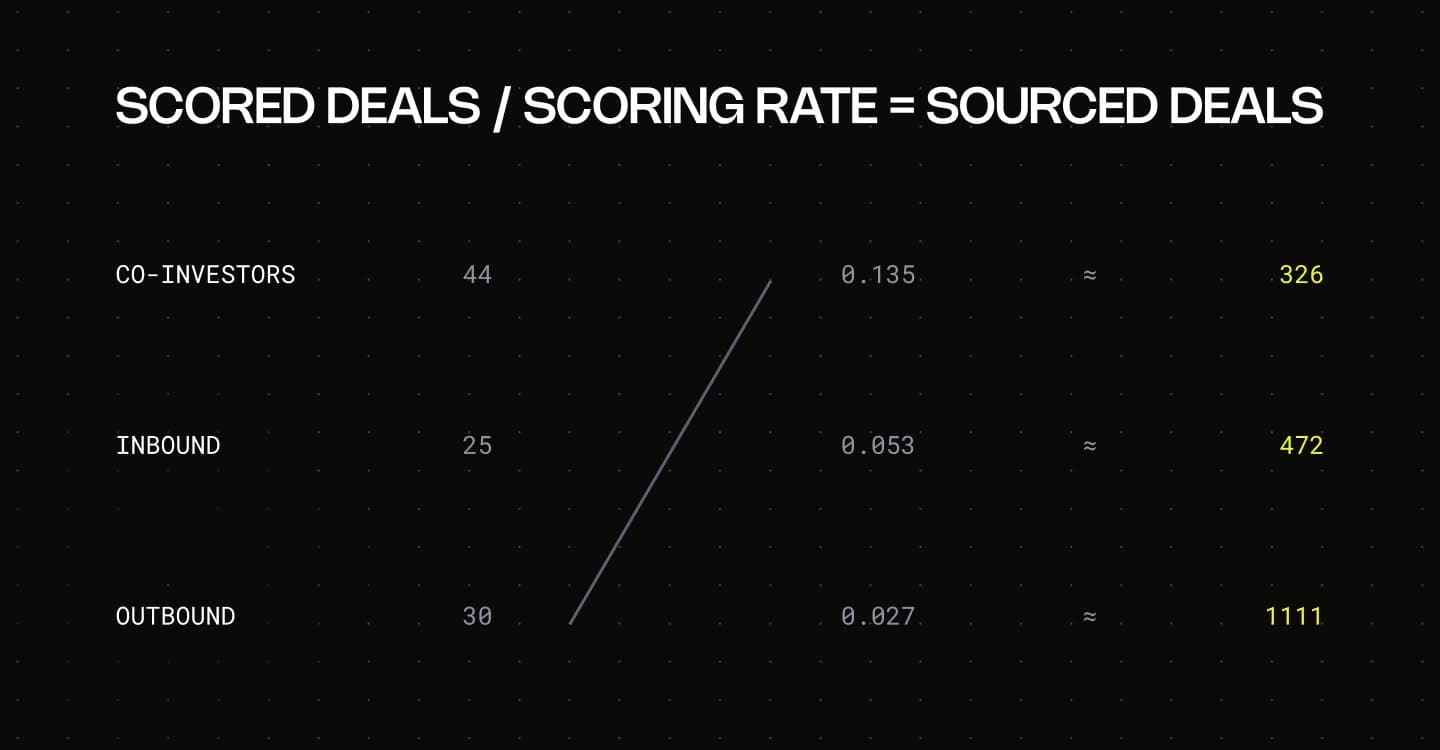
In practice, it compounds in 3 ways.
1.Higher-signal visibility. Execution partners sit inside the paths that generate higher-signal opportunities. They see who delivers under pressure, who stays honest about timelines, and which teams keep promises when the market tightens.
2.A network that behaves like a system. A repeatable path to audit firms, security reviewers, regulatory counsel, and distribution partners cuts founder search time and keeps decisions moving in a way that holds up in diligence. That often shows up as faster follow-ons, because fewer late reshuffles are needed to make the story match the reality.
3.More underwriteable seed risk. A repeatable execution structure makes it more reasonable to back first-time founders or non-obvious teams, because execution risk is being managed day to day, with visibility that still holds when diligence gets picky.
Put together, this is why some VCs treat DESH as a co-investor partner. And that’s why this model shows up more often now, especially in funds that treat execution as portfolio infrastructure rather than ad hoc support.
The shift shows up in how deals get evaluated once the first cheque clears. Roadmaps still matter, but follow-on confidence increasingly goes to teams that can turn intent into shipped work on a predictable cadence.
Part of the reason is simple: more execution debt is now embedded in the stack. More dependencies have to stay aligned, so slippage is easier to spot and harder to explain away when the next round comes with tighter diligence.
VC operating behaviour is adapting around that reality. Funds want support that is already wired in, because chasing vendors after a seed closes creates dead weeks, and those weeks tend to land exactly when a team needs momentum to stay fundable
Market data points in the same direction. Galaxy’s Q3 2025 snapshot shows $4.59B invested across 414 deals, with about 55 infrastructure deals in the mix, based on the chart breakout.
There are also visible examples of capital paired with an execution environment. a16z CSX ran a cohort with 21 startups across 11 countries in Fall 2024, which signals how standardized support is being treated as part of the investing setup.
In follow-ons, the gap between almost ready and ready is increasingly execution, so support is moving earlier in the lifecycle and becoming more structured.
At that point, the practical focus is day-to-day execution. A clear partnership rhythm, light governance, and a clean handoff plan usually matter more than the label on the relationship once a team is ready to build in-house.
The partnership works best when portfolio planning starts with a clear scope and a cadence the company and the fund can actually rely on. DESH can plug in deep at the beginning, then step back as the team hires and the operating model firms up.
Depending on how you want to deploy support, it can run in 3 shapes:
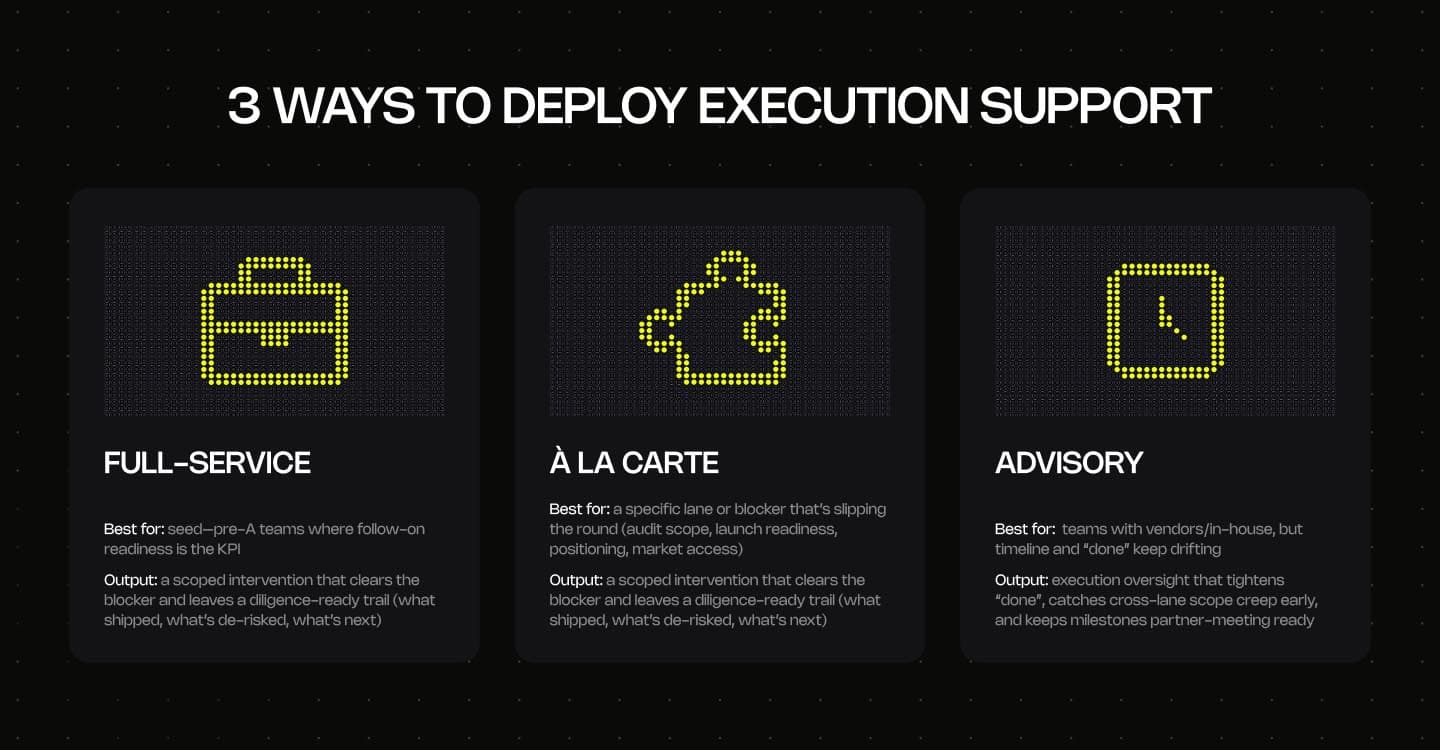
Day to day, the work runs on a simple rhythm: operational syncs with the company, with the fund pulled in only when a decision changes follow-on readiness or shifts the timeline, the kind of portfolio management process that keeps noise from turning into drift.
Updates stay lightweight. A short note each month captures what shipped, what changed in scope, and what needs attention next. Over time, that’s also how you start seeing patterns across the portfolio early enough to do something about them.
Exit is designed in from the start. As the company brings functions in-house, DESH hands over with documented processes, scoped IP, and a mapped set of external relationships. Some teams keep an advisory thread for high-stakes moments, where a fast second set of eyes is useful, without adding ongoing operational weight.
With the operating shape defined, the practical starting point is usually a short execution audit that identifies one bottleneck the team can clear in the next planning cycle. It tends to create a sharper conversation than a generic intro call.
If your LP thesis includes de-risking portfolio company execution, it helps to see how much of that risk is ownership gaps and what changes when one operating line carries the coordination load end to end.
DESH can start with a free execution audit on 1 portfolio company. You’ll get a short written report: the single bottleneck most likely to block the next milestone, plus the fix sequence to clear it.
If the format fits your operating model, we can shape terms around how you want to deploy execution support across the portfolio.
A 45-minute strategy call with DESH’s Head of Partnerships is the simplest way to pick the first company and align on scope 👇
Telegram: @desh_group