A practical guide to web3 development services in 2026: what they include, how to choose a web3 development company, and secure launch.

Web3 development services are the design, engineering, security, and launch services needed to build products on blockchain networks.
Founders, CTOs, and product leads from 2026 and beyond use web3 development companies to go to market faster, to decrease security risk, and to avoid very expensive architecture mistakes. This guide describes what you can expect from a web3 development company, how engagement works, and under what circumstances it would make sense to hire one instead of building out your own in-house team. Finally, we explore the things to look for when choosing a partner.
Typically, teams do not need generic vendors for web3 development. They need a partner that handles protocol logic, the product UX, the wallet flows, the infrastructure, and the launch readiness as a single system. Be it a DeFi application, a tokenized asset product, a wallet, or a game built around onchain ownership, there are many different cases, and strong web3 development services should be able to service them all.
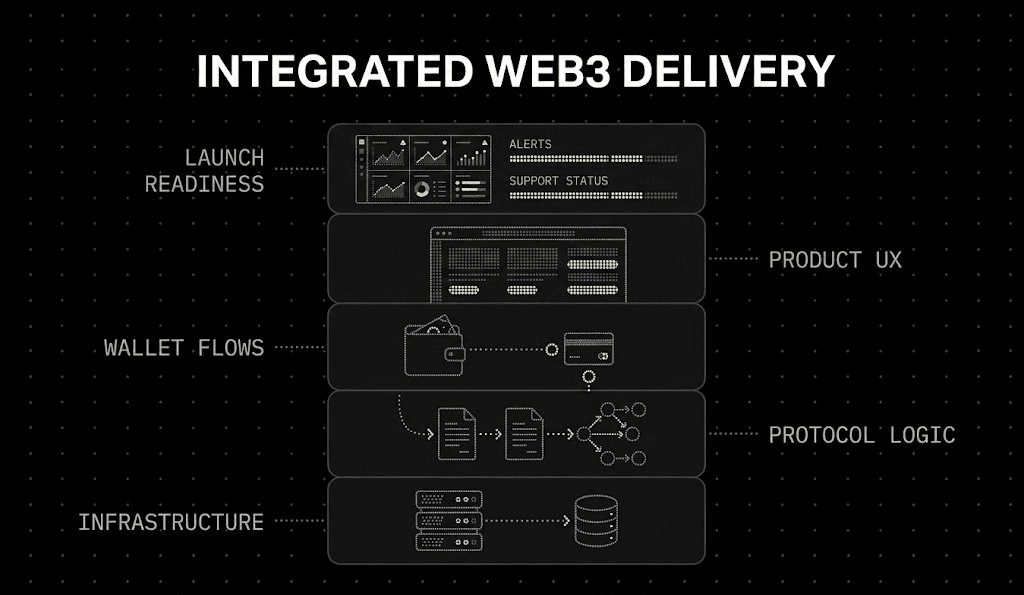 The scope usually looks like this:
That service mix sits on top of the broader Web3 concept, but buying services is not about theory; it is about getting a product to market with fewer blind spots.
The build model is almost as important as the technology stack. While building an in-house team will pay off in the long run, it may take too long and cost too much while the product still has open architecture questions. Freelancers can be used for very narrow tasks. However, as soon as contracts, frontend, QA, DevOps, and security are all involved in a release, the coordination risk will increase dramatically.
Web3 development companies sit between hiring a single developer and hiring a full team of web3 developers, giving founders access to senior level web3 engineers, a defined delivery process, and security habits from day one.
| Option | Best fit | Main upside | Main tradeoff |
|---|---|---|---|
| In house team | Long roadmap, stable budget, repeat shipping | Deep product ownership | Slow hiring, high fixed cost |
| Freelancers | Small isolated tasks, short support needs | Flexibility, lower entry cost | Fragmented accountability |
| Web3 development company | MVPs, protocol builds, launches, fast iteration | Cross functional delivery, faster start | Needs careful partner selection |
Many teams start with one of the good web3 companies for discovery, MVP, or major protocol launch, and then build out the rest of their capabilities internally once the product and architecture have stabilized.
There are many web3 development companies with nice websites listing out the blockchains they support. But there are very few that actually deliver real products, clean and well architected smart contracts, consistent delivery, and the discipline to say no to something that looks good at first but introduces unknown risks later.
A good selection process should feel closer to technical diligence than vendor shopping. If you want a wider benchmark, this guide on how to compare development companies is a useful reference point.
Look for these signals:
Some things to ask directly: Who writes the architecture? Who reviews contracts for your team? How are common edge cases tested? What portion of your application stack does your team handle internally? The quality of the answers tells you a lot.
Most web3 development company engagements fall into three models:
| Model | Best for | Typical pricing pattern |
|---|---|---|
| Staff augmentation | You already have product and engineering leadership | Monthly rate per specialist |
| Dedicated team | You need design, engineering, QA, and PM in one unit | Monthly retainer for a pod |
| Fixed scope | Clear MVP, defined features, tight timeline | Milestone based project fee |
Strong delivery is typically simple to describe but hard to execute. The goal is to reduce uncertainty as early as possible, stress test as much as possible before mainnet, and keep launch support close to the people building the product.
A solid process usually follows three stages:
The best teams make tradeoffs visible. They highlight where account abstraction can drive conversion, where a simpler MVP reduces risk, and where custom contracts are worth the additional audit burden.
DESH is a full-stack, full-cycle Web3 delivery partner. At DESH we have delivered DeFi, smart contracts, dApps, as well as token launches and related infrastructure for clients. We are well equipped to handle projects that need smart contract code, frontend UI, backend services, launch planning, and post-launch growth work, all at the same time.
We work across Solidity for EVM ecosystems like Ethereum, Polygon, and BNB Chain, and Rust for Solana or other performance heavy components, as well as mixed stack products. Security is built into delivery rather than bolted on as a late stage checkbox, and the process is designed to keep management overhead low for in-house teams. For founders who need to move fast, one vendor handling design, development, and go to market support can save weeks of coordination compared to stitching together separate vendors.
To demonstrate real traction, DESH has supported over 50 launches in the last 3 years and helped generate more than $3.5m in partner revenue, giving real evidence of success rather than empty claims from many other web3 companies.
Book your free consultation to receive a 48 hour product audit and actionable build plan.
Using Web3 development services makes sense when speed, security, and clarity of your end product are more important to you than building out a team to deliver the project. The right service provider will help you keep scope under control, invest where there is real risk, and deliver a good quality end product with fewer surprises along the way.