Stablecoin issuance in 2026 demands secure contracts, reserve controls, redemption rails, compliance, and cross-chain supply management.

Issuing a stablecoin in 2026 is not just about writing a token contract. It also requires a reserve, mint and burn logic, a redemption path, an oracle, a liquidity strategy, cross-chain supply management and last but not least a compliance path that maps to the current and evolving regulatory landscape for crypto assets. To issue a stablecoin that holds the peg in stress, redeems correctly and is safe for users, exchanges and regulators to use, you need to combine product, smart contract engineering, treasury and market structure.
Serious founders treat issuing a stablecoin as infrastructure and not as a neat logo and some web page. The supply of fiat-backed stablecoins crossed 273 billion dollars in March 2026. People are actually demanding these, and the bar is a lot higher than it was even a few years prior.
Issuance of a stablecoin starts with the token, but a fully functioning stack goes well beyond it. The stablecoin's infrastructure is spread across on-chain and off-chain systems and the weak link in the chain is typically the interface between the two.
A founder asking how to build a stablecoin should think in terms of synchronized state. The on-chain supply of base token must equal the reserves and collateral policy. The mint path must mirror the real world asset flow and collateral lockup. The burn path must mirror the actual redemptions, repayments, and vault settlements. As those streams drift apart, the credibility of the peg will slowly evaporate until it finally fails.
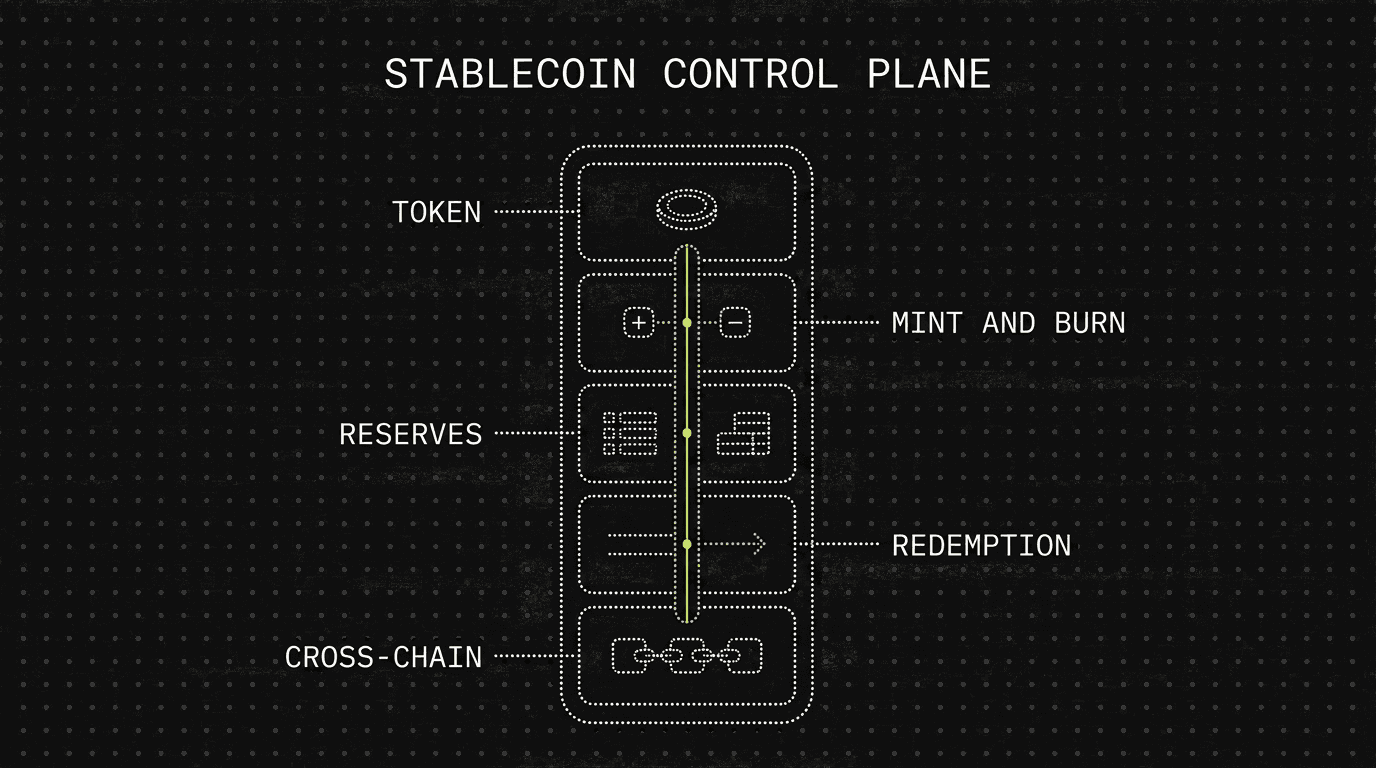
A production issuance stack usually includes:
The operational side matters just as much as the contracts.
That map actually represents the full scope of what stablecoin development entails. Many projects underestimate the degree of coordination required to issue a stablecoin, especially when stablecoin issuance is facilitated via a web application, back office tools, certain signing policies, and even external custodians.
There are three main models that work: fiat-backed, crypto-collateralized, and algorithmic. Each can be implemented better or worse, but the engineering burden changes dramatically with each model.
For teams that need fiat and regulatory backing to get broad trust, fiat-backed issuance is the simplest path. On the token side this can be quite simple as the token only has stability due to redeemability and the quality of the underlying reserve as opposed to on-chain complexity. The hard work is then moved off-chain to areas such as custody, attestations, issuance controls and the operations around redemptions.
In crypto-collateralized stablecoins most of the trust is shifted on-chain. The combination of a vault, a collateralization ratio, the rules of liquidation, and the handling of the oracle all play a crucial role. While stablecoins of this kind are transparent, they are very sensitive to volatility, the risk of an oracle failure, and most of all the liquidity gaps that occur during liquidations.
Algorithmic designs are the most fragile of them all. A design that relies for the most part on reflexive behavior of a peg is by definition subject to the whims and stresses of market confidence, of the existence of sufficient arbitrage and of the secondary markets for the underlying tokens. This is a market behavior problem, and it is here where most pretty designs fail.
| Stablecoin type | Peg mechanism | Main engineering burden | Main operational burden | Common failure pattern |
|---|---|---|---|---|
| Fiat-backed | Redemption against reserves | Access control, issuance ledger, compliance, redemptions | Custody, attestations, reserve reporting | Loss of trust in reserves or redemption delays |
| Crypto-collateralized | Overcollateralized vaults | Oracles, liquidations, vault math, bad debt handling | Risk monitoring, collateral policy updates | Oracle failure, liquidation cascade, bad debt |
| Algorithmic | Incentives and supply reflexes | Emission logic, market modules, peg arbitrage design | Constant market support and policy tuning | Death spiral after confidence shock |
For most founders the best model isn't the most creative way to structure something. It's the model where the failure modes of that model are something that your team can actually operate. Choosing the best model is already engineering.
A stablecoin smart contract should be boring in the places that matter most and explicit in the places that could hurt you the most. Simplicity is a feature in the token layer, and therefore complexity is best in bounded modules of code and not in a massive monolithic contract that tries to serve all of the following functions: issuance, collateral logic, governance, fees, and emergency powers.
First, design the mint authority function. A single owner mint function is unacceptable for serious money issuance. Instead, design out a role-based access control function that supports a minter module and a burner module, each housed behind a service layer that checks intake of reserve, collateral posting, or signed approval prior to supply changes. Burning too should be as fine grained as possible, as a single burn can represent redemption, collateral repayment, bridge exit or treasury retirement, and treating each of these events as a single event would destroy all auditability.
Most 2026 issuance systems will require emergency powers that the team does not want to grant. Pause, freeze, and blacklisting functionality is part of incident response, sanctions compliance, and legal enforceability. The critical question then is how narrow and transparent the emergency powers are. A strong architecture for emergency powers separates the different roles (pauser is not upgrader, treasury operator does not change redemption rules, blacklisting manager leaves immutable logs). Multisig with different thresholds and timelocks for different actions can help to avoid single points of failure.
Being upgradable and protecting a live system is one thing, but it introduces a lot of governance risk because every upgrade path is a privileged attack surface. If you decide to use proxies for instance, then storage layout discipline, upgrade simulations and role segregation are mandatory. The failure modes are all too familiar for most projects:
Most teams find out quickly that building a stablecoin is not about writing Solidity code, but about building a failure tolerant control plane.
A peg can hold as long as the market believes that the issuance and redemption of the pegged currency are real, on time and rational under stress. It can break whenever the market believes that the redemption of the currency is uncertain, the reserves are weak or that the supply incentives are mispriced. Thus, the reserve and emissions policy cannot be reduced to a simple spreadsheet analysis using normal market assumptions.
Fiat-backed designs fail as redemption friction outpaces confidence growth. Crypto-collateralized designs fail as the value of the collateral drops below the cost required for liquidation, whether through a drawdown or an update to the oracle feeds. Algorithmic designs fail as the required amount of arbitrage capital to keep the mechanism functional exits the system at the exact moment it is needed the most, testing the edges of the system rather than just the happy path.
Stress testing reserve depletion, queuing up redemptions, simulating varying levels of liquidity, modeling the discount window and figuring out who takes losses first, that is the hard work. All the token design principles from How to Create Your Own Cryptocurrency still apply, but now you are adding a treasury, a means of redemption, and a host of market reflexivity. The distribution mechanics from What Is a TGE also matter, because launching an issuance-based token introduces mint rights or reserve attestations into the mix. This is one of the first areas where doing it alone becomes risky, because peg design is a live market system with adversaries and exit behavior, not a simple whiteboard exercise.
A stablecoin can collapse through a direct attack on the protocol or through a relatively minor event that undermines confidence in the coin's peg. That can happen when a queue of pending redemptions freezes, the oracle feed utilized for price feeds diverges from reality, the bridge mint checks fail, or the admin's digital signature is compromised.
The attack surface includes token contracts, minter controllers, collateral vaults, keeper bots, bridge contracts, off-chain signing services, custody integrations, and all possible governance paths within the system. A system can be secure on the contract level but still be operationally unsafe due to overly broad admin roles or untested emergency scenarios.
 A serious Blockchain Security Audit for issuance would typically involve invariant testing, role abuse scenarios, upgrade testing, bridge accounting testing, oracle failure testing, and economic manipulation testing. It should give strong evidence that no more issued supply exists than there is backing, that emergency powers do not create ability for rogue operation of others, and that any stablecoin pause still preserves fair redemption for all holders. This is the second place DIY area that I consider to be High Risk. One exploit or one incorrectly scoped privilege in the issuance process could easily cause the project to get zeroed out, and as always the postmortem will likely reveal that the team had treated stablecoin security as if it were simply another dApp.
The architecture of payment stablecoin issuance is now directly regulated. The GENIUS Act was implemented as law on 18 July 2025 in the United States, with rules to implement coming into force on 18 July 2026. In the European Union the MiCA was implemented in full on 1 July 2026. These regulatory regimes set out to regulate the issuance of financial products, rather than the marketing blurb used to sell them.
For fiat-backed currencies, both frameworks above push for a liquid, 1 to 1 backed currency with par redemptions, reserve disclosures, and controlled issuance / redemption processes. If the contract layer above does not fulfill these promises, the contract would be in conflict with the legal structure above. In practice, this means:
The GENIUS Act rules govern the following elements: rules for permitted issuers, 1:1 reserves, public redemptions, and monthly reserve details. The OCC proposal published on 2 March 2026 goes into greater detail around reserve management, custodians, composition reporting, and monthly issuance value reporting. As an engineer, this means that attestation hooks, role separation, and predictable redemptions must all be hard-coded into the smart contracts and the flow of custody and reporting from the very beginning. Compliance cannot be tacked on after the launch of the system. If the contracts, the flow of custody, and the reporting are not all designed together, it will be very painful and very risky to try to close the gap later.
A stablecoin maintains its peg as long as there are enough users willing to trade size and support the peg, as long as there is good enough arbitrage in place, as long as redemptions are trusted to occur in a timely manner, and as long as there is sufficient liquidity to handle moments of extreme fear. Thin liquidity kills pegs.
Market integration on a DEX is more than just having a pool. You need to be able to route trades between venues, pick the right pairs, have market makers working in unison, an inventory policy, and a clear link between secondary market trading prices and primary issuance redemptions. If such a link is not in place, even a well backed token will trade off peg for longer than users care to tolerate. Liquidity deserves to be treated as a separate discipline to building a pool with incentives to fill, as while it is relatively trivial to get engineers to build out the former, bootstrapping durable liquidity requires significant work on market structure. The Kaspa DeFi case study gives a good example of how protocol integration can be paired with corresponding work on liquidity. Shipping a token to mainnet is not the same as shipping a market.
Many stablecoins launch across several different networks at the same time (so-called "day one") in 2026. A supply consistency problem arises on these "cross chain" stablecoins because users treat the stablecoin with the same name on different networks as one instrument (e.g. USD) and not as a number of separate local promises (one on each different network).
One clean architecture pattern for stablecoin supply is a canonical issuer chain that uses burn and mint messages to satellite chains. Supply can then move from one chain at a time without causing inflation across all chains, because every mint on a destination chain has a corresponding verified burn on the source chain.
Bridges are probably the highest risk component in stablecoin architecture right now because a single exploit of a bridge can cause synthetic inflation even if the underlying token contract is perfect. To mitigate this risk, many teams are now building out cross-chain logic as separate modules that have their own mint ceilings, per-chain rate limits, and circuit breakers, and are monitored in real time with telemetry around circulating supply on each chain, bridged balances, and failed relays.
The burn and mint messages should be idempotent, replay-protected, and auditable. The key property of a valid transfer is that a source burn that fails to complete its corresponding mint on the destination chain puts the user back in a recoverable state.
A strong internal team can manage parts of the issuance. The product strategy for the new issuance, the reserve policy, legal coordination, the treasury operations and the core protocol goals of the product should stay close to the founders and CTO. With senior talent in Solidity, backend, DevOps and security, it's possible to build a large part of the stack internally.
These gaps occur at the intersections of domains. For smart contract design, that means compliance. For redemption design, that means backend settlement. For cross-chain supply control, that means security and market operations. For liquidity rollout, that means token policy. Those are the seams where experienced partners can bring value to reduce risk. If you're going to staff issuance internally, you should have a realistic idea of what it takes to execute delivery, study the case of a real launch like Platnum's, and have a realistic sense of the depth of your team's hiring bar (e.g. How to Hire Solidity Developers). Issuance is one of the few product categories where technical debt, market debt, and compliance debt can all bite you at the same time.
If you want a second set of eyes on stablecoin issuance or stablecoin infrastructure before you commit architecture, Book a Call with DESH.