How Chainlink CCIP verifies cross-chain messages and token transfers, and how its security model compares to LayerZero v2 and Wormhole NTT.

Chainlink CCIP is a cross-chain messaging and token transfer protocol. It uses a decentralized oracle network and an independent Risk Management Network to verify messages before they are executed. It differs from simpler bridge designs in that CCIP separates message verification from execution and from risk management, so a compromise of one of these components does not affect the other components.
This protocol competes with other systems for transferring assets and data between blockchains, such as LayerZero v2 and Wormhole NTT. These also solve the same problem but with fundamentally different design trade-offs in terms of the security model, token semantics, and configuration. Here is some background on why one would choose one cross-chain infrastructure for a production protocol over another.
As Chainlink CCIP cross-chain infrastructure is a protocol layer service, the messaging provider that is chosen will impact the architecture of the contracts, the security model and the token semantics of the service from day one.
Replacing a cross-chain interoperability protocol is not a decision that can be reversed quickly once a token has launched. It typically requires redeployment of receiver contracts and a new security audit of all integration points, followed by the time-consuming process of migrating liquidity across the various chains.
When deciding on a token bridge for a certain token (canonical or wrapped token, transparent security model, required chain coverage), one has to consider that a token issued with lock-and-release semantics on one protocol cannot be easily ported to a burn-and-mint model on another. A coordinated migration is required.
Because cross-chain messaging is becoming an increasingly competitive space, several providers are expanding to new chains and releasing developer tools, making cross-chain messaging security a central differentiator that teams must evaluate carefully before committing to any provider. This in turn creates vendor lock-in risk for teams building on top of the corresponding protocol. Requirements also vary greatly between use cases: some require strict verification, while for others permissionless composability is key.
In CCIP, message verification and execution are separated into two layers, and risk monitoring is done in a third separate layer.
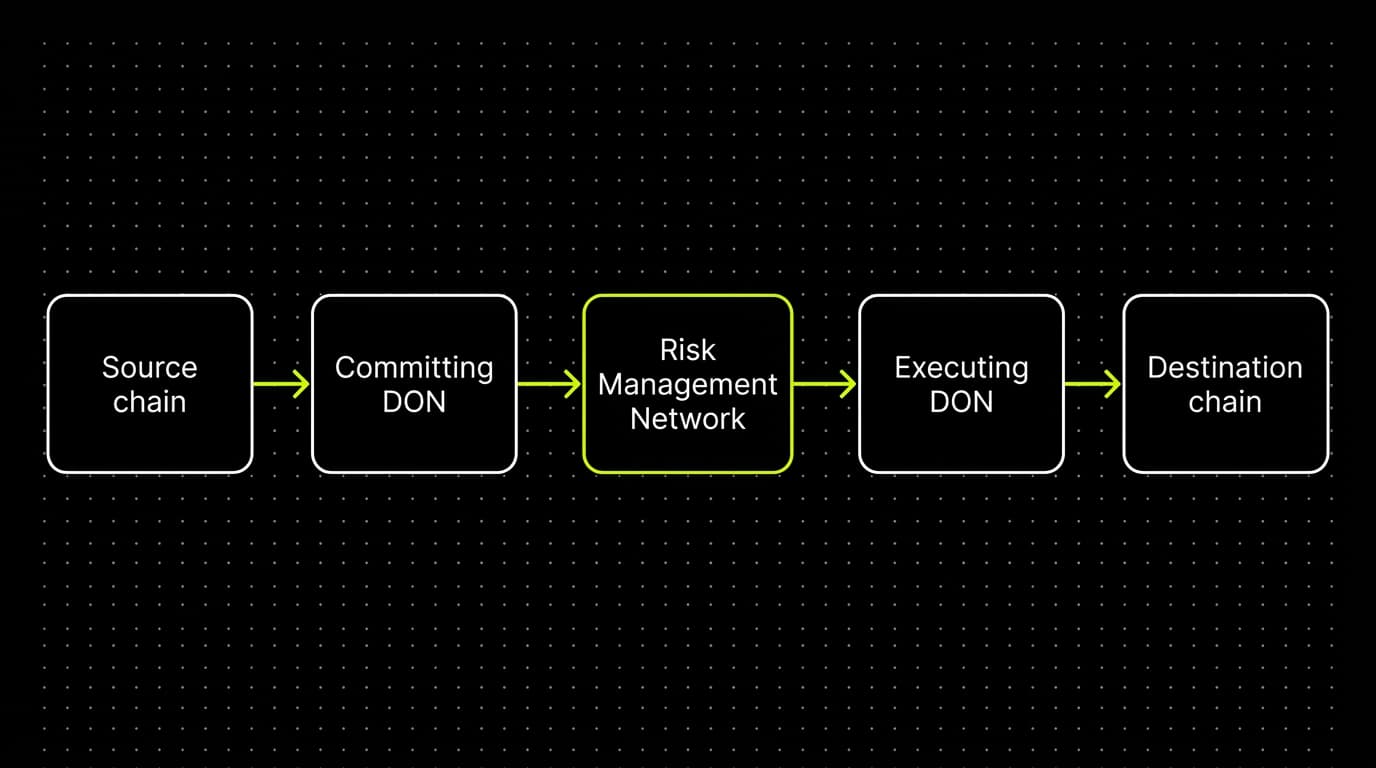
CCIP oracles are split into two different roles: the Committing DON, which batches cross-chain messages and commits their Merkle root to the destination chain, and the Executing DON, which triggers the final contract call. Neither DON can complete a transfer on its own without the commitment being checked.
The Risk Management Network runs on nodes separate from the other two layers in order to monitor message patterns independently. It can stop a message that reveals malicious activity before it gets executed.
CCIP applies rate limits per token per lane through token pools configured for each token on each lane. Programmable token transfers bundle tokens with arbitrary calldata in a single message, so a destination contract can, for example, receive tokens and stake them on the destination chain as one atomic action.
LayerZero V2 is a modular verification framework that can be configured by individual applications.
LayerZero deploys an immutable endpoint contract on each chain. Each application defines which verifiers it trusts, so the security of its messages is exactly as strong as the verifier set chosen by the application's owner.
The DVN security model allows an application to require a threshold of verifiers, expressed as X of Y of N, for all messages. Stricter thresholds increase security, while looser thresholds reduce security along with latency.
LayerZero cross-chain messaging separates message verification from message execution. A permissionless model for executing messages limits the risk of censorship but leaves liveness to market incentives as opposed to a committed network of validators.
Wormhole NTT is a transfer framework that decouples token transport from token ownership. It allows token teams to move canonical assets across chains without giving up control of their contracts.
The NTT Manager is deployed by the token team on each chain where the token lives. The token team retains all upgradeability and governance, and can configure rate limits and pausing as needed within the contracts it owns and controls.
The default NTT transceiver relies on the Wormhole Guardian network, a fixed set of 19 guardian nodes that must reach a two-thirds supermajority to attest any given message.
The legacy lock-and-mint bridge creates a wrapped derivative of the asset, which is distinct from the canonical version of the asset. NTT instead delivers the canonical version of a token (preserving brand and on-chain governance) on the destination chain, without an additional wrapped token sitting between application protocols.
The trust assumptions of the three protocols examined here differ significantly, and each shapes which smart contract security controls a team must add on its own side.
Chainlink CCIP verifies before it executes: the Committing DON creates a Merkle root, which is checked by the Risk Management Network before execution occurs. LayerZero's DVN framework lets each application set its own verification threshold, but it is not an optimistic bridge either.
Wormhole uses a transparent, auditable set of 19 guardians. In the LayerZero vs CCIP comparison, one meaningful distinction is that LayerZero DVNs can be combined and configured per application, effectively a dial as opposed to a constant, whereas CCIP relies on a fixed dual-layer architecture with the Risk Management Network.
Bridge failures typically target a single verification layer. This risk can be mitigated with a secondary verification layer (like the RMN) or with multiple DVNs that all must agree before settlement.
Token architecture decisions at launch can have long-lasting consequences for a project's ability to maintain supply integrity and to expand to new networks.
A CCIP burn and mint pool destroys tokens on the source chain and mints an equivalent amount on the destination chain, so no custodial reserve is needed to maintain global supply integrity. Alternatively, teams can use lock and release pools to keep their existing home-chain token and corresponding contract.
The OFT standard embeds the token transfer logic within the ERC-20 contract. The token itself acts as a bridge between chains, and tokens with this standard have unified supply across all connected chains. Moving an OFT token to another protocol later requires a coordinated migration of mint authority on every chain.
Another consideration at launch is how easily a token can be ported to other chains. A new launch would typically use OFT for ease of use, while an existing home-chain token would be better suited to a CCIP lock and release pool or Wormhole NTT in locking mode.
In terms of chain support, tooling maturity, and documentation quality, there are significant differences in how quickly a team can ship a product and reach the desired audience.
Chainlink CCIP lane additions follow formal security reviews per network, and CCIP supported chains are generally concentrated in EVM environments where DeFi TVL is highest. LayerZero chain coverage is broad, including non-EVM ecosystems such as Solana and Aptos. Wormhole supports Solana natively, making it particularly suitable for teams that need interoperability between Solana and EVM chains.
All three protocols ship solid SDKs for cross-chain work, but the developer experience differs. CCIP offers a more standardized integration path, while LayerZero's OApp (Omnichain Application) framework for configuring DVNs and executors is very mature and can be fully configured from the very first deployment of the app.
The same considerations of token architecture, chain targets, and security model drive the final protocol choice.
Chainlink CCIP fits teams that want the Risk Management Network as an independent verification layer on top of the DONs. For protocols that already integrate Chainlink oracles, keeping cross-chain messaging with the same provider simplifies operations.
When a token targets many heterogeneous chains and the team wants to run its own DVN security stack, LayerZero v2 is the better choice. The OFT standard unifies supply across all supported chains without separate pool contracts for each chain, greatly reducing the overhead of launching a new token.
For a mature protocol, NTT is preferred over CCIP in two main scenarios: when an existing contract on Solana needs to go multichain without being redeployed, or when the team specifically needs Solana to EVM transfers. In such scenarios, NTT's manager and transceiver architecture preserves the ownership and upgradeability of the original contract. Some mature protocols run two token bridge infrastructure layers in parallel, a topic covered in cross-chain bridge development.
Chainlink CCIP, LayerZero v2, and Wormhole NTT solve the same problem of token transfer and messaging, but each does so with a different trust model: DONs (Decentralized Oracle Networks) with an independent Risk Management Network, customizable sets of DVNs (Decentralized Verifier Networks), and a fixed Guardian quorum, respectively. A token team can choose any of these solutions based on its priorities for verification (defense in depth), security configuration (customization), and supply (canonicity) across chains. The trade-offs in finality guarantees, operational overhead, and chain coverage cannot be reduced to a single metric. A team scoping cross-chain activity should use the comparison framework outlined here as a starting point and then validate it against its specific chain targets and required throughput, and teams that need help with that scoping can turn to smart contract development services for pool design, verifier configuration, and pre-mainnet review.
Chainlink CCIP's defense-in-depth model, with an independent Risk Management Network that can stop suspicious cross-chain activity, is more conservative in its trust assumptions by design. LayerZero V2's configurable Decentralized Verifier Networks (DVNs), selected by each protocol for its own security, trade those fixed safety rails for modular verification that can be tailored to a specific use case.
Wormhole Native Token Transfers (NTT) is a token transfer framework. Rather than locking assets on the source chain and minting wrapped tokens that act as IOUs on the destination chain, NTT preserves the canonical supply of the token across all supported chains. It does this with native token contracts on each chain whose supply changes through burning or locking modes, directly governed by the token owner.
The Omnichain Fungible Token (OFT) standard suits projects looking for the widest chain coverage, the smallest integration overhead, and the ability to fine-tune security by choosing specific DVNs. Teams with strict security requirements may be better served by the structured risk management of Chainlink CCIP or by Wormhole NTT's ability to preserve canonical supply across chains.