Real estate tokenization places property title in an SPV, with tokens representing equity in that entity. Technical guide to structure and on-chain mechanics.

The property title is placed in a Special Purpose Vehicle (SPV). The tokens issued over this structure represent interests in the equity of this legal entity, not the property itself. Importantly, the rights of token holders, the cash flows to which they are entitled, and their exit opportunities are all determined by the operating agreement of the SPV in the relevant jurisdiction, not by the smart contract code itself. The on-chain mechanics are only as sound as the legal structure underlying them. The full stack of real estate tokenization is described in the following sections.
The entity structure created for tokenization constrains the design of all subsequent contracts.
Within the special purpose vehicle (an LLC or Ltd), legal title to the property is held. This entity is typically structured to be bankruptcy-remote of the sponsor, meaning that even in the event of the bankruptcy of the sponsor, the real estate will not be sold to pay the creditors of the sponsor. The operating agreement of the SPV will include provisions to permit the issuance of digital securities and describe the manner in which token ownership of such digital securities gives rise to membership interests in the entity. That provision is what gives the on-chain equity record legal effect.
Token structure is the terms of the instrument. It says what a holder actually gets, and where they stand when money moves. It also decides whether the thing is a security under national law. All of that happens on paper, before anyone opens an editor.
An equity token is a fractional membership interest in the SPV. Holders get their share of whatever the entity distributes. Some structures let them vote, pro rata, though plenty do not bother. A debt token works differently: fixed claim, paid ahead of equity, no upside if the building appreciates. Either way, under the Howey test, you are almost certainly looking at a security. Branding it otherwise changes nothing.
Token classes typically are ranked in a waterfall with respect to distributions. For example, in the smart contract's distribution function, an 8% cumulative preferred return for the preferred equity tranche would need to be fully paid out before any distribution to holders of common or other token classes. Typically, separate ERC-1400 partitions are created for each of the token classes.
Standard selection is effectively a one-way door. Once a token is deployed and holders are on the cap table, migrating to a different standard means a new contract, a new registry, and a coordinated reissuance. Compliance-oriented standards such as ERC-1400 and ERC-3643 exist precisely because a plain fungible token has no place to enforce transfer rules, and the trade-offs between them are covered in our guide to RWA tokenization.
For on-chain compliance, ERC-3643 implements a modular claim registry. This means that for every transfer of tokens, the smart contract checks if the recipient of the tokens is verified or if they hold the required claims. If not, the transfer will fail. All the compliance rules are executed on-chain by the smart contracts, and no off-chain middleware is required to prevent subsequent transfers.
Put minting behind role-based access control with a multi-sig threshold. Two of three, three of five, depending on how many people you trust with it. The harder part is keeping the on-chain registry in step with the SPV membership ledger. They have to match. When they do not, nobody is obliged to treat the chain as the real record, and the issuer is the one left arguing about who owns what.
Off-chain data points matter for tokenized real estate ownership. Tokenized property structures therefore inherently are subject to a trust boundary between the off-chain legal reality and the on-chain contract structure.
Rent receipts, appraisals, title updates. None of it starts on-chain, so it all has to come across through an oracle layer. Rent you can verify against a property manager API or a bank feed. Valuations are different: there is no market price for a building, so the number comes from a licensed appraiser and someone has to sign for it. Each of these is a centralized trust assumption, and each one belongs in the offering documents. Chainlink Functions works; so does a custom authorized node. What really changes between them is who can turn the feed off.
Distribution, minting, and transfer restriction updates should sit behind a multi-sig with a timelock in the range of 48 to 72 hours, which gives holders a window to react before a privileged call executes. On upgradeability, prefer a narrow surface: modular compliance components that can be swapped independently are easier to reason about than a fully upgradeable token contract, where a proxy admin can rewrite the entire instrument.
Off-chain legal events such as a title transfer or an SPV refinancing have to be reflected in contract state. These should be written by the multi-sig admin role rather than exposed as open oracle calls, because a legal event is a discrete, verifiable action, not a continuous data feed.
On-chain cash flow distribution for tokenized assets representing real estate properties means executing the promised cash flows of the property as they are received by the smart contract. This is typically done by following a waterfall which has been encoded in the smart contract at deployment time.
Pro rata math over an integer token supply never divides cleanly. Truncated remainders accumulate in the contract, and the accounting has to decide explicitly where they go: carried into the next distribution, or swept to a designated address. Failed transfers need the same treatment. A holder whose address cannot receive the settlement asset should not be able to block the distribution for everyone else, which is another argument for the pull model.
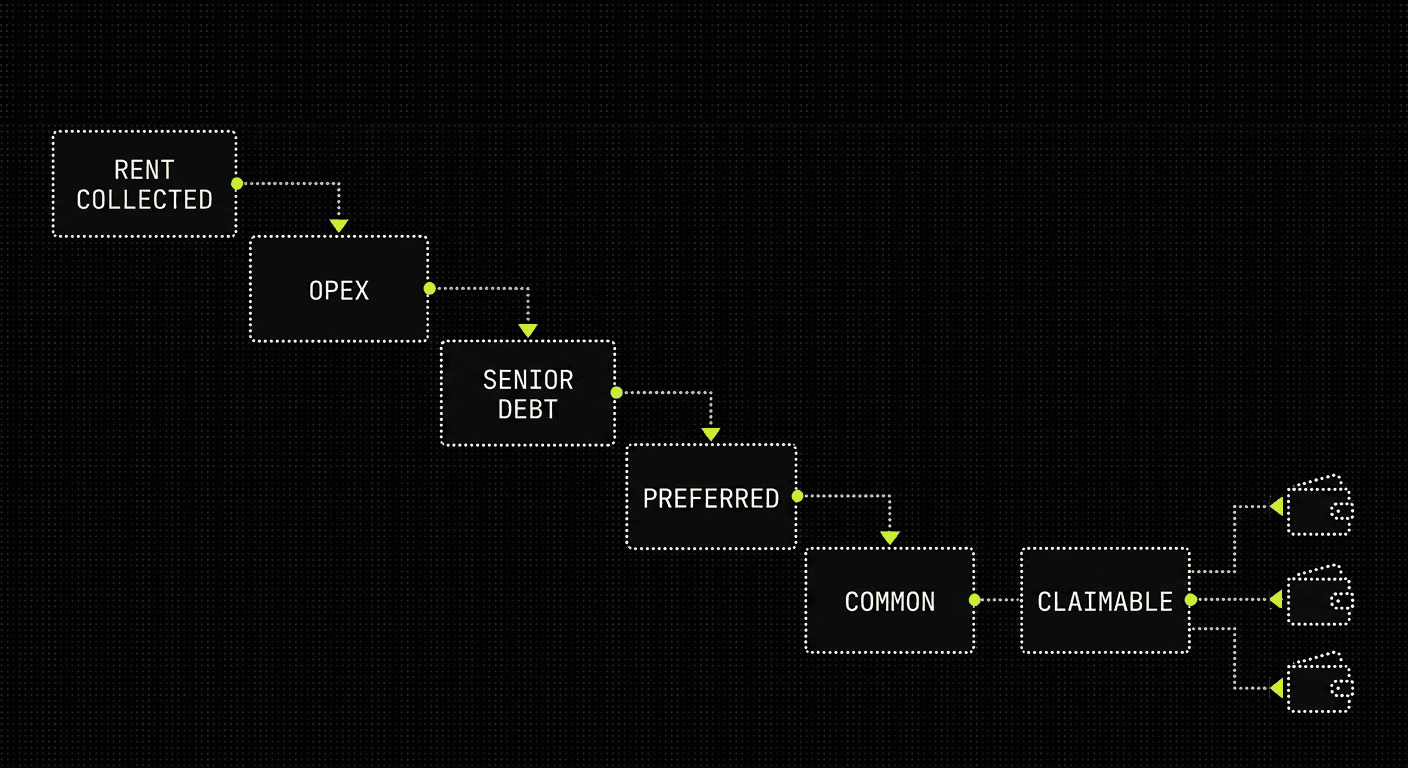
Once the holder count approaches the low hundreds, pushing a distribution to every address in a single transaction becomes prohibitively expensive. By storing holders' claimable amounts in a mapping instead and allowing them to withdraw in pull fashion, the gas cost per distribution to any holder stays constant even when the number of holders goes up. Note, however, that the design of the claim accounting contract needs to be thoroughly audited for potential errors (rounding) as well as for reentrancy vulnerabilities.
A distribution waterfall smart contract will typically (i) take a snapshot of the outstanding tokens as of the record block time in the subsequent block (ii) calculate the pro rata share of the distributable amount after all preferred distributions have been paid to each investor and store this amount in the contract's claimable[address] mapping; (iii) emit events such as DistributionCreated and Claimed so that investors and off-chain dashboards can track payments made with the utmost accuracy using on-chain data.
Whether a holder can get out depends on two things at once. What the contract permits, and what the operating agreement obligates the entity to do. A redemption function the SPV cannot fund is just a promise the code cannot keep. Three mechanisms cover most designs: scheduled redemption, secondary trading, contractual buyback.
Time locks for quarterly on-chain redemption windows are implemented. A claim period (e.g., for a real estate token) is set to unlock at a specific block number in time, followed by a window to burn tokens and then release the corresponding value in stablecoins at the NAV price (as reported by the authorized oracle) within the same time frame.
You cannot just pair a restricted token on a permissionless exchange. The pool is an address holding tokens, and it passes no identity check at all. So secondary trading runs through venues that verify investors at the venue level, while the contract keeps enforcing its own transfer rules underneath. Those two layers are not doing the same job. One decides who trades. The other decides who is allowed to hold.
The risks of production security tokens extend beyond the simple contract of a security token. Each component of a stack (identity management, oracle, etc.) must be covered by a blockchain security audit before it goes into production.
Auditing the token contract for a real estate project in isolation does not add any value, because the biggest risks in the waterfall of logic and the access control to assets for the distribution contract lie outside of the token contract itself.
The greatest risk of the smart contract is the admin key being compromised and therefore should be mitigated by the use of hardware security modules to store the admin keys and by documenting the quorum rotation procedure for the smart contract. By requiring multiple independent sources of data for the rent oracle and then aggregating that data on the multiple sources using a median value before making any change to the on-chain data, the risk of the rent oracle being manipulated (e.g., inflating the distribution) can also be mitigated.
When it comes to tokenization engineering, the choice of partner for a technical procurement decision is not something that needs to be marketed. It will reveal itself in production, not in demos.
Ask for three things before signing anything. First, audit reports for systems that are live and holding real value, not testnet deployments or unreleased prototypes. Second, evidence of a working transfer agent integration, since that is where most tokenization projects stall. Third, and most revealing, a document mapping every privileged contract function to the clause in the operating agreement that authorizes it: identity registry, distribution waterfall, forced transfer. A team that cannot produce that mapping has not done the legal-engineering work, whatever the contracts look like.
Treat a general Web3 audit as insufficient evidence on its own. What matters is whether the audit covered the distribution and compliance logic, not just the token contract. Beyond documentation, a credible team should be able to explain, without preparation, the trust assumptions in their identity registry and exactly who can trigger a forced transfer and under what conditions. Vagueness on either point usually means those decisions have not been made.
Building an AMM has almost nothing in common with this. Neither does a lending market. The work here is distribution waterfalls, oracle-fed NAV updates, forced-transfer paths that only reach pre-whitelisted addresses, and every one of those has to trace back to a clause in a legal document. If you are scoping a build and want the architecture pressure-tested before you commit, our engineers can review your tokenization stack.
When setting up a real estate tokenization structure, a Special Purpose Vehicle (SPV) such as an LLC or Ltd is typically set up to hold one property. The economic interests of and relating to that property are then held by the holders of corresponding tokens. The legal form of an SPV has several advantages. For one, liability is isolated. The cap table can be managed more easily. There is a clear legal connection between the on-chain issued and traded tokens and the off-chain held rights of the token holders. No regulator mandates this structure by name. It became standard practice because it is the cleanest way to give a token a defensible legal claim on a physical asset.
A waterfall can be built into smart contracts for tokenized real estate to pay out cash flows from a property such as rent, or from the sale of a property. Senior debt holders will get paid first, followed by preferred equity holders and lastly the common token holders. Payments can be made in stablecoins such as USDC or USDT and can be distributed on a fixed schedule. The system should take into account all token transfers between payment cycles to avoid paying out double or missing payments altogether. It is recommended to use audited, upgradeable smart contracts with proper admin rights.
In-house makes sense if the team has done RWA work before, has counsel on retainer, and has enough deals coming to spread the cost across. First deal on a tight timeline? Usually not. And the thing sponsors underestimate is almost never the token contract. It is the oracle integration, the identity and compliance hooks, the transfer agent coordination, and then the ongoing work of keeping the on-chain registry lined up with the entity ledger. That last part does not end at launch.